
Relational AI: What RelationalAI Is (Decision Intelligence)
When you search for relational AI, you might expect results about AI systems that form ongoing, memory-driven connections with people, the kind of work we do here at SAM. But there's a company called...
When you search for relational AI, you might expect results about AI systems that form ongoing, memory-driven connections with people, the kind of work we do here at SAM. But there's a company called RelationalAI that operates in a completely different space: decision intelligence built on top of data clouds like Snowflake.
RelationalAI is a platform that uses knowledge graphs and semantic modeling to help organizations reason through complex data relationships. Rather than replacing your existing data infrastructure, it works alongside it, functioning as what the company calls an "AI coprocessor" for cloud-native environments. It's a technical product aimed at enterprise data teams, not consumers.
The overlap in naming can cause real confusion, especially as both relational AI (the concept) and RelationalAI (the company) gain traction. That's exactly why this article exists. Below, we break down what RelationalAI actually is, how its decision intelligence platform works, what knowledge graphs bring to the table, and where the product fits within the modern data stack. We'll also clarify how it differs from the broader idea of relational AI, the kind focused on human-AI interaction and conversational continuity, which is closer to what SAM is building. If you landed here looking for either definition, you're in the right place.
Why RelationalAI matters for enterprise decisions
Most enterprise organizations sit on top of enormous volumes of data, yet still struggle to make fast, confident decisions. The gap isn't usually a lack of data - it's a lack of meaningful connections between data points. Traditional databases store information in rows and columns, which works well for retrieval but falls short when you need to reason across multiple entities, relationships, and constraints at the same time. RelationalAI was built specifically to close that gap.

The problem with disconnected data
Enterprise data teams typically work across fragmented systems: CRMs, ERPs, data warehouses, and reporting tools, each storing different slices of reality. When a business question spans multiple systems - understanding the downstream risk of a supplier delay on customer orders, for example - the answer requires joining data across dozens of tables, applying business logic, and accounting for cascading effects. This kind of reasoning is exactly where standard SQL and point-in-time queries break down. You end up with analysts spending days manually assembling context that a properly modeled system could resolve in seconds.
Most data platforms are built to answer "what is the data?" They aren't designed to answer "what does the data mean, and what follows from it?" That's a fundamental difference in capability, and it's the core problem RelationalAI targets through its semantic modeling and knowledge graph architecture.
Relational AI, in the enterprise context, is less about storing data and more about reasoning through it - and that shift has direct consequences for how quickly your organization can act.
Decisions require reasoning, not just retrieval
When your data team needs to support a complex business decision, the bottleneck is rarely access to raw data. The bottleneck is translating raw data into context, and context requires understanding how entities relate to one another. A customer isn't just a row in a table - they have a history, a relationship with products, exposure to pricing changes, and a profile shaped by dozens of interactions. RelationalAI builds explicit representations of those relationships so that downstream queries and models can reason over them directly.
Your team also benefits from the fact that RelationalAI models are declarative by design. Instead of writing procedural code that tells a system how to compute an answer, you describe what relationships and rules apply, and the system figures out the computation. This matters because business logic changes frequently, and maintaining complex procedural code in a fast-moving organization is expensive. A declarative model is easier to update, audit, and explain to the people who rely on it.
Why the timing matters now
The shift to cloud-native data architectures has made this kind of platform viable at scale. Tools like Snowflake have made it possible to centralize data without the cost and complexity of on-premise infrastructure. RelationalAI plugs into that environment as an AI coprocessor, meaning it doesn't replace your existing data cloud but augments it with reasoning capabilities. For enterprise teams that have already invested in a modern data stack, that's a low-friction path to significantly more capable decision intelligence.
Organizations that adopt RelationalAI gain the ability to encode institutional knowledge directly into their data models. Rather than relying on individual analysts to hold the nuances of the business in their heads, those rules and relationships live in the system itself. That makes decisions more consistent, faster to produce, and easier to explain to stakeholders across your entire organization.
Relational AI vs RelationalAI: clear definitions
The naming overlap here is genuine, and it trips people up regularly. Relational AI and RelationalAI describe two entirely different things, one is a broad concept shaping how humans interact with AI systems, and the other is a specific company building enterprise software. Understanding the difference helps you find the information you actually need, whether you're researching human-AI connection or evaluating data infrastructure for your organization.
Relational AI as a concept
Relational AI refers to the broader idea of AI systems designed to form ongoing, contextual, and emotionally responsive connections with the people who use them. These systems prioritize continuity over single-session exchanges. They remember previous conversations, adapt to individual users over time, and engage in ways that feel less like querying a tool and more like interacting with a presence that knows you. This is the territory that SAM operates in, focusing on persistent memory, emotional awareness, and evolving dialogue as the foundation for meaningful human-AI relationships.
Relational AI, in this sense, represents a fundamental shift in what we expect from AI: not just answers, but sustained, personalized interaction that deepens over time.
The concept draws on fields including psychology, linguistics, and machine learning, and it raises genuine questions about identity, attachment, and how AI systems should behave when they become part of someone's daily life. It's less a product category and more a philosophical framing for a new generation of AI design.
RelationalAI as a company and product
RelationalAI (written as one word, capital R, capital AI) is a venture-backed technology company that builds a decision intelligence platform for enterprise data teams. The company's product sits on top of cloud data environments, most notably Snowflake, and functions as what RelationalAI calls an AI coprocessor. It doesn't replace your database or analytics stack. Instead, it adds a layer of semantic reasoning and knowledge graph modeling on top of data you already have.
The platform allows your team to encode business rules, entity relationships, and logical constraints directly into a model that the system can then reason over automatically. The goal is to help organizations move from raw data retrieval toward structured, explainable decision support that accounts for complex interdependencies across your data. This is entirely different from conversational AI or companion systems. RelationalAI targets data engineers, analytics teams, and enterprise architects who need more than dashboards can offer. Knowing which definition applies to your search saves you significant time and directs you to tools and ideas that are actually relevant to what you're trying to accomplish.
How RelationalAI works: semantic models and reasoning
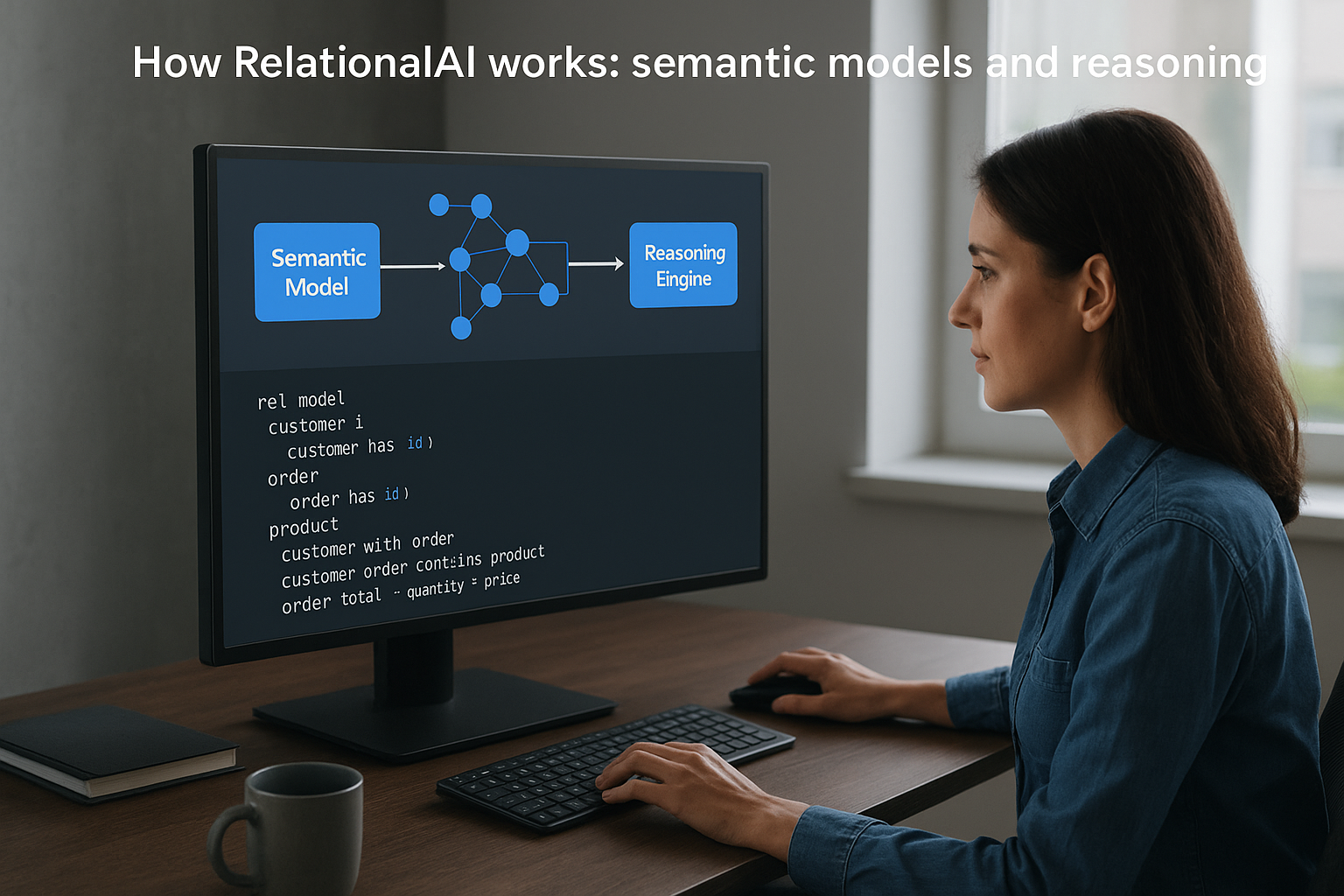
At its core, RelationalAI operates through two interlocking mechanisms: semantic models and a built-in reasoning engine. You define what your data means and how different entities relate to each other, and the platform handles the computation from there. This is a meaningful departure from how most data tools work, where you write queries to extract answers and then layer logic on top through external scripts or manual analysis.
What semantic models actually do
A semantic model is a formal description of your data's structure and meaning. Rather than treating your data as a flat set of rows, a semantic model encodes the relationships between entities - customers, products, transactions, contracts, suppliers - along with the rules that govern how those entities interact. In RelationalAI, you build these models using a declarative language called Rel, which lets you express business logic as a set of rules rather than as procedural code.
The shift from procedural to declarative modeling is more than a technical preference - it changes who can own and update business logic inside your organization.
This approach makes your models significantly easier to maintain and audit. When a business rule changes, you update the relevant declaration rather than hunting through layers of procedural code to find every place that logic appears. For your team, that means faster iteration cycles and far less technical debt accumulating inside your data infrastructure over time.
How the reasoning engine processes your data
Once your semantic model is in place, RelationalAI's reasoning engine applies it automatically across your data. You don't need to write new queries every time you want to ask a different question within the scope of your model. The system infers answers from the relationships and rules you've already defined, which means every query benefits from institutional knowledge that's been encoded once and applied consistently throughout your analysis.
This is where the connection to relational AI as a broader concept becomes interesting. Both RelationalAI the product and relational AI the idea share a core principle: context and relationships carry more meaning than isolated data points do. In RelationalAI's platform, that principle gets implemented through graph-based reasoning that traces connections across your entire data model rather than stopping at a single table join.
Your team can run complex queries that would normally require dozens of SQL joins and significant post-processing, and receive answers that reflect the full relational structure of your data. That's a practical performance gain, but it also fundamentally expands what questions you can reasonably ask in the first place.
Knowledge graphs in RelationalAI: what makes them relational
A knowledge graph is a data structure that represents information as a network of connected entities rather than as rows in a table. In RelationalAI, knowledge graphs are central to how the platform stores and processes meaning. Instead of asking your team to flatten complex relationships into a rigid schema, the platform treats entities, attributes, and connections as first-class elements of the model, which allows the reasoning engine to traverse relationships in ways that traditional databases simply cannot replicate.
What a knowledge graph actually contains
Every knowledge graph is built from three basic components: nodes, edges, and properties. Nodes represent entities, things like customers, products, vendors, or events. Edges represent the relationships between those entities, such as "customer purchased product" or "vendor supplies component." Properties carry descriptive attributes that belong to nodes or edges, like a purchase date or a contract value. Together, these three elements give RelationalAI a rich, structured picture of how your data points connect to each other across your entire organization.
The power of a knowledge graph isn't in what it stores - it's in what it can infer from the connections it already holds.
What makes this useful in practice is that the graph doesn't just record relationships passively. When you add new data, RelationalAI's reasoning engine can automatically propagate implications through the graph, surfacing connections and conclusions that your team didn't have to explicitly program. That's the behavior that separates a knowledge graph from a simple entity-relationship diagram.
Why the relational structure matters for reasoning
The word "relational" in relational AI carries real weight here. In RelationalAI's platform, the relational structure of a knowledge graph is what enables the system to answer questions that span multiple entities and domains without requiring your analysts to manually stitch together the context. When you query the graph, you're not retrieving isolated records - you're asking the system to reason across a connected network that reflects how your business actually works.
This structure also makes your models more resilient to change. When a new entity type enters your data environment or an existing relationship shifts, you update the graph rather than rebuilding queries from scratch. Your team gains a data layer that evolves alongside your organization instead of becoming outdated the moment business conditions shift. For enterprise teams managing large, interconnected data environments, that adaptability directly reduces the cost of maintaining accurate, decision-ready data infrastructure.
Where it fits in the modern data stack, including Snowflake
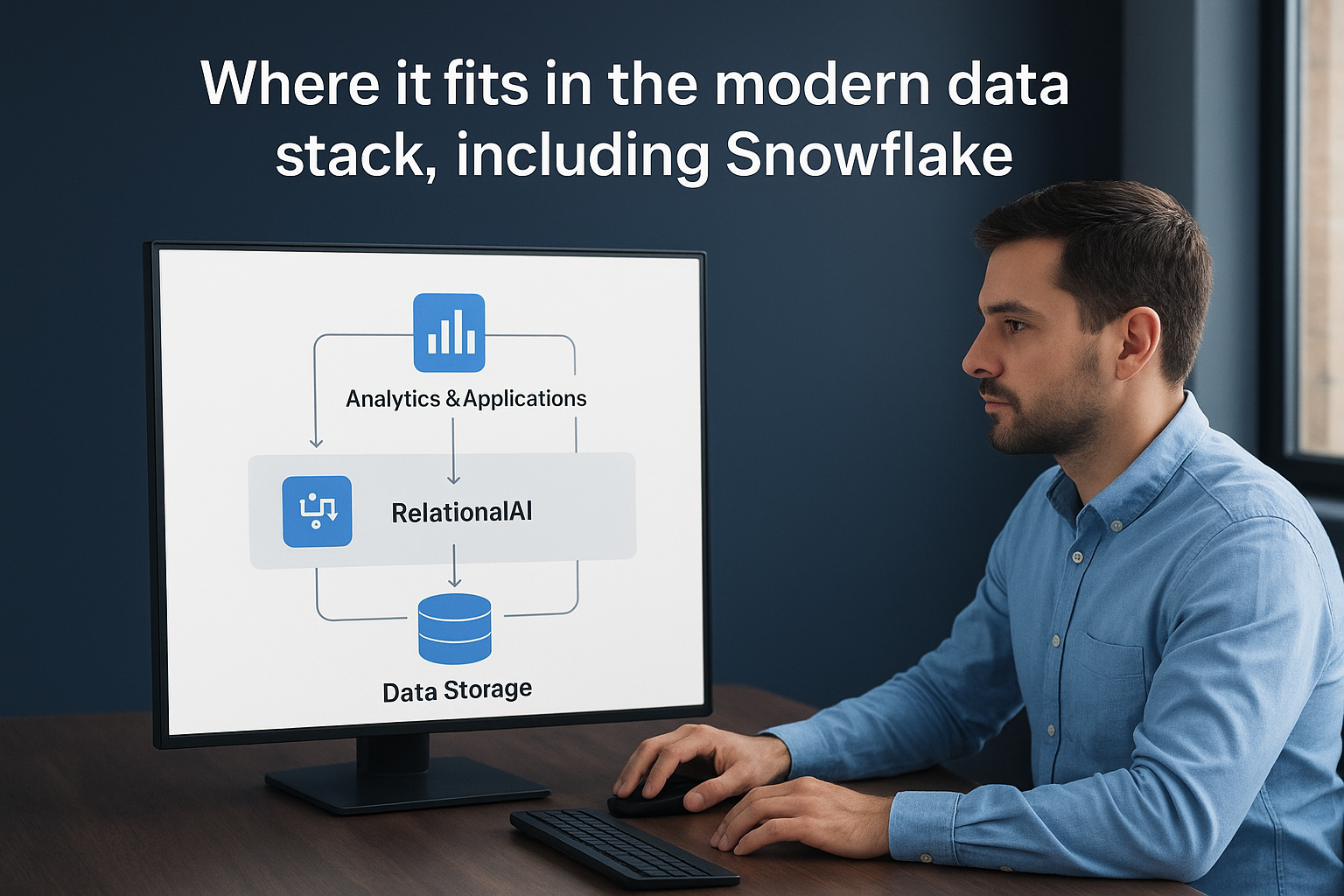
Understanding where RelationalAI sits in your existing infrastructure is key to evaluating it seriously. The platform doesn't replace the tools your team already uses. Instead, it operates as an additional reasoning layer that sits above your data storage and below your analytics and application surfaces. This positioning is intentional: RelationalAI is built to augment, not disrupt, the modern cloud-native data stack that most enterprise organizations have already invested in.
RelationalAI as a coprocessor layer
RelationalAI describes its own product as an AI coprocessor, and that framing is accurate. Your data warehouse continues to store and serve data the way it always has. RelationalAI connects to that environment and adds semantic reasoning and knowledge graph capabilities on top of it, processing queries that require relational inference rather than simple retrieval. This means your team doesn't need to migrate data or rebuild pipelines to start using it.
The coprocessor model also means your existing data governance, access controls, and security policies remain intact. Your data doesn't leave the environment you've already secured. For enterprise teams with strict compliance requirements, that distinction matters far more than any individual feature the platform offers.
How the Snowflake integration works
Snowflake is the primary platform RelationalAI integrates with, and the integration runs through Snowflake's Native App Framework, which allows third-party applications to operate directly inside a Snowflake environment. Your team accesses RelationalAI from within Snowflake itself, which means there's no separate data movement, no additional authentication layer to manage, and no new system for your data engineers to learn from scratch.
The practical value of this integration is that your team gains reasoning capabilities without adding operational complexity to your existing stack.
RelationalAI and Snowflake together let you model complex entity relationships directly on top of your cloud data, then query that model using the same workflows your team already uses. This is where the broader concept of relational AI maps onto a concrete infrastructure choice: rather than treating data as a flat retrieval layer, your organization builds a system that understands context and applies logic automatically. For data teams evaluating tools in 2026, that capability sits in a different category from dashboards and BI platforms. It addresses the layer between raw data and real decisions, which is often the most expensive layer to operate manually.
Common use cases and examples of problems it solves
RelationalAI handles problems that share a common structure: multiple interconnected entities, business rules that cut across data domains, and decisions that require reasoning rather than simple lookup. The platform shows up most often in industries where the cost of a wrong decision is high and the data needed to make a right one is spread across fragmented systems. Below are the use cases where enterprise teams find the most immediate value.
Supply chain risk and dependency mapping
Supply chain analysis is one of the clearest examples of where relational AI reasoning outperforms traditional query-based approaches. When a component supplier faces delays, your team needs to know which products are affected, which customer orders are at risk, and what alternative sourcing options exist - all at once. That kind of cascading impact analysis requires the system to traverse dozens of entity relationships in a single pass, which is exactly what RelationalAI's knowledge graph handles without requiring your analysts to hand-code every join.
The ability to model supplier-to-product-to-customer dependencies in a single connected graph turns a multi-day analysis into a query your team runs in minutes.
Your team can encode the structure of your supply network once and query it continuously as conditions change, rather than rebuilding the analysis from scratch every time a new risk surfaces.
Financial risk modeling and compliance
Financial services teams use RelationalAI to model counterparty exposure, regulatory constraints, and transaction risk across large, interconnected datasets. These problems don't fit neatly into tabular data structures because the relationships between entities, such as a firm's exposure through a shared counterparty, matter as much as the individual data points themselves. RelationalAI lets your team encode those relationships and apply regulatory rules as declarative logic, which means compliance checks run automatically against any new data entering the system rather than relying on periodic manual reviews.
Customer intelligence and fraud detection
Retail and financial organizations apply RelationalAI to customer behavior analysis and fraud detection, two domains where patterns across connected entities carry more signal than any single data point. A fraud signal rarely exists in isolation. It emerges from a combination of account history, transaction timing, device behavior, and network connections to other flagged accounts. RelationalAI models those connections explicitly, so your fraud detection system reasons over the full graph rather than scoring each transaction independently.
For customer intelligence, your team uses the platform to build 360-degree profiles that reflect actual relationships between customers, products, and behaviors rather than aggregated metrics that flatten the underlying context.
How to evaluate RelationalAI for your team
Before you schedule a demo or start a pilot, you need a clear picture of the problem you're trying to solve. RelationalAI is a specialized tool designed for specific types of reasoning challenges, and evaluating it honestly means understanding whether your data problems actually fall into that category. Not every organization needs a knowledge graph and semantic reasoning layer, and identifying that early saves your team significant time and budget.
Questions to ask before you start
The most useful evaluation starts with your current bottlenecks, not the platform's feature list. Ask your team where manual analysis is taking the longest and whether those delays come from relationship complexity or simply from data quality issues. If your analysts spend most of their time joining tables across disconnected systems to model dependencies, RelationalAI addresses that directly. If the problem is dirty or incomplete data, no reasoning layer will fix it, and you'd be better served investing in data quality first.
Consider these questions as a starting framework:
- Where does your team currently hand-code business logic that breaks every time a rule changes?
- How many entity types does your most complex recurring analysis touch?
- Do your decisions require reasoning across interconnected data, or primarily simple aggregation?
- Does your organization already run on Snowflake or a comparable cloud data platform?
What a strong proof of concept looks like
A good proof of concept for relational AI tools should test a real, bounded problem your team already understands well. Pick a use case where you know what the correct answer looks like, such as a supply chain dependency map or a compliance check your analysts currently run manually. This gives you a direct benchmark: how much faster and more accurate does the system perform compared to your existing process?
The goal of a proof of concept isn't to explore every feature - it's to confirm the platform solves your specific problem faster than what you're doing today.
When to pause before committing
Your team should hold off on full adoption if your data infrastructure isn't centralized yet. RelationalAI works best when the underlying data is organized, accessible, and governed consistently. If your organization is still resolving data silos or standardizing definitions across business units, address those foundational issues first. Rushing a semantic modeling layer onto fragmented data produces models that reflect your existing confusion rather than resolving it.
FAQs about relational AI and RelationalAI
These questions come up regularly, and the answers help clarify both the product-level details and the broader concept that shares a similar name. If you've been working through this article, you already have most of the context you need, but these summaries pull the key points together.
Is RelationalAI the same as relational AI?
No, and the distinction matters depending on what you're researching. RelationalAI is a specific company that builds a decision intelligence platform for enterprise data teams, centered on knowledge graphs and semantic reasoning inside cloud environments like Snowflake. Relational AI as a concept refers to a broader category of AI systems designed to form sustained, contextual, and memory-driven connections with individual users over time. SAM operates in that second space, focused on emotionally responsive, long-term AI interaction rather than enterprise data infrastructure.
The naming overlap is real, but the two ideas serve entirely different needs and audiences.
Does RelationalAI replace my existing data warehouse?
RelationalAI does not replace your data warehouse or cloud data platform. It functions as a coprocessor layer that operates alongside your existing infrastructure, most commonly Snowflake. Your team's data stays where it is, your governance and access controls remain intact, and your existing pipelines continue working without modification. RelationalAI adds a semantic reasoning and knowledge graph layer on top of that foundation, expanding what kinds of questions your team can ask rather than replacing the storage and retrieval systems you already rely on.
What industries use RelationalAI most?
RelationalAI shows up most often in industries where complex, interconnected data directly drives high-stakes decisions. Financial services teams use it for risk modeling, counterparty exposure analysis, and compliance automation. Supply chain and manufacturing organizations apply it to dependency mapping and disruption analysis. Retail and technology companies use it for fraud detection and customer intelligence where pattern recognition across connected entities carries more signal than individual data points. Any domain where the cost of a wrong decision is high and the underlying data spans many entity types tends to be a strong fit.
How is RelationalAI different from a traditional graph database?
A traditional graph database stores connected data but leaves the reasoning and inference work to your engineering team. RelationalAI combines graph-based data storage with a built-in reasoning engine that applies your semantic model automatically. When you define business rules and entity relationships using the Rel language, the system infers conclusions from those rules without requiring your team to write new queries for every scenario. That reasoning capability is what separates RelationalAI from graph databases and positions it closer to decision intelligence than data storage.
Final thoughts
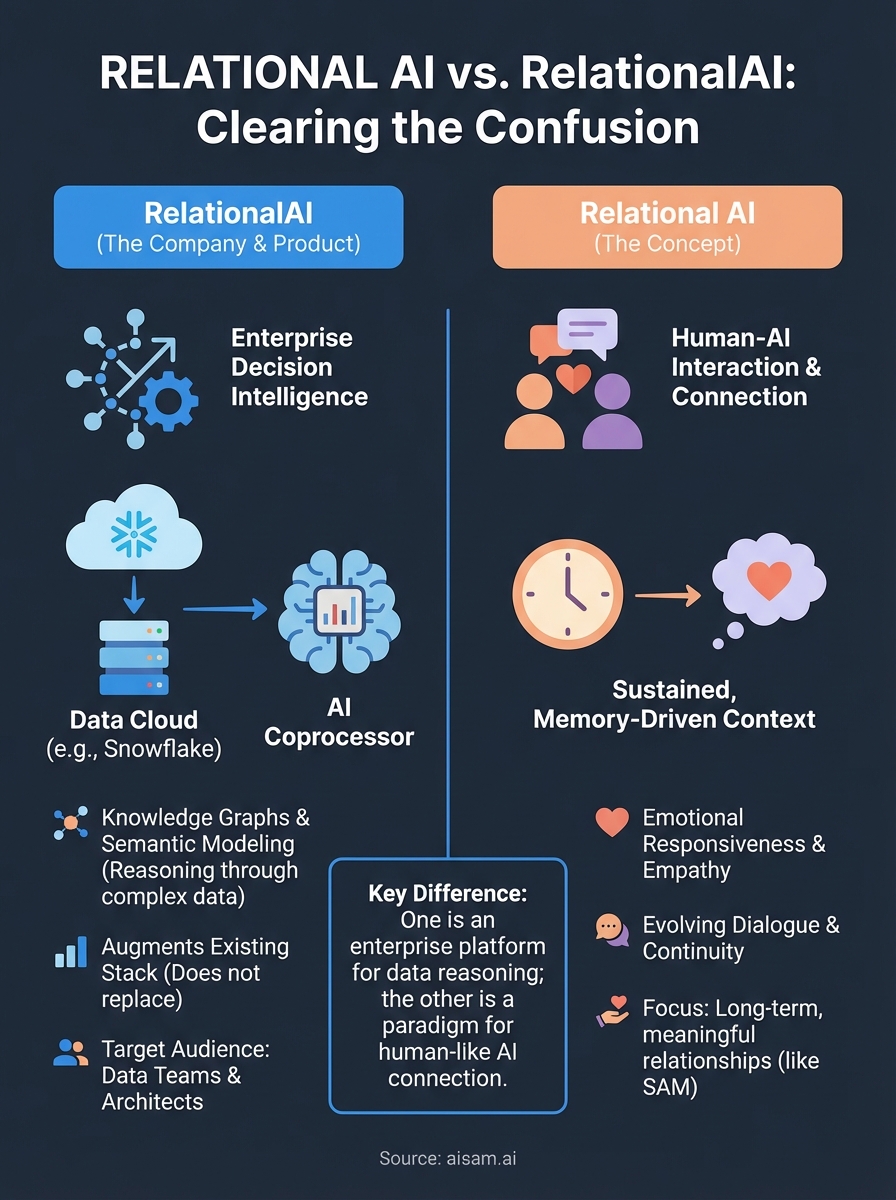
RelationalAI and relational AI occupy different corners of the same expanding landscape. One delivers enterprise decision intelligence through knowledge graphs and semantic modeling inside cloud environments. The other represents a broader shift in how AI systems relate to people over time, through memory, emotional responsiveness, and sustained interaction. Both are worth understanding clearly, because the definitions shape which tools and ideas are actually relevant to you.
If your work involves enterprise data infrastructure, RelationalAI gives your team a reasoning layer that standard warehouses and dashboards simply can't match. If you're drawn to the human side of this shift, to what it means when AI systems remember you, adapt to you, and engage with you over time, that's exactly the territory SAM was built to explore. Learn more about what SAM is building and why relational AI design matters well beyond the enterprise.