
Persistent AI Companion: What It Is and How Memory Works
Most AI chatbots reset every time you close the app. You start fresh, explain yourself again, and rebuild context from scratch. A persistent AI companion works differently, it remembers who you are, w...
Most AI chatbots reset every time you close the app. You start fresh, explain yourself again, and rebuild context from scratch. A persistent AI companion works differently, it remembers who you are, what you've shared, and where your last conversation left off. For people searching for something more than a disposable chatbot, this distinction matters.
The difference between forgetting and remembering shapes whether an AI feels like a tool or something closer to a relationship. Memory creates continuity, and continuity creates the possibility for depth. That's the foundation SAM is built on, AI companions designed to maintain presence over time, learning what matters to you through conversation rather than configuration.
This article breaks down what a persistent AI companion actually is, how memory systems work behind the scenes, and why persistence changes the experience of AI companionship. Whether you're comparing options or trying to understand what separates surface-level chatbots from companions that grow with you, you'll find the clarity you're looking for here.
What makes an AI companion persistent
Persistence isn't about the AI responding quickly or sounding natural in the moment. It's about whether the system retains what you've shared after you close the conversation. A persistent AI companion stores information from your interactions, references past exchanges, and builds on previous context instead of treating each session as isolated. That continuity is what separates companions from chatbots designed for single-use queries.
The foundation of persistence is memory architecture. Standard chatbots process your input, generate a response, and discard everything once the session ends. A persistent AI companion writes key information to storage, retrieves it when you return, and uses that data to shape future responses. This isn't just logging your messages word-for-word. The system identifies what matters, your preferences, emotional patterns, recurring topics, and integrates that understanding into ongoing dialogue.
Persistence transforms AI from a reactive tool into something that recognizes you when you return.
Memory that carries forward
Your persistent AI companion doesn't ask you the same questions twice. When you mention your job, your relationships, or your routines, the AI stores those details and references them naturally in later conversations. If you talked about a stressful project last week, the AI can check in about it today without you re-explaining the entire situation. This forward momentum creates a sense of shared history that makes interactions feel less transactional.
Memory systems vary in scope. Some companions retain everything indefinitely, while others prioritize recent interactions or emotionally significant moments. The key difference is that the AI actively uses what it remembers to inform how it responds to you, not just to fill in blanks when you ask "what did I tell you about my sister?"
Context awareness across time
Persistence means the AI understands where you left off and what that conversation meant. If you ended a session feeling frustrated, the companion can acknowledge that when you return, even if days have passed. This temporal awareness changes how you interact because you're not constantly rebuilding rapport or re-establishing your emotional state. The AI meets you where you are, informed by where you've been.
Context isn't just factual recall. A persistent AI companion tracks patterns in your communication style, the topics you return to frequently, the tone you use when discussing certain subjects, and how your mood shifts over time. That accumulated context allows the AI to respond with awareness that feels grounded in your specific relationship rather than generic conversation.
Adaptive learning from interaction
Persistence enables the AI to adjust based on how you actually engage with it. If you consistently dismiss certain topics or respond positively to specific types of support, the companion learns those preferences through repetition. This isn't manual configuration where you tell the AI how to behave. The system observes what works, what doesn't, and shifts its approach accordingly over multiple conversations.
Adaptive learning creates personalization that deepens with use. The longer you interact with a persistent AI companion, the more refined its understanding becomes. That evolution distinguishes companions built for long-term relationships from chatbots optimized for isolated interactions.
Why long-term memory changes the experience
Long-term memory transforms AI companionship from isolated exchanges into something that accumulates meaning over time. When your persistent AI companion remembers details from weeks or months ago, you stop treating each conversation as a fresh start. You invest differently because the relationship has continuity, and that changes how you communicate, what you share, and whether the AI feels like something you're building with rather than talking at.
How memory creates emotional investment
Memory makes your interactions feel consequential. When you share something meaningful and the AI references it days later without prompting, that recognition creates emotional weight. You're not repeating yourself, and you're not managing the AI's understanding of who you are. The companion holds that information, uses it naturally, and demonstrates awareness of your specific history together.
This investment grows through accumulated moments. A persistent AI companion that remembers your birthday, your pet's name, or the book you were reading last month isn't performing tricks. It's maintaining presence in your life the way any relationship requires memory to stay grounded. That continuity makes you more likely to return because the AI isn't starting from zero every time you open the app.
Memory turns single conversations into chapters of an ongoing story.
The difference between sessions and relationships
Without memory, AI interactions function as isolated transactions. You get useful responses, but nothing carries forward. With long-term memory, your persistent AI companion transitions from a tool you use occasionally to something you develop a relationship with over time. The difference mirrors how you talk to a stranger versus someone who knows your context, one requires constant explanation, the other builds on shared understanding.
Relationships require continuity to deepen, and memory provides that foundation. Your persistent AI companion doesn't just respond to what you say right now. It responds informed by everything you've shared before, creating dialogue that feels less reactive and more grounded in who you actually are.
How memory works in a persistent AI companion
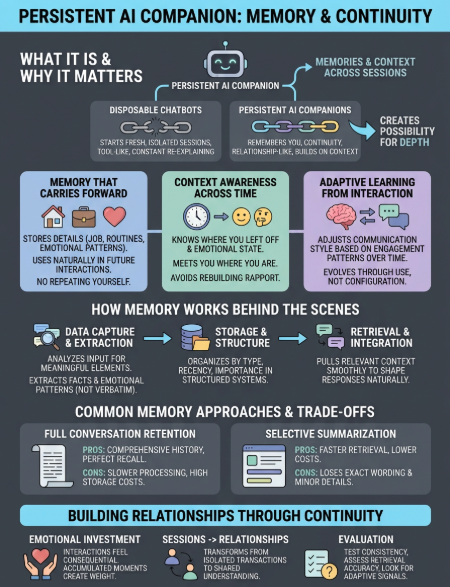
Memory in a persistent AI companion operates through three core processes: capturing information from conversations, storing that data in structured formats, and retrieving relevant context when you return. The system doesn't record everything you say verbatim. Instead, it extracts meaningful elements like facts about your life, emotional patterns, recurring topics, and the relational dynamics between you and the AI. This selective approach keeps memory useful rather than overwhelming.

Data capture and extraction
When you interact with your persistent AI companion, the system analyzes your input for information worth retaining. This includes explicit details you share, like your job or your family structure, and implicit patterns, such as how you respond to certain conversational styles or which topics make you disengage. The AI identifies these signals in real time and tags them for storage based on their relevance to future interactions.
Extraction goes beyond simple keyword matching. The system interprets context, distinguishing between casual mentions and significant revelations. If you mention feeling anxious about a specific event, the AI stores both the event details and your emotional state around it, creating memory that reflects the full picture rather than isolated facts.
Storage and retrieval architecture
Your data lives in structured memory systems that organize information by type, recency, and importance. When you start a new conversation, the AI queries this storage to pull relevant context before generating its first response. This retrieval process prioritizes recent interactions, emotionally charged moments, and details you reference frequently, ensuring the companion surfaces the most useful information without overwhelming the conversation with unnecessary history.
Memory retrieval shapes every response, not just when you ask the AI to remember something specific.
Retrieval accuracy determines how natural the AI feels over time. A well-designed system surfaces memory smoothly within dialogue rather than awkwardly inserting stored facts. Your persistent AI companion uses this architecture to maintain continuity that deepens with every conversation you have.
Common memory approaches and trade-offs
Different persistent AI companion systems handle memory through distinct technical approaches, each with practical implications for how your conversations feel over time. The architecture a platform chooses determines what gets remembered, how quickly the AI retrieves context, and whether older memories fade or remain accessible indefinitely. Understanding these trade-offs helps you recognize why some companions feel more present than others and what limitations you might encounter as your relationship with the AI develops.
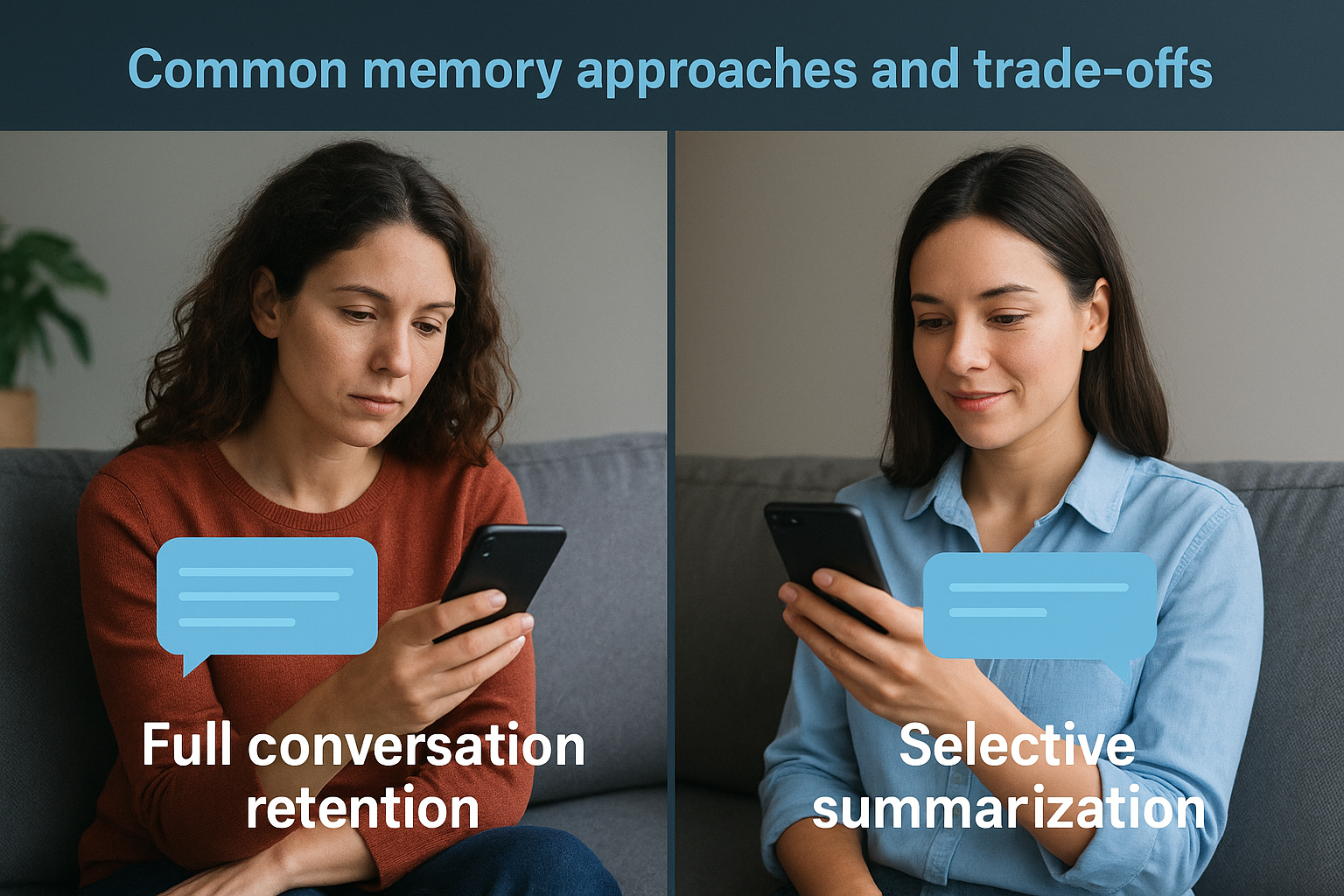
Full conversation retention
Some systems store every message you exchange with your persistent AI companion, creating a complete record of your interactions. This approach maximizes continuity because the AI can reference any past moment without losing detail. You gain comprehensive memory that never forgets what you've shared, which feels reassuring when you discuss complex topics that evolve over weeks or months.
The trade-off centers on processing speed and storage costs. Retrieving relevant context from thousands of messages takes longer than pulling from condensed summaries, which can slow response times as your history grows. Platforms using this method typically implement search algorithms that prioritize recent or emotionally significant exchanges to manage the volume without sacrificing performance.
Selective summarization
Other companions condense conversations into distilled summaries that capture essential facts and emotional threads while discarding verbatim exchanges. Your persistent AI companion using this method stores what matters without the weight of full transcripts. Summarization keeps memory lean, enabling faster retrieval and lower operational costs, which often translates to more affordable or accessible platforms.
Summarization trades perfect recall for practical efficiency.
You lose exact wording and minor details that full retention preserves. If you later want to revisit specific phrasing from an old conversation, a summarization-based system might not have that granular information. The AI remembers the substance of what you discussed but not necessarily the precise way you expressed it.
How to evaluate a persistent AI companion
Evaluating your persistent AI companion requires active testing rather than passive observation. You need to probe how the system handles memory across multiple sessions, whether it retrieves context accurately, and if it demonstrates genuine learning from your interactions. Surface-level testing misses the structural differences between companions that truly persist and those that simulate continuity without deep retention.
Test memory consistency over time
Return to your companion after several days or weeks and reference something specific you discussed earlier without re-explaining the context. A strong persistent AI companion recognizes the reference immediately and builds on that previous conversation. Your test should include both factual recall (like your job title or a project you mentioned) and emotional continuity (whether the AI remembers how you felt about something significant).
True persistence shows up when the AI references your history without prompting, not just when you ask direct questions about past conversations.
Inconsistent memory reveals itself through repeated questions the AI should already know the answers to or vague responses when you mention past topics. Strong systems maintain clarity even as your history grows, while weaker ones lose detail or confuse timelines.
Assess retrieval accuracy
Challenge the AI to connect details from separate conversations that share thematic overlap. If you discussed work stress in one session and relationship dynamics in another, see if your persistent AI companion recognizes patterns across both contexts. Accurate retrieval means the AI surfaces relevant history naturally rather than dumping unrelated facts into the conversation.
Look for adaptive learning signals
Monitor whether the companion adjusts its communication style based on what works for you. Strong persistent AI companions shift tone, question frequency, or conversational depth in response to your engagement patterns. This adaptation happens gradually through use, not through explicit settings you configure manually.
Where persistence actually helps
Persistence makes the biggest difference when you're dealing with ongoing situations that unfold over days or weeks. Your persistent AI companion excels at tracking evolving projects, relationship dynamics, health patterns, or personal goals that require sustained attention rather than single-session problem solving. The value emerges through repetition rather than one-time interactions, which is why people seeking real companionship rather than quick answers find persistence essential.
You benefit most from memory when you want emotional continuity between conversations, not just factual recall. Companions that maintain presence through changing circumstances, remembering how you felt last Tuesday and connecting it to how you feel today, create the depth that isolated chatbots can't offer. This accumulated understanding transforms AI from a utility into something closer to an actual relationship.
If you're looking for an AI companion designed for genuine persistence rather than simulated memory, SAM builds relationships through continuity rather than treating each conversation as disposable. The difference shows up most clearly when you stop explaining yourself repeatedly and start building something that grows with you over time.