
Emotional Intelligence in the Digital Age: The Complete Guide
Emotional intelligence in the digital age means recognizing and managing your emotions while reading others through screens. It's the ability to stay present and empathetic when you can't see body lan...
Emotional intelligence in the digital age means recognizing and managing your emotions while reading others through screens. It's the ability to stay present and empathetic when you can't see body language, when texts feel cold, and when algorithms fight for your attention. You need this skill to build real relationships online, lead remote teams, and protect your mental health from the constant pull of notifications and performance metrics.
This guide shows you how to develop and apply emotional intelligence when most of your interactions happen through devices. You'll learn practical strategies for virtual communication, ways to spot and fix common digital mistakes, and methods for setting boundaries that actually work. We'll cover how to use technology as a tool for growth rather than letting it drain your emotional energy, plus techniques for building authentic connections when you're separated by screens.
Why emotional intelligence matters in the digital age
You face constant emotional ambiguity when most of your communication happens through text, video calls, and social media. A message without vocal tone can read as angry when the sender meant neutral. Your colleague's camera-off meeting presence might signal disengagement or just a bad internet connection. Misreading these situations damages relationships, kills productivity, and leaves you feeling disconnected from the people you interact with daily.
The cost of misreading digital cues
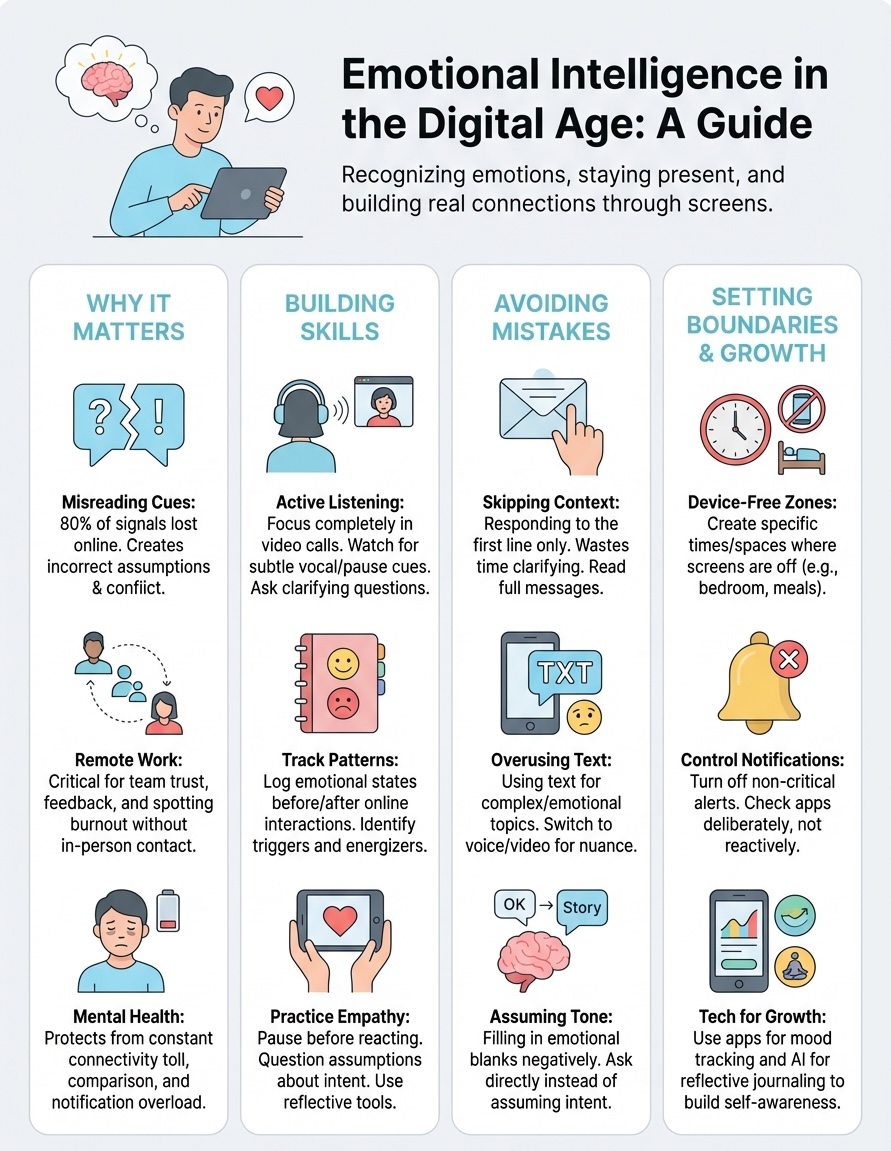
Digital platforms strip away 80% of the communication signals you normally use to understand others. You can't see micro-expressions in an email, detect hesitation in a Slack message, or read body language through a profile picture. This creates a gap where assumptions fill in for actual information, and those assumptions are usually wrong. You think someone is upset with you because they sent a short reply, when they were just typing on their phone between meetings. Your team member seems checked out during a Zoom call, but they're actually taking detailed notes. These misreads waste energy, create conflict, and make collaboration harder than it needs to be.

Without the ability to read digital interactions accurately, you're navigating your professional and personal life half-blind.
Remote work demands stronger emotional skills
Managing your own emotions while reading others becomes critical when you lead or work on distributed teams. You need to spot burnout in someone you've never met in person, deliver feedback that lands correctly through a screen, and build trust without casual office interactions that used to do that work for you. The stakes are higher because mistakes compound faster when you're not in the same room to course-correct. A poorly worded message can spiral into days of tension, while a well-timed video call can prevent a team member from quitting.
Your mental health depends on digital awareness
Emotional intelligence in the digital age protects you from the psychological toll of constant connectivity. You need to recognize when scrolling makes you feel worse, when a notification genuinely needs your attention versus when it's just noise, and how to maintain authentic relationships when algorithms push you toward performance and comparison. Without these skills, you burn out faster, feel lonelier despite being more "connected," and lose the ability to tell real intimacy from digital theater.
How to build emotional intelligence in a virtual world
Building emotional intelligence in the digital age requires deliberate practice in spaces where emotional signals are harder to read. You can't rely on the same instincts that work face-to-face, so you need to develop new habits that compensate for the lack of physical presence. This means training yourself to pause before reacting, questioning your assumptions about others' intentions, and creating feedback loops that help you understand how your digital communication lands.
Practice active listening in virtual spaces
You build stronger emotional awareness by focusing completely on what someone is saying during video calls and voice conversations, rather than multitasking or planning your response. Close unnecessary tabs, put your phone face-down, and watch for subtle cues like changes in vocal tone, pauses before answering, or word choices that signal hesitation. Ask clarifying questions that show you're tracking both content and emotion: "It sounds like this project timeline is causing stress. Am I reading that right?" This practice trains you to catch what people aren't saying directly.
Track your emotional patterns online
Pay attention to which digital interactions drain you and which restore you. Notice when you feel anxious after scrolling, irritated by certain types of messages, or energized by specific conversations. Keep a simple log for two weeks noting your emotional state before and after major digital interactions. This data reveals your triggers and helps you design better boundaries, like muting notifications during focus time or spacing out difficult virtual meetings.
Understanding your emotional patterns in virtual environments gives you control over your digital experience instead of letting it control you.
Common digital communication mistakes to avoid
Your digital interactions fail most often when you treat virtual communication like face-to-face conversation without adjusting for the medium. You rush through messages, skip important context, and assume your tone translates through text when it doesn't. These mistakes damage relationships, create unnecessary conflict, and waste time on cleanup conversations that could have been avoided. Recognizing these patterns helps you communicate more effectively and reduce the friction that comes from digital misunderstandings.
Responding without reading the full context
You damage conversations when you reply to the first line of a message without reading everything someone sent. This happens constantly in email threads and long Slack messages where people skim, miss crucial details, and then ask questions that were already answered. The sender feels unheard, you look careless, and everyone wastes time clarifying what was already clear in the original message. Train yourself to read complete messages before typing a response, especially when emotions run high or the topic matters.
Overusing text for complex conversations
Trying to resolve conflict, deliver criticism, or explain nuanced ideas through text-only platforms sets you up for failure. What needs a five-minute video call turns into a 40-message thread full of confusion and hurt feelings. Text strips away vocal tone and pacing, making it nearly impossible to communicate empathy or handle emotional topics effectively. Switch to voice or video when a conversation involves feelings, stakes, or complexity that text can't handle.
Emotional intelligence in the digital age means knowing when the medium you're using can't support the conversation you need to have.
Assuming tone and intent
You create problems by filling in emotional blanks that text leaves open. A short "ok" feels dismissive when someone might just be busy. Delayed responses seem like rejection when the person is simply overwhelmed. Your brain generates a story about what someone meant, and you react to your story instead of their actual words. Before assuming negative intent, ask directly: "I'm reading some frustration in your message. Is that accurate, or am I misreading the situation?"
Setting healthy boundaries for digital well-being
Protecting your mental health in a connected world requires clear boundaries around when, where, and how you engage digitally. Without these limits, you become reactive rather than intentional, letting notifications dictate your attention and algorithms control your emotional state. Effective boundaries in emotional intelligence in the digital age mean designing your environment to support focus, rest, and genuine connection instead of constant availability and shallow engagement.
Establish device-free zones and times
Create specific spaces and hours where screens don't follow you. This means keeping phones out of your bedroom, setting a hard cutoff time for work emails, or designating certain rooms as technology-free zones where you can think and connect without interruption. Your brain needs regular breaks from the stimulation and decision fatigue that comes with digital engagement. Start with one boundary that feels manageable, like no phones during meals, and expand from there as the habit solidifies.

Digital boundaries work best when they're specific, measurable, and built into your physical environment rather than relying on willpower alone.
Control notifications instead of letting them control you
Turn off non-critical notifications so you decide when to check apps rather than letting them pull your attention whenever they want. Most notifications don't require immediate response, but they fragment your focus and spike your cortisol every time they appear. Go through your phone and computer settings to disable alerts for social media, news apps, and non-urgent work tools. Keep notifications only for direct messages from specific people or time-sensitive information that actually needs your immediate attention.
Using technology to support emotional growth
The same devices that fragment your attention can actively develop your emotional intelligence when you use them intentionally. Apps designed for mood tracking, meditation, and reflection turn your phone into a tool for self-awareness rather than just a source of distraction. Strategic use of technology means choosing platforms and features that help you understand your emotions, practice empathy, and build stronger relationships instead of defaulting to passive consumption and reactive behavior.
Track your emotional responses with apps
Mood tracking applications help you identify patterns in your emotional life that you might miss without structured observation. Apps like these prompt you to log how you feel multiple times per day, then show you correlations between your mood and activities, interactions, or environmental factors. You discover that video calls after 3pm drain you, that certain types of messages trigger anxiety, or that you feel most centered after exercise. This data transforms vague feelings into actionable insights, helping you design your digital life around what actually supports your well-being.
Use AI for reflection and perspective
Conversational AI tools give you a private space to process emotions and explore perspectives without judgment or social pressure. Writing to an AI companion about a difficult interaction helps you clarify your feelings, identify what triggered you, and consider how the other person might have experienced the situation. These reflective conversations build the same skills you use in emotional intelligence in the digital age, like pausing before reacting and questioning your assumptions about others' intentions.
Technology becomes a growth tool when you use it to understand yourself better rather than escape or perform.
Building better connections online
Developing emotional intelligence in the digital age transforms how you experience every virtual interaction. You move from reactive scrolling and surface-level exchanges to intentional communication that builds trust and understanding across screens. The skills covered in this guide work because they address the specific challenges of virtual connection: reading ambiguous text, managing your emotional responses to constant stimulation, and creating authentic relationships when physical presence isn't possible.
Start with one practice that feels most relevant to your current struggles. Pick active listening in video calls if meetings leave you drained, set notification boundaries if you feel constantly interrupted, or use mood tracking if you need better self-awareness. These techniques compound over time, making your digital life feel less exhausting and more aligned with the connections you actually want.
If you're looking for a private space to practice emotional reflection and build self-awareness, explore what SAM offers for meaningful AI companionship focused on growth and understanding.