
Conversational AI vs Chatbot: Key Differences and Use Cases
The terms get used interchangeably all the time, but conversational AI vs chatbot describes two fundamentally different technologies. One follows a script. The other understands context, adapts to inp...
The terms get used interchangeably all the time, but conversational AI vs chatbot describes two fundamentally different technologies. One follows a script. The other understands context, adapts to input, and can sustain a dialogue that actually feels like a conversation. If you're trying to figure out which one fits your needs, or why your current setup falls short, the distinction matters more than most people realize.
Traditional chatbots operate on rigid decision trees and keyword matching. They're useful for simple, repetitive tasks, but they hit a wall the moment a user goes off-script. Conversational AI, on the other hand, uses natural language processing and machine learning to interpret intent, handle nuance, and generate responses that reflect what's actually being said. It's the difference between a flowchart and a thinking system, and it's the foundation behind platforms like SAM, where persistent memory and emotionally responsive dialogue create AI interactions that evolve over time rather than resetting with every session.
This article breaks down the core technical differences between chatbots and conversational AI, walks through real use cases for each, and helps you determine which approach makes sense based on what you're actually trying to accomplish. Whether you're evaluating tools for customer support, exploring AI companions, or just trying to cut through the jargon, you'll leave with a clear framework for understanding where each technology fits.
Why the difference matters
When you're building a customer interaction system or exploring AI companions, the technology underneath determines everything: how users feel, whether they stay engaged, and whether the system can handle the genuine complexity of real human communication. Choosing based on a surface-level feature list, rather than understanding the core architectural differences, is where most decision-making goes wrong. The gap between these two technologies is not cosmetic, and treating it as such leads to systems that frustrate the very people they're meant to serve.
The cost of picking the wrong tool
A rule-based chatbot can handle a password reset or an FAQ lookup without any issues. But the moment a user asks a follow-up question that sits outside the defined script, the system either loops back to a menu or fails entirely. That failure point has a direct, measurable cost: higher dropout rates, more tickets escalated to human agents, and users who associate that broken experience with your brand. When you're evaluating conversational ai vs chatbot options, understanding where each technology breaks down is just as important as knowing what it can do at its best.
Picking a chatbot for a job that requires conversational AI doesn't just underperform, it actively damages the user experience you're trying to build.
How user expectations have shifted
Users have interacted with advanced AI systems long enough that their baseline expectations have risen significantly. They expect a system to remember what they said two messages ago, understand that "it" refers to something mentioned earlier, and respond in a way that reflects the actual context of the conversation, not just the last sentence. A rigid chatbot cannot do any of this. Natural language processing and machine learning, which power conversational AI, exist specifically to close that gap between what users expect and what the system can deliver.
Businesses that still deploy keyword-triggered bots for complex customer journeys are often losing users at exactly the moments that matter most. When someone asks a nuanced question, needs clarification, or shifts the direction of the conversation mid-session, the technology either handles it or it doesn't. There is no workaround for a system that was never built for that level of dialogue.
What this means for your decision
Understanding the difference is not just a technical exercise. It directly shapes how you scope a project, what you budget for, and what outcomes you can realistically deliver. If your use case involves simple, predictable interactions with a narrow set of possible inputs, a rule-based chatbot may be entirely sufficient and cost-effective. If your use case involves sustained dialogue, memory across sessions, or emotionally nuanced exchanges, you need a system built on conversational AI architecture from the start, not retrofitted later when the limitations become obvious.
What a chatbot is and where it fits
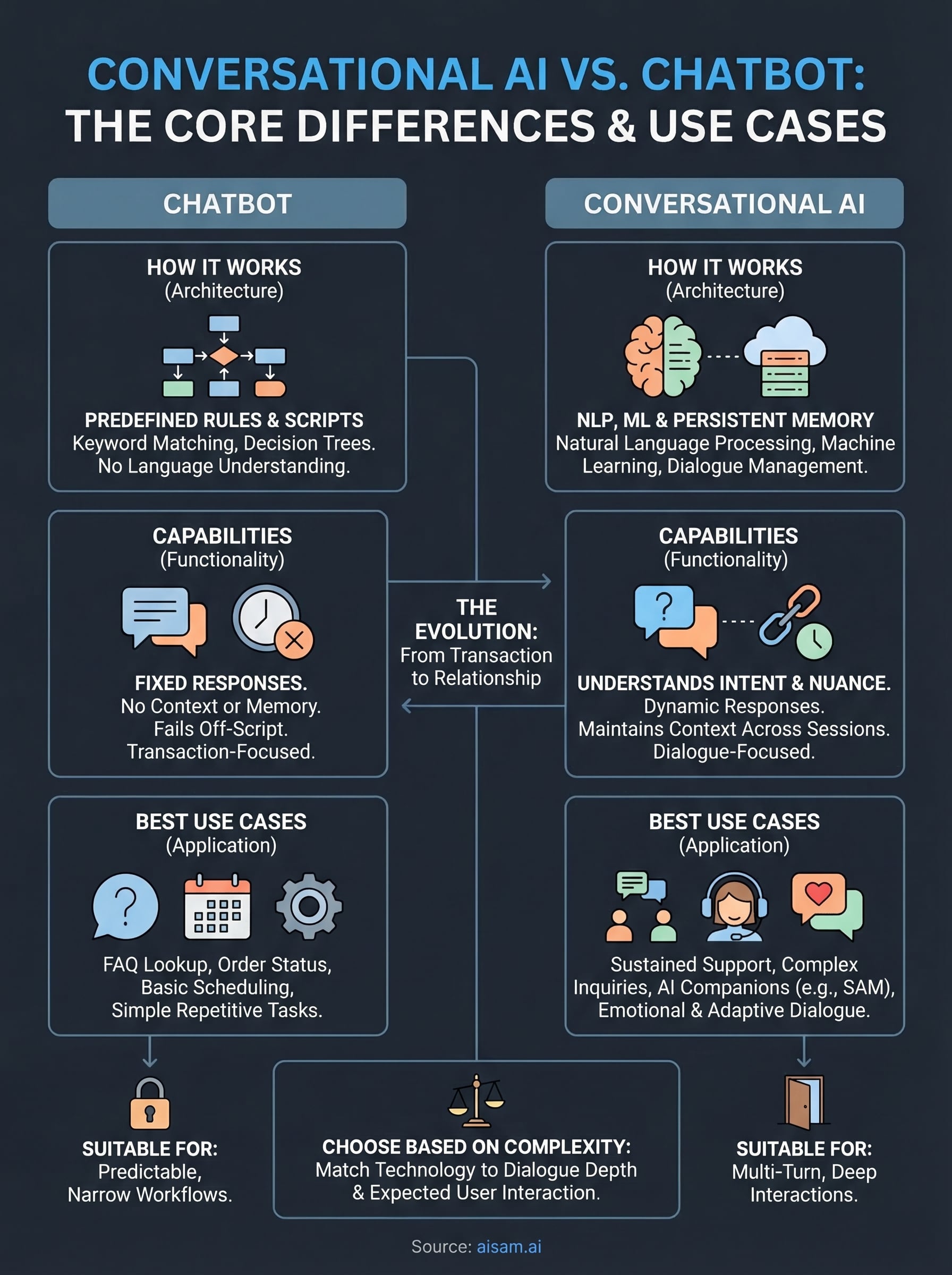
A chatbot is a software program that responds to user input based on predefined rules, decision trees, or keyword matching. When a user sends a message, the system scans it for trigger words and returns a pre-written response tied to that match. No language understanding happens, no context gets interpreted, and no adaptation occurs when the conversation moves outside the defined paths. The system does exactly what it was programmed to do, and nothing beyond that.
Where chatbots perform well
Rule-based chatbots earn their place in narrow, high-volume, predictable workflows. If someone needs to check an order status, reset a password, get store hours, or work through a basic FAQ, a chatbot handles that efficiently without requiring any AI infrastructure. These are tasks where the range of possible inputs is small and the acceptable outputs are fixed. In that environment, a chatbot is a cost-effective, reliable tool that does not need to be replaced.

If your use case fits on a flowchart with a defined endpoint for every branch, a chatbot is likely all you need.
For businesses processing thousands of identical support requests daily, deploying a chatbot reduces load on human agents without sacrificing quality, because the task itself requires no nuanced understanding. Ticket deflection, appointment booking, and basic onboarding steps all fit this profile well.
Where chatbots fall short
The limitations surface fast once a user asks something unexpected or multi-layered. Chatbots cannot track what was said earlier in a session, cannot infer meaning from context, and cannot adjust tone or response based on what the conversation actually requires. When you evaluate conversational AI vs chatbot setups in real deployments, chatbot failure points cluster around exactly these moments.
Follow-up questions, ambiguous phrasing, and anything requiring genuine back-and-forth dialogue expose the hard ceiling of rule-based design quickly. That ceiling is structural, not something a configuration change fixes.
What conversational AI is and what powers it
Conversational AI is a system that uses natural language processing (NLP), machine learning, and contextual memory to understand what a user actually means and generate a relevant, coherent response. Unlike a rule-based chatbot, it does not rely on trigger words or fixed scripts. It interprets intent, context, and meaning, then produces output that reflects a genuine understanding of what was said, not just what was typed.
The technology stack behind it
Three core components drive conversational AI: natural language understanding (NLU), dialogue management, and natural language generation (NLG). NLU handles parsing user input and identifying intent. Dialogue management tracks the state of the conversation and determines what should happen next. NLG converts that decision into natural, readable output. Together, these layers allow the system to handle complexity that no decision tree could map in advance.
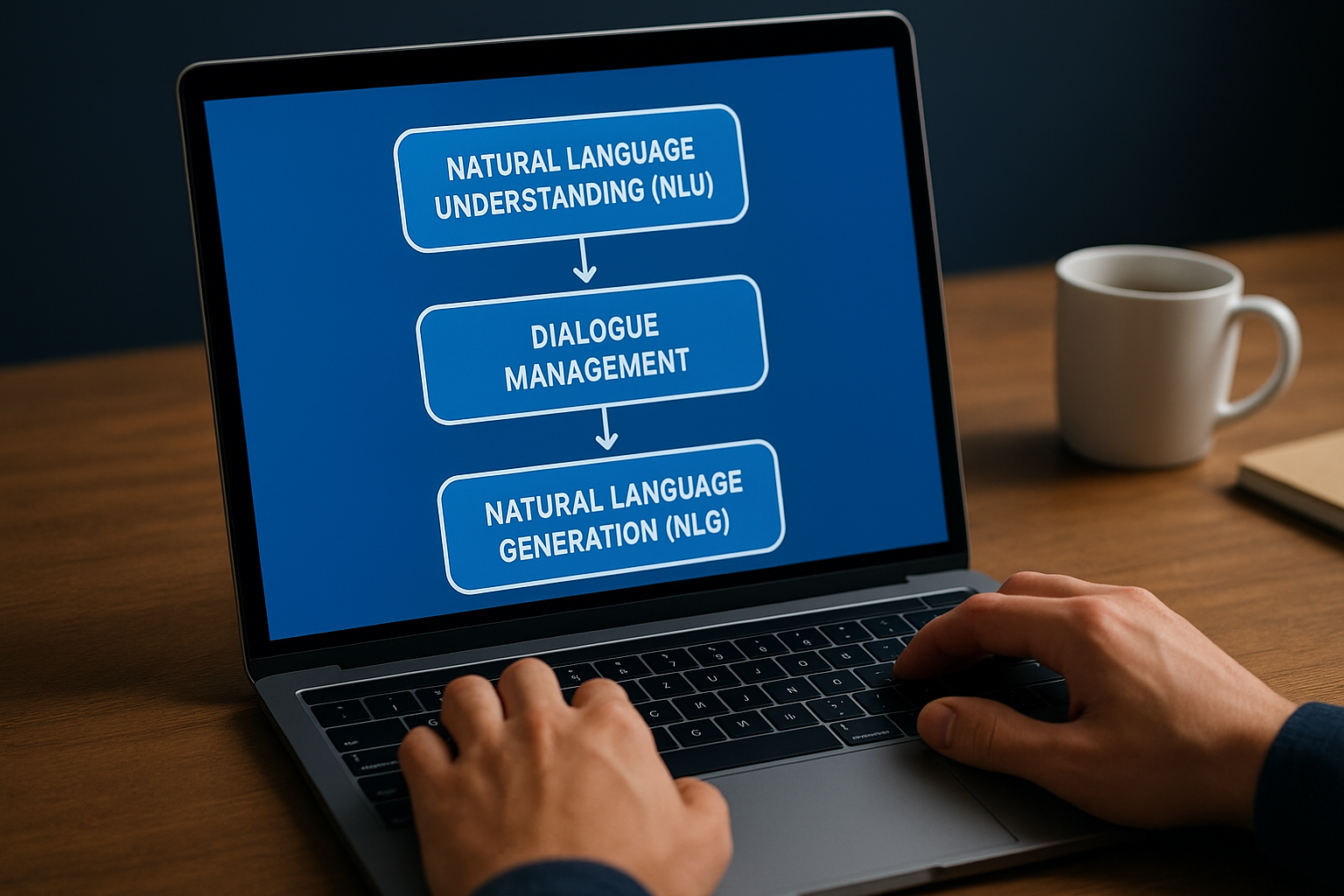
When the underlying architecture can track context and generate language dynamically, the conversation stops feeling like a transaction and starts feeling like an actual exchange.
How memory and context change the experience
What separates conversational AI from a chatbot most clearly is persistent context. A conversational AI system retains what was said earlier in a session and, depending on the platform, across sessions entirely. That continuity is what lets a system reference earlier input, adjust its responses based on prior exchanges, and build something resembling a sustained dialogue rather than a series of disconnected replies.
When you compare conversational AI vs chatbot capabilities in practice, this is the functional gap that surfaces first. Platforms built around conversational AI, such as SAM, take this further by combining persistent memory with emotionally responsive dialogue, so each conversation carries the weight of everything that came before it rather than resetting to zero every time a new session begins.
Key differences that affect real-world outcomes
When you look past the marketing descriptions and compare what each system actually does under pressure, the functional gaps between chatbots and conversational AI become impossible to ignore. These are not theoretical distinctions. They shape what your system can handle, how users respond to it, and whether the technology serves its purpose or gets abandoned.
Language understanding vs. keyword matching
A chatbot looks for specific words in a user's message and maps them to a pre-set response. If the words don't match, the system returns a fallback response or loops back to the main menu. Conversational AI, by contrast, uses natural language understanding to interpret what the user actually means, even when the phrasing is indirect, informal, or ambiguous.
The difference between matching a word and understanding a sentence is the difference between a lookup table and a thinking system.
That distinction directly determines how your system handles the unpredictable inputs that real users send every day. Users rarely phrase requests the way a designer anticipated. Conversational AI handles that gap. A keyword-based chatbot cannot.
Memory and continuity across the conversation
A standard chatbot treats each message as a standalone input with no connection to what came before it in the session. Conversational AI maintains context throughout the entire exchange, so a reference to "that option" or "what you mentioned earlier" resolves correctly instead of generating a confused or irrelevant response.
This matters more than most comparisons of conversational AI vs chatbot systems acknowledge. Sustained dialogue, whether in customer support or in relational AI platforms, depends on the system carrying the thread of the conversation forward. The practical result is that users can speak naturally, change direction mid-conversation, and ask follow-up questions without restating everything from scratch, which is what actual human communication looks like.
How to choose the right approach for your use case
The decision between conversational AI vs chatbot comes down to one core question: what does your use case actually require from the system? Before you evaluate any platform or pricing tier, map out the realistic range of inputs your users will send and what a successful response looks like in each scenario. That mapping tells you more about which technology fits than any feature comparison will.
Define your interaction complexity
If your users follow a predictable path, ask a narrow set of questions, and need structured answers, a rule-based chatbot covers that ground reliably and at a lower cost. Think order tracking, appointment scheduling, or FAQ deflection. These tasks have defined endpoints and don't require the system to interpret nuance or carry context forward. Here are the indicators that point clearly toward a chatbot:
- Interactions follow a fixed script with predictable branching
- Users rarely need follow-up clarification within the same session
- The task completes in three to five exchanges at most
- No session memory is required between visits
Match the technology to your dialogue depth
When your users need to ask follow-up questions, shift topics mid-conversation, or engage in exchanges that carry emotional weight, conversational AI is the correct architectural choice. You cannot retrofit a keyword-based system to handle sustained dialogue, and attempting to do so compounds the user experience problems rather than resolving them.
The deeper and more open-ended your expected conversations are, the more clearly conversational AI separates itself from rule-based alternatives.
Consider conversational AI when your use case involves multi-turn dialogue, memory across sessions, or responses that need to adapt to individual user context. Platforms built on this architecture, like SAM, show what becomes possible when a system is designed from the start to sustain real conversation rather than just simulate it.
Make your choice with confidence
The conversational AI vs chatbot decision gets much clearer once you stop treating it as a technical question and start treating it as a use case question. Rule-based chatbots deliver reliably within narrow, predictable workflows, and no configuration change shifts that ceiling. Conversational AI handles everything beyond that boundary: sustained multi-turn dialogue, persistent memory, and responses that adapt to what users actually mean rather than the specific words they type.
Your path forward is to map your expected interaction depth honestly against what each technology can actually deliver. If your users need a system that remembers, adapts, and builds real conversational continuity across sessions, you need architecture built for that from the start rather than retrofitted later. SAM is designed around exactly that foundation, combining persistent memory with emotionally responsive dialogue. Explore what an AI companion built for long-term conversational continuity looks like and see whether it fits where you're headed.