Conversational AI Use Cases Real-World Examples by Industry
Conversational AI has moved well past the novelty stage. Businesses across healthcare, retail, finance, and dozens of other sectors now rely on it to handle real interactions, with real customers, at...
Conversational AI has moved well past the novelty stage. Businesses across healthcare, retail, finance, and dozens of other sectors now rely on it to handle real interactions, with real customers, at real scale. The range of conversational AI use cases keeps expanding as the underlying technology gets sharper, more context-aware, and better at holding meaningful dialogue over time.
But not every use case looks the same. Some focus on cutting support costs. Others aim to improve patient intake, streamline employee onboarding, or build entirely new kinds of user experiences. At SAM, we build AI companions designed around persistent memory and emotionally responsive conversation, which sits at one end of a much broader spectrum. Understanding where conversational AI is already working (and where it's headed) matters whether you're evaluating tools for a business or simply trying to grasp how this technology reshapes interaction across industries.
This article breaks down real-world conversational AI use cases organized by industry, with specific examples of how companies are applying the technology right now. You'll walk away with a clear picture of what's actually working, what problems these systems solve, and where the biggest opportunities still sit.
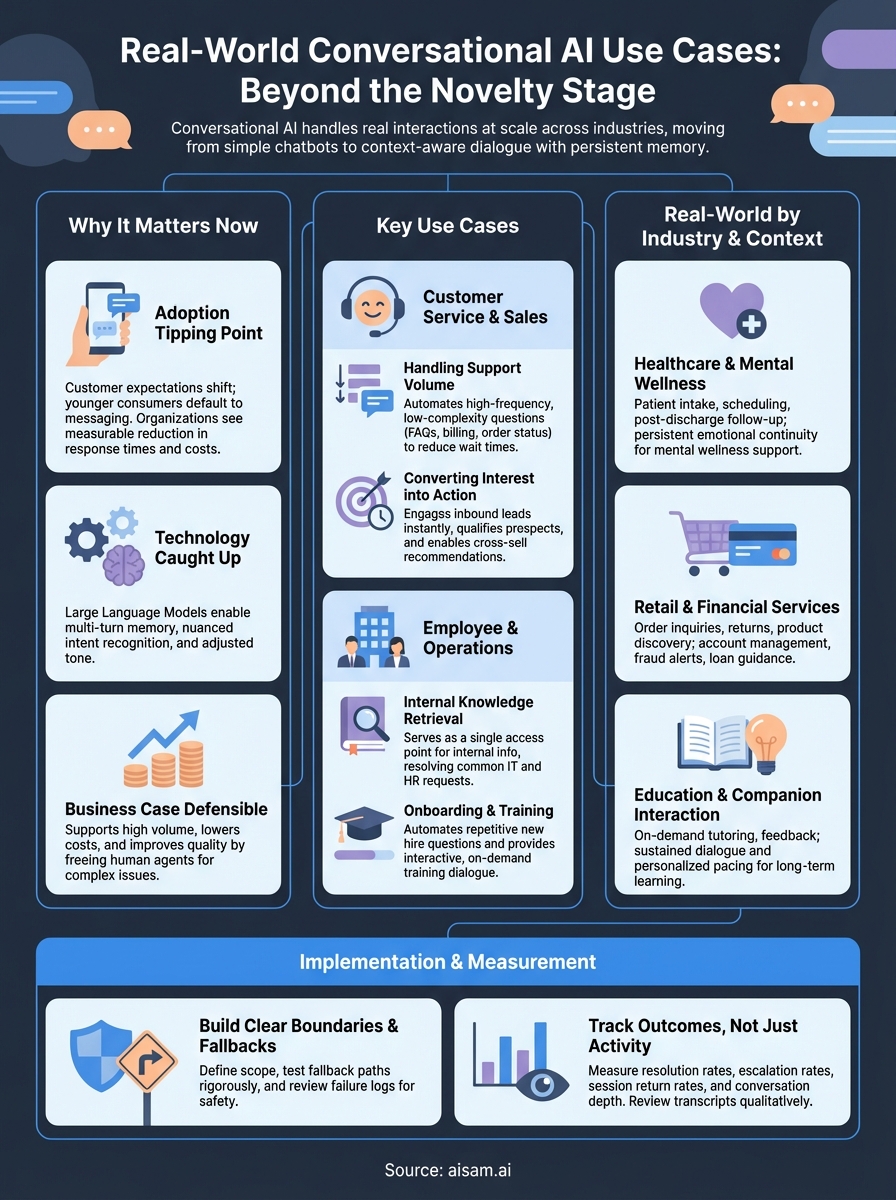
Why conversational AI matters now
For years, conversational AI sat in a frustrating middle ground. The potential was clear, but the reality was chatbots that looped users in circles and voice assistants that misheard more than they understood. That gap between promise and performance has closed substantially, and the surge of real-world deployment you're seeing now reflects genuine capability improvements rather than hype. What's changed is the speed, the depth, and the range of interactions these systems can handle reliably at scale.
Adoption has reached a tipping point
The numbers back up what you're likely already observing. Microsoft's research on enterprise AI adoption shows organizations across industries reporting measurable reductions in response times and operational costs after deploying AI-assisted communication tools. Customer expectations have shifted alongside adoption rates, and people now arrive expecting fast, context-aware, accurate responses regardless of the channel they use. Businesses that can't meet that standard are losing ground to those that can.
The question has shifted from whether to deploy conversational AI to which use cases to prioritize and in what order.
Younger consumers increasingly default to messaging and chat over phone calls, which means the channel itself now demands a conversational AI layer just to keep up with volume. This expectation shift is structural, not temporary, and it's accelerating across every industry that interacts with customers at scale.
The technology caught up with the promise
Earlier systems struggled with anything beyond a single exchange. The moment a conversation required multi-turn memory or nuanced intent recognition, the experience broke down. Large language models changed that dynamic significantly. Modern systems follow conversations across multiple exchanges, hold context between sessions, and adjust tone based on signals in the dialogue itself without requiring manual rules for every scenario.
That improvement is exactly why conversational ai use cases have expanded so dramatically in the past two years. These systems now handle complex support escalations, guide users through multi-step processes, assist employees with internal knowledge retrieval, and in some cases sustain dialogue over weeks or months. The surface area of what's actually deployable has grown in every direction, and it's still growing.
The business case no longer needs defending
Businesses face a straightforward arithmetic problem: support volume keeps climbing while hiring costs stay high and customer tolerance for wait times stays low. Conversational AI handles the high-frequency, lower-complexity interactions that consume the most agent time, which frees your human team for conversations that actually require judgment and relationship management.
The result is an improvement in both efficiency and quality simultaneously, not a trade-off between them. Companies across healthcare, retail, banking, and logistics have used this logic to justify deployment, and the results have been consistent enough that the business case rarely needs heavy defense anymore. Beyond cost reduction, the most forward-looking organizations are also investing in emotionally responsive and memory-driven AI systems that sustain long-term interaction rather than handling single-session utility, which is where the next wave of meaningful applications is actively developing.
How to pick the right conversational AI use case
Not every organization needs the same starting point. The most common mistake businesses make is deploying conversational AI based on what's popular rather than what actually fits their specific workflow. Picking the right conversational AI use cases starts with a clear-eyed look at where your current processes create friction, cost the most time, or produce the most inconsistent outcomes for people on either end of the exchange. Without that diagnostic step first, you end up building something that technically runs but doesn't move any metric your team actually tracks.
Start with the problem, not the technology
Before evaluating any system, identify the specific interaction pattern you want to improve. Is it the volume of repetitive support tickets your team fields every day? The drop-off rate in your onboarding flow? The lag between an employee asking an internal question and getting a useful answer? Each of those points to a different deployment approach, and starting with the problem keeps your decision grounded in operational reality rather than feature lists.
The clearest signal you've found the right use case is that solving it would visibly change a number your team actually cares about.
A useful exercise is to map your highest-volume interactions and sort them by two variables: how frequently they occur and how much variation they contain. Interactions that happen often and follow predictable patterns are strong candidates for conversational AI. Interactions that are infrequent or highly unpredictable are better handled by humans, at least until you have enough data to train more robust responses.
Match the use case to your interaction volume and complexity
Volume and complexity together determine your deployment ceiling. A high-volume, low-complexity use case, like answering the same ten billing questions repeatedly, delivers fast ROI and carries low risk. A low-volume, high-complexity use case, like guiding a user through a sensitive medical intake process, demands more careful design and stronger fallback options before you run it at scale.
You also need to factor in how much conversational continuity the use case actually requires. Some interactions are effectively single-session tasks where context doesn't carry over between conversations. Others benefit from persistent memory, where knowing what a user said last week shapes how the system responds today. That second category is where emotionally responsive and memory-driven AI systems produce the most differentiated outcomes, particularly in healthcare, education, and long-term customer relationships where the relationship itself carries value.
Customer service and sales use cases
Customer service is where most organizations first encounter conversational AI use cases in a serious, operational context. The logic is straightforward: support teams spend the majority of their time answering questions they've already answered hundreds of times before. Automating that repetition frees your human agents to handle the conversations that actually require judgment, empathy, or account-level knowledge that a system can't replicate without significant context.

Handling support volume without scaling headcount
Deploying conversational AI at the front of your support queue lets you resolve the highest-volume, lowest-complexity tickets before they ever reach a human agent. Questions about order status, password resets, return policies, billing details, and account changes are all strong candidates. These interactions follow predictable patterns, require accurate information retrieval, and have low tolerance for wait time on the customer's side.
The biggest ROI in support automation comes from solving the same fifty questions faster, not from solving fifty new ones.
Companies in retail and telecommunications have consistently reported deflection rates above 50% after deploying AI-assisted support, which translates directly into reduced queue volume and faster resolution times for the cases that do reach a human. You get faster responses for customers and lower cost-per-interaction for your team at the same time.
Here's where conversational AI delivers the most consistent value in support:
- Answering FAQs across multiple channels simultaneously
- Processing returns, refunds, and subscription changes without human review
- Triaging inbound tickets and routing complex cases to the right agent
- Sending proactive updates on orders, outages, or account changes
Converting interest into action at the right moment
Sales teams use conversational AI to engage inbound leads the moment they show interest, rather than hours later when the context and urgency have faded. An AI system running on your website or product page can qualify a prospect, answer product questions, and book a discovery call without any human involvement in the initial exchange. That speed matters because response time is one of the strongest predictors of conversion in inbound sales.
Beyond lead qualification, conversational AI supports upsell and cross-sell workflows by surfacing relevant offers based on what a customer is already discussing. A user asking about one product can be shown a logical addition or upgrade without the interaction feeling like a hard sell, because the recommendation follows naturally from the conversation rather than arriving as an interruption.
Employee and operations use cases
Customer-facing deployments get most of the attention, but some of the strongest conversational AI use cases sit entirely inside your organization. Employees deal with the same friction that customers do: they ask the same questions repeatedly, wait for information that should be instant, and lose time to processes that don't need human involvement at every step. Conversational AI applied to internal workflows reduces that friction at the source rather than patching it with more headcount.
Internal knowledge retrieval and IT support
Every organization has knowledge scattered across wikis, policy documents, HR portals, and internal ticketing systems. When an employee needs an answer, they either search across all of those sources manually or ask a colleague who then has to do the same thing. Conversational AI solves this by acting as a single access point for internal information, pulling relevant answers from across your knowledge base and surfacing them in a natural exchange rather than a search result list.
The fastest way to reduce internal support tickets is to make the answers easier to find than the tickets are to file.
IT support follows the same pattern. Password resets, software access requests, and common troubleshooting steps account for a significant share of internal IT volume in most organizations. An AI system handling those requests around the clock keeps your IT team focused on problems that actually require technical judgment rather than repetitive queue management.
- Answering HR policy questions without routing to a human
- Guiding employees through benefits enrollment step by step
- Resolving common IT requests without opening a ticket
- Surfacing relevant documentation based on what the employee is trying to accomplish
Onboarding and training
New hire onboarding involves a predictable set of questions that HR teams answer over and over for every cohort. Conversational AI handles that repetition automatically, giving new employees a consistent, on-demand resource they can query at any point in their first weeks without waiting for a scheduled session or chasing down a contact.
Training workflows benefit from the same approach. Instead of pushing static content at employees and hoping it sticks, interactive AI-assisted training creates a dialogue where the employee asks questions, works through scenarios, and confirms their understanding in real time. That back-and-forth produces better retention than passive content consumption, and it scales across your entire organization without adding instructor hours. Your managers spend less time repeating fundamentals and more time on work that genuinely needs their attention.
Real-world use cases by industry and context
The most useful way to evaluate conversational AI use cases is to see them applied in contexts where the friction was real and the outcomes are measurable. Across healthcare, retail, financial services, and education, organizations are solving different problems with the same core capability: systems that hold context, respond accurately, and scale without adding headcount. Each industry applies that capability differently depending on where interaction volume is highest and where inconsistent responses cost the most.
Healthcare and mental wellness
Healthcare organizations use conversational AI to handle patient intake, appointment scheduling, and post-discharge follow-up without routing every interaction through an already stretched administrative team. Patients complete intake information through a guided dialogue rather than a static form, which improves both completion rates and data quality before a clinician ever opens the file. Pre-screening tools reduce the time providers spend on triage by surfacing relevant patient history automatically, so the appointment starts with context rather than repetition.

In mental wellness specifically, the shift toward persistent, memory-driven AI conversation has opened a new category of support that didn't exist at scale before.
Platforms built around long-term emotional continuity give users a consistent, private space for reflection and dialogue between sessions with a human provider. This doesn't replace clinical care, but it fills the gap that exists between appointments and outside office hours where people often need a responsive, non-judgmental presence.
Retail and financial services
Retail and e-commerce teams deploy conversational AI to handle order inquiries, manage returns, and guide product discovery across web, mobile, and messaging channels at the same time. A customer asking about a product gets an accurate answer instantly rather than waiting for an available agent, and the interaction data feeds back into improving future responses across your entire catalog.
Financial services firms apply the same logic to account management, fraud alerts, and loan application guidance. Banks that have integrated AI conversation layers into their customer communication report faster resolution times and measurable drops in inbound call volume. You get better service delivery at lower operational cost without sacrificing accuracy on questions where compliance matters.
Education and companion-style interaction
Educational platforms use conversational AI to give students on-demand access to tutoring, feedback, and guided practice without requiring a live instructor for every exchange. The system walks through problems step by step and adjusts pacing based on how the student responds rather than moving at a fixed rate regardless of comprehension.
Longer-term companion applications build on this by sustaining genuine conversational continuity across sessions, so the AI recalls what the learner struggled with previously and adapts accordingly. That persistent, context-aware dialogue is where the most differentiated applications in education and personal development are actively taking shape.
How to implement safely and measure success
Deploying conversational AI without a clear safety framework and measurement plan is one of the most common ways organizations undermine results they've already paid to achieve. The implementation decisions you make upfront determine whether your system builds user trust over time or quietly erodes it. Before you go live with any of the conversational ai use cases covered in this article, you need a structured approach to both containment and evaluation, not as an afterthought but as a core part of the design.
Build in clear boundaries and fallback paths
Every conversational AI system needs to know what it can't handle. Defining the boundaries of your system's scope before deployment keeps it from producing confident responses to questions it doesn't have reliable data to answer. Map out the categories of interaction your system will handle, and for anything outside that scope, build a clean handoff to a human or a direct acknowledgment that the system can't help with that specific request.
The fastest way to lose user trust in an AI system is to let it answer questions it shouldn't be answering at all.
Fallback paths should be tested as rigorously as primary flows. Users who hit an edge case and find a graceful exit maintain confidence in the system. Users who hit an edge case and get a confusing or wrong response stop using it. Build your escalation paths, test them under real-use conditions, and review failure logs regularly to catch patterns before they compound.
Track the metrics that reflect real outcomes
Measuring success means going beyond simple activity counts like total conversations or messages sent. Resolution rate and escalation rate tell you whether your system is actually solving the problems it was designed to handle. If your escalation rate stays high, the system is deflecting volume without adding value. If your resolution rate climbs over time, your training data and dialogue design are working.
For longer-term or memory-driven applications, session return rate and conversation depth matter more than single-session completions. These metrics reflect whether users find enough value in the experience to come back and continue the relationship the system is designed to build. Pair quantitative tracking with periodic qualitative review of actual conversation transcripts to catch tone and accuracy issues that numbers alone won't surface. Regular review cycles keep your system improving rather than drifting toward lower quality as your user base grows.
Where to go from here
The conversational ai use cases covered in this article represent where the technology is working right now, across customer service, internal operations, healthcare, retail, finance, and education. Each example points to the same underlying shift: AI systems that hold context and sustain dialogue are producing outcomes that single-session, task-based tools simply can't match. The gap between those two categories keeps widening as memory-driven and emotionally responsive systems mature.
Your next step is deciding which use case fits your actual situation. Start with the interaction pattern that creates the most friction today, build in clear fallback paths, and measure outcomes that reflect real user experience rather than surface-level activity. The organizations getting the most from this technology are the ones treating deployment as an ongoing design process, not a one-time launch. If you want to see what sustained, memory-driven AI conversation looks like in practice, explore SAM's approach to relational AI.