
Conversational AI Architecture: Components, Patterns, Stack
Every AI system that holds a conversation, whether it's answering a support ticket or remembering what you said three months ago, runs on a stack of interdependent components. Conversational AI archit...
Every AI system that holds a conversation, whether it's answering a support ticket or remembering what you said three months ago, runs on a stack of interdependent components. Conversational AI architecture refers to the structural design behind these systems: the layers responsible for understanding language, managing context, generating responses, and maintaining memory. Get the architecture wrong, and you get a chatbot that forgets everything between sessions. Get it right, and you build something that actually evolves with each interaction.
This matters to us directly. SAM is built on the kind of architecture this article breaks down, persistent memory, emotional responsiveness, and dialogue management designed for long-term continuity. Every design decision in our stack traces back to the principles covered here. So this isn't abstract theory; it's the structural foundation behind AI systems that maintain real conversational presence over time.
Below, you'll find a full breakdown of the core components, common design patterns, and the modern stack behind conversational AI, from traditional NLU pipelines to generative architectures powered by large language models. Whether you're evaluating platforms, building your own, or trying to understand what separates a stateless chatbot from a true AI companion, this is the technical map you need.
Why conversational AI architecture matters
Most people evaluating an AI system focus on the surface: how natural does it sound, how fast does it respond, how well does it handle an edge case. But the decisions that actually determine long-term performance are made at the architectural level, before any user ever types a word. Conversational AI architecture is the structural layer where your system either gets the foundations right or inherits compounding problems that no amount of prompt tuning or fine-tuning can fully correct once the system is in production.
The cost of getting the foundation wrong
A poorly designed architecture creates friction at every touchpoint. Stateless systems, for example, treat each conversation turn as isolated input. They process your message, return a response, and discard everything. This works fine for a one-off query, but it makes sustained dialogue impossible. When a user references something they said earlier, a stateless system either fails to connect the context or generates a fabricated connection, and both outcomes erode trust faster than a slow response ever could.
Architecture determines not just what your AI can do today, but what it will be capable of scaling toward tomorrow.
Beyond memory, a poorly scoped architecture also creates bottlenecks in latency, safety, and evaluation. If your intent classification module and your response generation layer are tightly coupled with no clear interface between them, testing one without affecting the other becomes difficult. You end up shipping regressions you didn't catch because the system had no clean separation of concerns. These issues compound quickly in production environments where conversation volume is high and every failure has a direct cost to user experience.
What good architecture enables
When your conversational AI architecture is designed with clear component boundaries, you gain the ability to upgrade individual layers without rebuilding the entire system. You can swap a retrieval model, adjust a safety filter, or improve memory persistence without touching response generation. This modularity is what separates systems that improve over time from systems that require full rebuilds every six months just to incorporate a new capability.
Strong architecture also enables genuine personalization at scale. When memory is a first-class architectural concern rather than an afterthought bolted onto a stateless core, the system can track user preferences, prior context, and evolving conversational patterns across sessions. This is the difference between an AI that greets you with "How can I help?" every single time and one that picks up from where you left off. Achieving the latter requires deliberate early decisions about memory storage, retrieval strategy, and context window management, not patches applied after the fact.
Finally, a well-structured design gives you a defensible and consistent safety layer. When moderation, content filtering, and policy enforcement are embedded at the right points in the processing pipeline rather than applied as a single post-generation check, your system handles edge cases predictably. You spend less time patching unexpected outputs and more time improving the quality of expected ones. Safety is not a feature you add later; it is a structural property you design for from the start, and that distinction shows clearly in how real-world systems behave under pressure.
Core components and how data flows
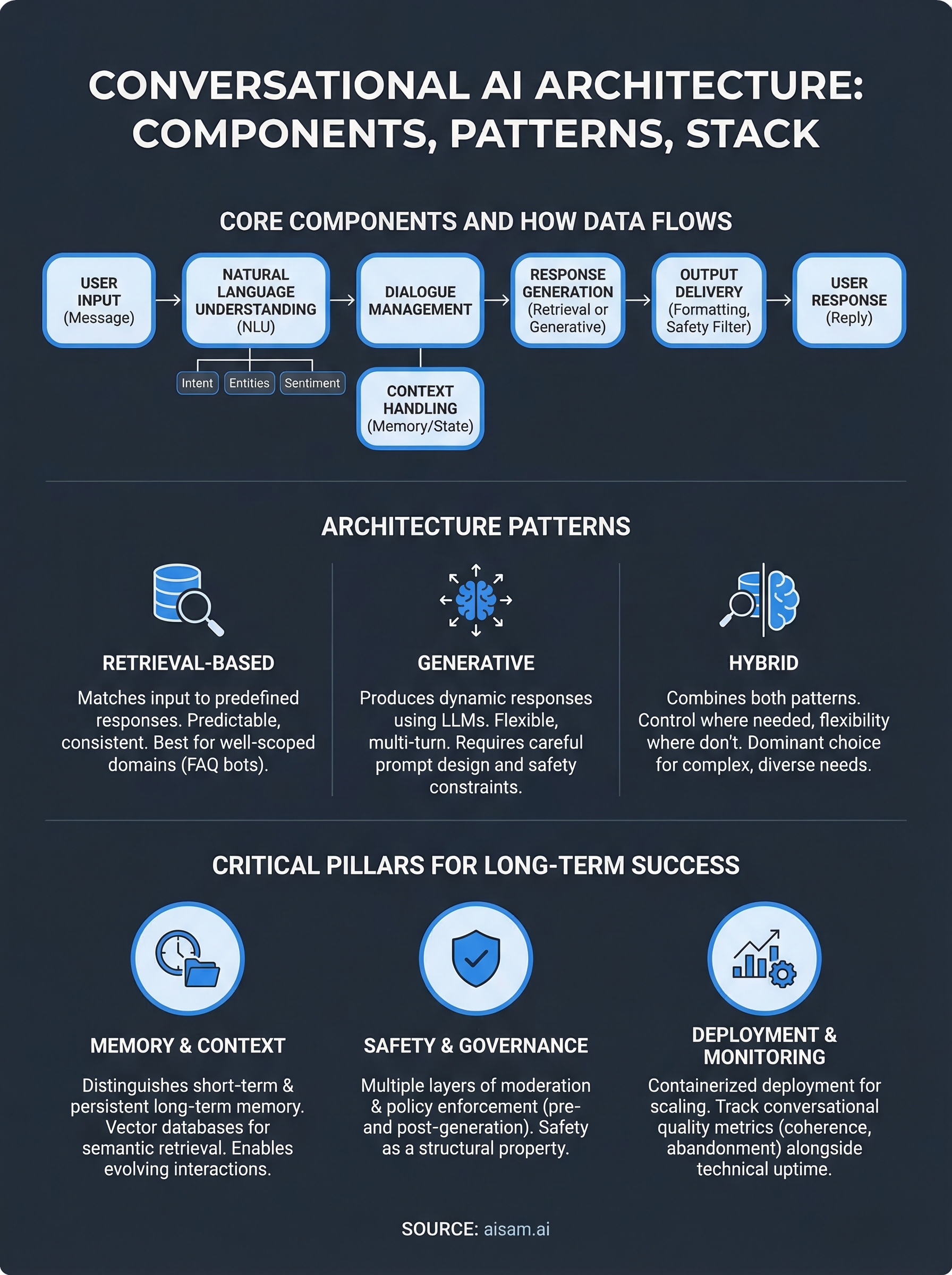
Every conversational AI architecture is built from a sequence of discrete processing stages. A user sends a message, and that input travels through several specialized layers before any response reaches them. Understanding what each layer does and how they connect gives you the clarity to evaluate, build, or improve a system with precision.

Natural language understanding
The first stage your system encounters is natural language understanding (NLU). This layer takes raw user input and converts it into structured signals: intent (what the user wants), entities (specific values like names, dates, or topics), and sentiment where applicable. How well your NLU layer performs directly determines the quality of everything downstream, because misclassified intent or missed entities cause cascading errors through the entire pipeline.
Your NLU layer is the entry point where meaning is extracted, and errors here propagate through every subsequent stage with compounding effect.
Modern systems increasingly delegate this stage to large language models rather than traditional intent classifiers, which improves handling of ambiguous or complex input at the cost of additional latency and compute overhead.
Dialogue management and context handling
Once intent and entities are extracted, your dialogue manager takes over. This component decides what to do next: trigger a specific response path, request clarification, query a knowledge base, or pass the input to a generation model. In stateful systems, the dialogue manager also reads and updates the conversation context, maintaining continuity across turns so the system can reference earlier exchanges coherently.
Context handling is where most basic architectures fail under real-world conditions. Without a dedicated context store and retrieval mechanism, your system loses the thread between sessions and can only respond to the immediate input, not the broader conversation arc.
Response generation and output delivery
The final stage produces what the user actually receives. In retrieval-based systems, the response engine selects a pre-written reply matched to the current intent. In generative systems powered by large language models, the engine produces a novel response conditioned on the full context window. Your output layer may also apply formatting, apply a safety filter, and log the exchange for evaluation purposes before delivery.
Common architecture patterns you can choose
Not every conversational AI system needs the same underlying structure. The pattern you choose shapes how your system handles ambiguity, scale, and memory, and each option comes with a different set of tradeoffs. Understanding the three dominant patterns gives you a clear basis for matching architecture to use case, rather than defaulting to whatever approach is most familiar.
Retrieval-based architecture
A retrieval-based system works by matching user input to a fixed set of predefined responses stored in a knowledge base or intent library. When the user sends a message, the system classifies the intent and retrieves the best-matched reply from its catalog. This pattern gives you predictable, consistent output and makes it easy to control exactly what the system says in any given scenario.
The tradeoff is rigidity. Retrieval-based designs handle well-scoped domains reliably, but they break down quickly when users go off-script, combine multiple intents, or phrase a familiar request in an unexpected way. For high-stakes, narrow use cases such as FAQ bots or structured customer service flows, this pattern is often the right call.
Generative architecture
Generative systems use large language models (LLMs) to produce responses dynamically based on the full conversation context rather than selecting from a fixed catalog. This gives the system far greater flexibility to handle novel phrasing, multi-turn dialogue, and nuanced topics without requiring you to author every possible response in advance.
The shift from retrieval to generative architecture is where conversational AI architecture moves from scripted interaction to genuine dialogue.
The cost of that flexibility is less deterministic output. Generative systems require careful prompt design, context window management, and safety filtering to prevent responses that drift from your intended behavior. They also carry higher compute requirements, which affects both cost and latency at scale.
Hybrid architecture
Hybrid systems combine both patterns, using retrieval for well-defined intents where precision matters and generative models for open-ended or complex exchanges. This approach gives you control where you need it and flexibility where you don't, making it the dominant choice for production systems that serve diverse user needs across a single interface.
Memory, safety, and governance in practice
Three components get underbuilt more consistently than any other in conversational AI architecture: memory, safety, and governance. Each one is technically optional in a minimal prototype, but all three become critical constraints the moment your system interacts with real users at any meaningful scale. Treating them as design priorities from the start saves significant rework later.
Memory design and persistent context
Memory in a conversational system is not a single feature; it is a design decision that spans storage, retrieval, and context window management. At minimum, your architecture needs to distinguish between short-term memory, which holds the current session context, and long-term memory, which persists user-specific information across sessions. Without that separation, you cannot build interactions that evolve over time.

Persistent memory is what separates a system that answers questions from one that builds a relationship with the person asking them.
Your retrieval strategy matters as much as your storage approach. Vector databases such as those offered through cloud providers like Microsoft Azure AI Search allow you to retrieve semantically relevant past context rather than relying on exact keyword matches, which significantly improves how the system surfaces prior exchanges during response generation. The right combination of storage format and retrieval method determines how coherent your system feels across long conversation histories.
Safety layers and policy enforcement
Safety filtering should sit at multiple points in your pipeline, not just as a single post-generation check. Applying moderation before generation reduces the likelihood of producing harmful output in the first place. Applying it after generation catches edge cases your upstream filters missed. Relying on a single filter at the end of the pipeline gives you one point of failure with no redundancy.
Policy enforcement goes beyond content filtering. It includes defining what your system will and will not do, how it handles requests that push against those boundaries, and how consistently it applies those rules under varied phrasing. Documenting these policies as explicit system-level constraints rather than informal guidelines gives your team a testable standard and gives your users a predictable experience they can build trust around over time.
Deployment, monitoring, and evaluation
Shipping a conversational AI system is not the finish line; it is the point where your architectural decisions get stress-tested against real users at real scale. The deployment and ongoing management layer of your conversational AI architecture determines whether the system holds up over time or quietly degrades in ways that are hard to detect until users stop trusting it. Planning for monitoring and evaluation from the start is not optional work you can schedule for later.
Deployment infrastructure and scaling
Your deployment environment needs to match the performance demands your system will actually face. Containerized deployments using services like Google Cloud Run or Amazon ECS give you the flexibility to scale individual components independently, so a spike in traffic doesn't require you to scale every layer of your stack equally. Your response generation layer and your memory retrieval layer have very different compute profiles, and treating them as separate scalable services reduces both cost and latency under load.
You also need to decide early how you will handle versioning and rollback. Generative systems can shift in behavior after a model update even without changes to your application code, so maintaining clear version checkpoints and the ability to roll back to a known-good configuration protects your users from regressions they never expected.
Monitoring conversational quality
Standard infrastructure metrics like uptime and latency tell you whether your system is running, but they do not tell you whether it is performing well as a conversational experience. You need a monitoring strategy that captures turn-level signals: response coherence, intent classification accuracy, and whether users are completing the interactions they started. Logging conversation outcomes and flagging sessions where users abandoned early or repeated themselves gives you the signal you need to identify where the system is failing.
What you do not measure in a deployed conversational system is what quietly degrades your user experience without triggering any alerts.
Evaluation frameworks and quality benchmarks
Automated evaluation metrics like BLEU or ROUGE give you a fast, consistent baseline for response quality, but they measure surface similarity, not conversational coherence. Pairing automated metrics with human evaluation panels that assess naturalness, accuracy, and contextual relevance gives you a fuller picture of how the system actually performs. Review cycles tied to specific failure categories, not just general quality, help your team prioritize improvements with the highest impact on user experience.
Final takeaways
Conversational AI architecture is not a background technical detail; it is the foundation that determines what your system can actually do over time. Every component covered here, from NLU and dialogue management to memory design, safety layering, and evaluation frameworks, contributes directly to whether your AI delivers a coherent, trustworthy experience or a fragile one that breaks down under real conditions. Getting the structure right from the start is the decision that compounds most in your favor as the system scales.
No single pattern or stack fits every use case, but the principles remain consistent: build with modularity, treat memory and safety as structural concerns, and monitor for conversational quality, not just uptime. The systems that hold up over time are the ones designed with long-term continuity in mind at every layer. If you want to see what that looks like in practice, explore how SAM applies these principles to build AI companionship that genuinely evolves with every conversation.