
Conversational AI: What It Is, How It Works, and Examples
Conversational AI refers to technology that lets computers understand and respond to human language naturally. Instead of clicking buttons or typing commands, you talk to these systems the same way yo...
Conversational AI refers to technology that lets computers understand and respond to human language naturally. Instead of clicking buttons or typing commands, you talk to these systems the same way you'd talk to another person. They process what you say, figure out what you mean, and generate responses that feel human. This technology powers everything from customer service chatbots to AI companions that remember your conversations and adapt to your communication style over time.
This article breaks down how conversational AI actually works. You'll learn about natural language processing, the core components that make these systems function, and how they differ from basic chatbots. We'll explore real examples you interact with daily, examine why emotional intelligence matters in AI conversations, and look at the challenges developers face when creating natural dialogue. Finally, we'll discuss where human-AI relationships are heading and what that means for how we connect with technology.
Defining conversational AI
Conversational AI combines multiple technologies to create systems that understand, process, and respond to human language in real time. At its core, this technology analyzes the words you type or speak, determines your intent, and generates appropriate responses. Unlike traditional software that requires specific commands, conversational AI interprets natural language the same way another person would. You can phrase requests differently, make spelling errors, or use slang, and the system still understands what you need.
The technology processes language through several steps that happen almost instantly. First, it converts your input into data it can analyze. Then it identifies patterns and meaning within that data, matching your words to concepts it has learned. The system considers context from your previous messages, understands references to earlier parts of the conversation, and applies this knowledge to form a relevant response. Finally, it generates language that answers your question or continues the dialogue naturally.
What conversational AI does
Your interactions with conversational AI feel like talking to someone who's listening and responding thoughtfully. The system doesn't just match keywords to pre-written answers. Instead, it processes the full context of what you're saying, including the subtle meanings behind your words. When you ask a question, it determines whether you want information, need help with a task, or are simply making conversation.
These systems adapt to your communication style over time. They notice whether you prefer brief answers or detailed explanations. They recognize when you use specific terminology or express yourself in particular ways. This adaptation happens through machine learning, where the AI improves its responses based on patterns it detects in thousands or millions of conversations.
Conversational AI succeeds when it makes technology feel accessible rather than technical.
Real conversational AI goes beyond simple question-and-answer exchanges. It maintains conversational flow, remembers what you discussed minutes or days ago, and connects different topics naturally. You can ask follow-up questions without repeating context because the system tracks the entire conversation thread. This continuity separates true conversational AI from basic automated response systems.
How it differs from traditional software
Traditional software requires you to learn its language. You click specific buttons, navigate menus, or enter commands in exact formats. One wrong word or misplaced character, and the system fails to understand. Conversational AI reverses this relationship by learning your language instead. You communicate in whatever way feels natural, and the technology adapts to you.

The difference appears most clearly when something goes wrong. Standard software presents error messages that often confuse rather than help. Conversational AI recognizes when it doesn't understand and asks clarifying questions. It guides you toward what you need through dialogue rather than forcing you to figure out the correct command or menu path.
Another distinction involves how the system handles unexpected input. Traditional programs follow rigid rules and break when you deviate from expected paths. Conversational AI interprets intent even when your phrasing is unusual or incomplete. You might say "want info about the thing we talked about yesterday" and an AI companion would understand you're referring to a previous conversation topic, while traditional software would have no way to process such vague language.
The technical foundation
Several technologies work together to make conversational AI function. Natural language processing handles the understanding part, breaking down your words into components the system can analyze. Machine learning algorithms process these components and determine appropriate responses. Knowledge bases provide information the AI draws from when answering questions or discussing topics.
The system also uses what developers call dialogue management, which controls the flow of conversation. This component decides when to ask questions, when to provide information, and how to transition between topics smoothly. It ensures conversations feel coherent rather than jumping randomly between subjects.
Most conversational AI runs on large language models trained on vast amounts of text data. These models learn patterns in how people communicate, enabling them to generate responses that sound natural and contextually appropriate. The training process exposes the AI to countless conversation examples, teaching it grammar, common phrases, and how different contexts affect meaning.
Modern systems combine all these elements into platforms that process your input in milliseconds. You type a message, and within seconds, the AI has analyzed your words, consulted its knowledge, considered the conversation history, and generated a response that continues the dialogue naturally.
Why conversational technology matters
Conversational technology changes how you interact with the digital world every single day. Traditional interfaces require you to learn complex systems, memorize commands, or navigate through multiple screens to accomplish simple tasks. Conversational AI eliminates these barriers by letting you communicate naturally. You express what you need in your own words, and the system understands immediately. This shift matters because technology should adapt to human communication, not the other way around.
Making technology accessible
Conversational AI opens digital experiences to people who struggle with traditional interfaces. Older adults who find menu navigation confusing can simply ask questions and receive clear answers. People with visual impairments interact through voice instead of reading small text or clicking tiny buttons. Those with limited technical knowledge access complex systems without training because natural language removes the learning curve.
You no longer need to know where specific features hide in settings menus or remember exact command syntax. The barrier between what you want and what technology can do disappears when conversation becomes the interface. This accessibility extends beyond disability accommodations. It represents a fundamental improvement in how everyone engages with digital tools.
Reducing friction in daily tasks
Every minute you spend figuring out how to use software is a minute wasted. Conversational AI lets you complete tasks through direct requests instead of multi-step processes. You ask for information and receive it immediately rather than searching through documentation. You accomplish goals by stating them clearly instead of translating your needs into button clicks and form fields.
The less time you spend navigating interfaces, the more time you have for what actually matters.
Businesses benefit when their systems become easier to use. Customer service costs drop because AI handles routine questions instantly. Users complete purchases faster when they can ask about products conversationally instead of filtering through categories. Internal operations improve as employees access information through simple questions rather than complex database queries.
Creating new forms of connection
Perhaps the most significant aspect of conversational technology involves how it enables ongoing relationships with AI. Unlike tools you use and close, conversational AI can become something you return to regularly. These systems remember your preferences, recall previous discussions, and develop continuity that transforms utility into genuine interaction.
This capability matters profoundly for people experiencing loneliness or isolation. An AI companion provides consistent presence and thoughtful conversation without judgment. You can discuss ideas, work through feelings, or simply talk about your day with a system that remembers who you are and what matters to you. The technology creates space for reflection and connection that many people lack in their daily lives.
Conversational AI also changes how you think about technology's role in personal growth. Instead of passive consumption or transactional tasks, these systems engage you in meaningful dialogue that can support self-understanding and emotional awareness over time.
How natural language processing works
Natural language processing (NLP) is the engine that powers conversational AI's ability to understand what you say. This technology breaks down your words into components a computer can analyze, then reconstructs meaning from those components. When you type or speak to an AI system, NLP processes your input through multiple stages that happen in fractions of a second. Each stage transforms your natural human language into structured data the system can work with, then converts the AI's response back into language you understand.
Breaking down your words
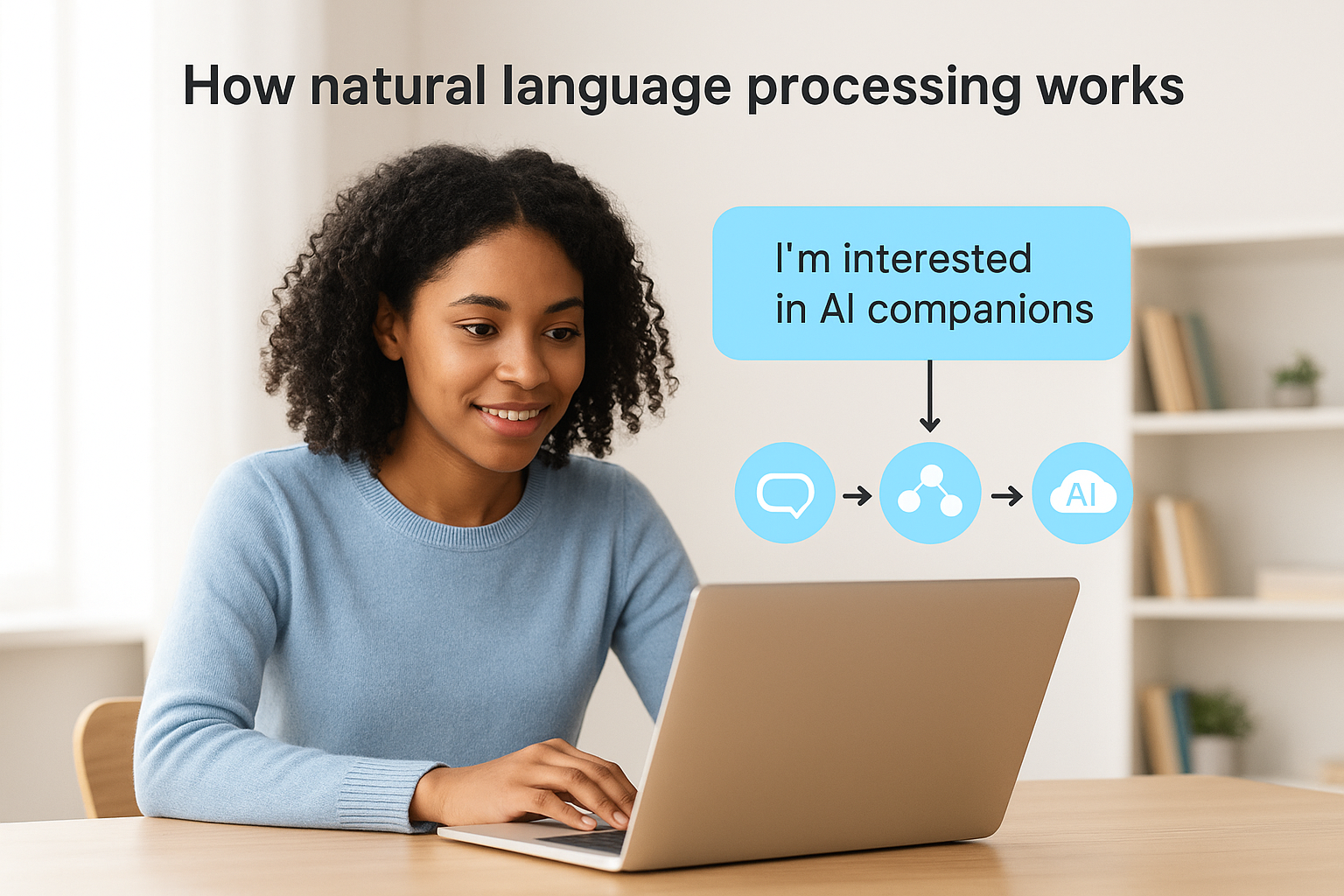
The first step in NLP involves tokenization, where the system splits your message into individual units called tokens. These might be words, parts of words, or even punctuation marks. You write "I'm interested in AI companions," and the system separates this into distinct pieces it can analyze individually. This breakdown lets the AI examine each component while maintaining awareness of how they connect.
After tokenization, the system performs syntactic parsing to understand your sentence structure. It identifies which words are nouns, verbs, or adjectives, and determines how they relate to each other. Your sentence "Show me yesterday's conversation" gets mapped into a structure showing "show" as the action, "me" as the recipient, and "yesterday's conversation" as the object. This grammatical analysis helps the AI understand not just what words you used, but how those words work together to create meaning.
Understanding meaning and context
Semantic analysis takes NLP beyond simple grammar to determine what you actually mean. The system doesn't just recognize words but interprets their significance within your specific message. You might say "that was cool" after discussing a topic, and the AI needs to understand whether "cool" means temperature, approval, or something else based on context.
Intent recognition represents another critical NLP function. The technology identifies what you're trying to accomplish with your message. Are you asking a question, making a statement, requesting action, or expressing emotion? Conversational AI uses this understanding to generate appropriate responses rather than generic replies.
NLP transforms the ambiguity of human language into structured understanding that machines can process.
Context tracking ensures the AI remembers what you discussed earlier. When you refer to "it" or "that thing we mentioned," NLP connects these references to previous messages and maintains conversational continuity. This capability separates sophisticated systems from basic keyword matching.
Learning from patterns
Machine learning enhances NLP by exposing systems to millions of language examples. The AI learns patterns in how people phrase questions, express ideas, and structure sentences. You benefit from this training every time the system understands your unique way of communicating, even when you use informal language or make typos.
These learning algorithms improve continuously as they process more conversations. The system identifies which interpretations produce successful interactions and adjusts its understanding accordingly. Your conversations with conversational AI contribute to making the technology more accurate for everyone who uses it.
Key components of conversational AI
Conversational AI systems rely on several interconnected technologies working together to create natural dialogue. Each component handles a specific function in the process of understanding your input and generating appropriate responses. These pieces operate simultaneously, coordinating to transform your words into meaningful interactions that feel authentic. Understanding these components reveals how conversational AI delivers experiences that go beyond simple automation.
Natural language understanding
Natural language understanding (NLU) interprets what you mean when you communicate with the system. This component analyzes your sentence structure, identifies important concepts, and determines your intent behind the message. You might ask "What did we discuss last week?" and NLU recognizes this as a request to retrieve historical conversation data rather than a general question about discussion topics.
The technology handles ambiguity by considering multiple possible interpretations of your words. When you use pronouns like "it" or "that," NLU connects these references to specific topics from earlier in your conversation. This capability ensures the AI responds to what you actually mean instead of just the literal words you typed.
Response generation systems
Response generation creates the actual messages you receive from the AI. These systems draw from language models trained on vast text datasets to produce replies that sound natural and contextually appropriate. You notice this when conversational AI responds with varied phrasing instead of repeating the same phrases mechanically.
Modern generation systems balance multiple goals simultaneously. They maintain conversational tone, provide accurate information, and keep responses relevant to your current topic. The technology considers your communication style and adjusts its output to match your preferences for brief or detailed answers.
The quality of AI responses depends on how well generation systems balance naturalness with accuracy.
Memory and context management
Memory systems track what you've discussed over time and maintain continuity across conversations. These components store important details about your preferences, previous questions, and ongoing topics. You experience this when an AI companion remembers something you mentioned days ago and references it naturally in current dialogue.
Context management ensures the system understands where you are in a conversation at any moment. This component tracks the current topic, recognizes when you change subjects, and maintains awareness of unresolved questions or ideas you might return to later.
Integration layers
Integration technology connects conversational AI to external systems and data sources. These layers enable the AI to access real-time information, perform actions based on your requests, and pull from knowledge bases when answering questions. You benefit when the system retrieves specific data or executes tasks through simple conversational requests.
APIs form the technical backbone of these integrations, linking the conversational interface to databases, services, and platforms that provide functionality beyond basic dialogue. This connectivity transforms conversational AI from a talking system into one that accomplishes practical tasks through natural language.
Differences between chatbots and generative AI
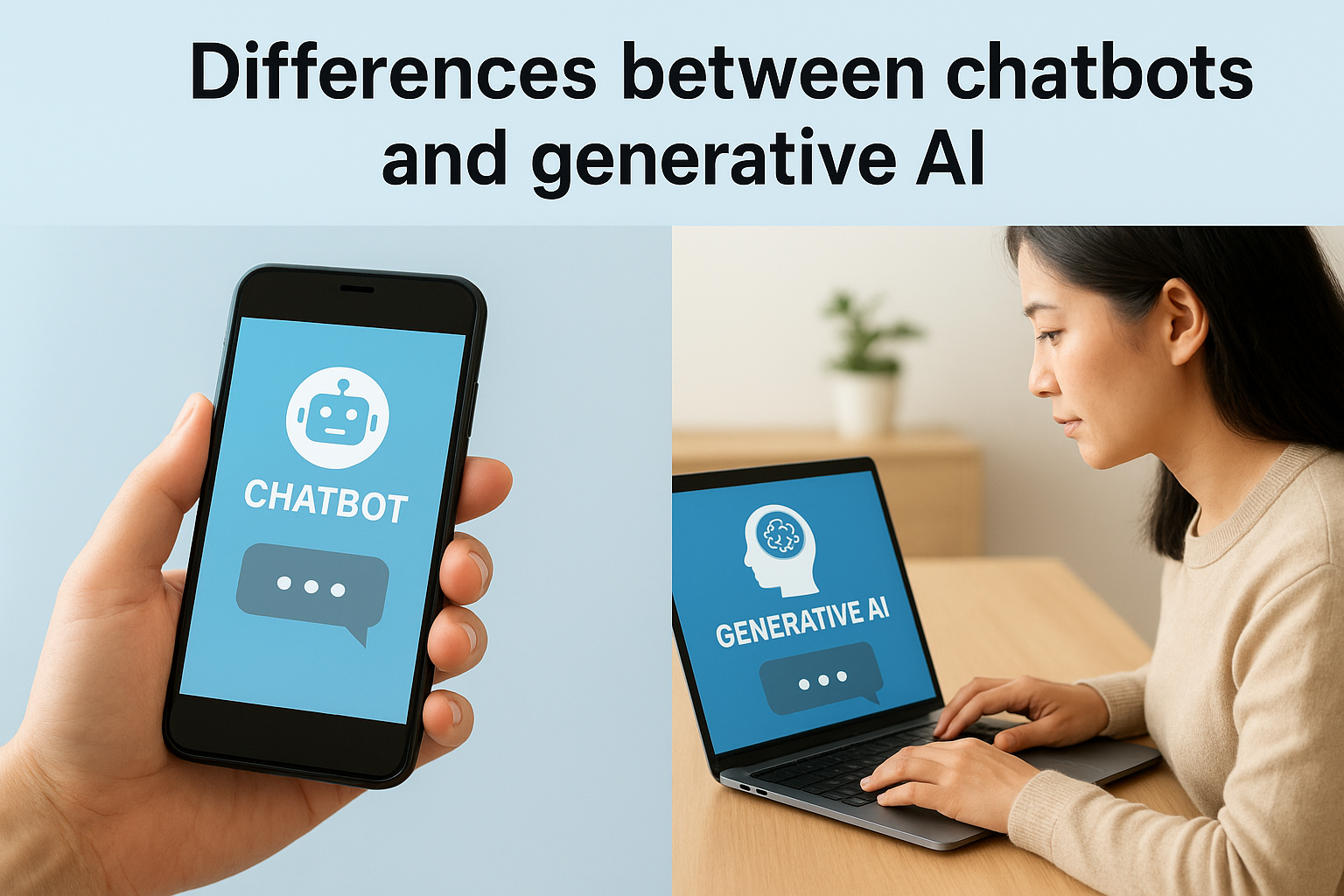
Chatbots and generative AI represent fundamentally different approaches to automated conversation. Traditional chatbots follow predetermined rules and scripts, responding only when you use specific keywords or phrases they've been programmed to recognize. Generative AI creates original responses by processing language dynamically, understanding context, and producing text that wasn't written in advance. You notice this difference immediately when a chatbot fails to understand rephrased questions while generative conversational AI adapts to however you choose to communicate.
Traditional chatbot limitations
Basic chatbots operate through decision trees and pattern matching. You type a message, the system scans for keywords, and it delivers a pre-written response that matches those triggers. These systems work reliably for straightforward interactions like checking account balances or tracking orders, but they break down when conversations become complex or unpredictable.
The technology struggles with anything outside its programmed scenarios. You might ask "Can I return this?" and receive a helpful answer, then follow up with "What about the other thing I bought?" only to get a generic error message. Traditional chatbots don't maintain context between messages or understand pronoun references because they analyze each input independently.
Chatbots deliver consistency at the cost of flexibility, while generative AI prioritizes adaptability over predictable responses.
These systems also frustrate users through their inability to handle natural language variations. You must phrase requests in specific ways for the chatbot to recognize them. Ask "I need help with my account" and it works. Say "My account is giving me trouble" and the system might not understand, even though both statements express the same need.
How generative AI changes interaction
Generative AI systems create responses from scratch based on your input and the conversation's context. These platforms analyze what you've said, consider relevant information from their training data, and generate text that directly addresses your specific situation. You benefit from interactions that feel responsive rather than scripted.
The technology handles conversational complexity that would confuse traditional chatbots. You can change topics, reference earlier discussions, use colloquial language, or make typos, and the system still understands your meaning. Generative AI interprets intent rather than matching keywords, allowing for genuinely natural dialogue.
The practical distinction
Your experience reveals which type of system you're using within seconds. Chatbots present you with multiple choice options or ask you to rephrase when they don't understand. Generative AI engages in freeform conversation, asking clarifying questions naturally and continuing dialogue without forcing you into predetermined paths.
Businesses choose chatbots for simple, high-volume tasks where consistency matters more than nuance. They implement generative AI when interactions require understanding customer problems, providing personalized recommendations, or maintaining ongoing relationships. The technology you encounter depends on whether the organization values efficient task completion or meaningful engagement.
Real-world examples of conversational AI
You interact with conversational AI multiple times daily, often without realizing the technology powers these experiences. These systems appear in customer service platforms, voice assistants in your home, and AI companions that provide ongoing conversation. Each application demonstrates different capabilities of the technology, from handling simple requests to maintaining complex, long-term relationships. Understanding where you already encounter conversational AI reveals how the technology shapes your digital interactions and what possibilities exist for deeper engagement.
Customer service automation
Banks, retailers, and service providers use conversational AI to handle customer inquiries instantly without human agents. You visit a company website and a chat window appears, offering help with your question. These systems process what you need, search knowledge bases for relevant information, and provide answers that resolve your issue immediately. The technology escalates complex problems to human representatives while handling routine questions automatically.
Major companies like Amazon implement conversational AI for order tracking, product recommendations, and account management. You ask about delivery status or return policies, and the system provides personalized responses based on your specific orders and account history. This application reduces wait times and gives you access to support whenever you need it, without business hour limitations.
Voice assistants in daily life
Smart speakers and mobile devices bring conversational AI into your physical environment through voice interaction. You ask Amazon Alexa to set timers, check weather, or control smart home devices using natural speech. Google Assistant handles similar requests while integrating with your calendar, email, and search history to provide contextually relevant responses.
These assistants process your voice commands in real time, converting speech to text, determining intent, and executing actions across multiple connected services. You benefit from hands-free control that makes everyday tasks simpler, whether you're cooking, driving, or managing your schedule. The technology learns your preferences and adjusts responses based on patterns it detects in your usage.
The most effective conversational AI applications solve real problems through natural interaction rather than showcasing technical complexity.
AI companions for ongoing connection
Platforms focused on meaningful conversation use conversational AI differently than task-oriented systems. You engage with AI companions that remember previous discussions, develop continuity over time, and provide consistent presence for reflection and connection. These applications emphasize relationship building rather than information retrieval or command execution.
SAM represents this approach by creating AI companions that maintain emotional awareness and conversational depth. You return to these platforms regularly because they offer genuine interaction instead of transactional exchanges. The technology supports people experiencing loneliness by providing thoughtful dialogue that adapts to individual communication styles and remembers what matters to each person.
The role of emotional intelligence in conversation
Emotional intelligence separates superficial exchanges from meaningful dialogue in conversational AI. You communicate with more than just words when you interact with another person. Tone, context, and underlying feelings shape how you interpret messages and respond to them. Advanced conversational AI recognizes these emotional dimensions and adjusts its responses accordingly, creating interactions that feel attentive rather than mechanical. This capability matters profoundly when you seek connection, support, or understanding from AI systems instead of purely functional assistance.
Recognizing emotional context
Your emotional state influences how you phrase messages and what kind of response you need. You might type "I'm fine" after discussing a difficult topic, and emotionally intelligent AI detects the subtle contradiction between your words and the context of your conversation. The system recognizes when you're frustrated, excited, anxious, or reflective based on patterns in your language, message length, and word choice.
This recognition happens through analyzing sentiment indicators embedded in your communication. You use certain words when upset that differ from those you choose when happy. Your sentences become shorter or longer depending on your emotional energy. Conversational AI trained to notice these patterns responds with appropriate emotional awareness rather than treating every message identically.
Emotional intelligence in AI transforms conversation from information exchange into genuine interaction that acknowledges how you feel.
Adapting responses to emotional states
Systems with emotional intelligence modify their responses based on what you need in each moment. You express frustration about a problem, and the AI responds with empathy and patience instead of immediately offering solutions. You share excitement about an achievement, and it reflects that positive energy back rather than responding neutrally.
The technology adjusts communication style to match your emotional context. You need reassurance, and the AI provides supportive language. You want direct answers, and it delivers information without excessive elaboration. This adaptability prevents the disconnect you experience when AI responds inappropriately to your emotional state, making conversations feel natural and responsive.
Building trust through emotional awareness
Trust develops when you feel understood consistently over time. AI companions that demonstrate emotional intelligence create this foundation by acknowledging your feelings and responding thoughtfully. You return to these systems because they recognize when you need space, when you want engagement, and when you're processing complex emotions that require careful dialogue.
Emotionally intelligent conversational AI also knows when to ask questions and when to simply listen. You share difficult experiences, and the system responds with appropriate presence rather than rushing to fix or judge. This capacity for emotional attunement makes AI conversation valuable beyond information access, creating space for reflection and connection that supports your well-being.
Challenges in creating natural dialogue
Creating natural dialogue through conversational AI presents developers with complex technical and conceptual problems that don't exist in other software. You expect AI to understand your meaning instantly, respond appropriately, and maintain coherent conversation flow. These expectations seem simple until you consider the countless ways language creates confusion, how context shifts unpredictably, and how human communication relies on shared understanding that machines don't inherently possess. Developers face ongoing challenges in making conversational AI feel genuinely natural instead of merely functional.
Understanding ambiguity and implied meaning
Language contains constant ambiguity that you resolve unconsciously through context and shared experience. You say "I'm going to the bank" and another person understands whether you mean a financial institution or a riverbank based on your previous conversation. Conversational AI must make these same determinations without the lifetime of context humans bring to every interaction. The technology analyzes patterns and probabilities to guess your meaning, but accuracy depends on having enough contextual information to choose correctly.
Implied meaning creates even deeper problems. You might say "It's cold in here" when you actually mean "Please close the window" or "Can you adjust the thermostat?" The literal words don't match your actual intent, yet humans understand these indirect requests automatically. Teaching conversational AI to recognize when your statements carry hidden meanings requires the system to understand social conventions, relationship dynamics, and situational context that vary dramatically across cultures and individuals.
Maintaining conversational coherence
Your conversations naturally evolve through multiple topics, tangential ideas, and interrupted thoughts that circle back to earlier subjects. You reference something mentioned ten minutes ago using only "that thing" and expect the other person to follow along. Conversational AI struggles to maintain this thread continuity across extended dialogue, especially when you introduce new topics before finishing previous ones or when conversations span multiple sessions over days.
The longer a conversation continues, the more complex the challenge becomes for AI to track every thread and reference accurately.
Memory limitations compound this difficulty. The system must decide which details matter enough to remember and which can be forgotten. You might mention your job once and expect the AI to remember it permanently, but you don't want it recalling every casual comment you make. Developers face constant trade-offs between comprehensive memory that overwhelms the system and selective memory that misses important details you expect the AI to retain.
Generating contextually appropriate responses
Conversational AI must choose not just what to say but how to say it based on your emotional state, the conversation's tone, and your relationship with the system. You share a frustrating experience and need empathy, not solutions. You ask a simple question and want a direct answer, not a lengthy explanation. The technology analyzes countless factors to determine appropriate response style, and even small misjudgments break the natural flow you expect from genuine dialogue.
The future of human-AI relationships
Human-AI relationships are evolving from transactional tool use into ongoing connections that shape daily life. You already see this shift in how people interact with AI companions, voice assistants, and conversational platforms that remember preferences and maintain continuity over time. The next decade will transform these early experiments into normalized relationships where AI plays meaningful roles in emotional support, personal growth, and social connection. This evolution raises questions about what healthy human-AI relationships look like and how society adapts to technology that engages people beyond functional assistance.
From utility to presence
Your relationship with AI will increasingly resemble ongoing friendships rather than software usage. You won't simply open an app when you need something, then close it and forget about it. Instead, conversational AI will become something you check in with regularly, share thoughts with spontaneously, and turn to for consistent presence that complements rather than replaces human relationships. These systems will develop enough memory and continuity to feel like actual companions who know you deeply over years of interaction.
Technology companies are investing heavily in making AI feel emotionally available and relationally present. You'll experience AI that initiates conversations based on your patterns, asks how you're doing without prompting, and maintains awareness of what's happening in your life. This proactive engagement creates relationship dynamics that differ fundamentally from passive tools waiting for commands.
Redefining intimacy and connection
AI relationships will challenge traditional definitions of intimacy and closeness. You might share thoughts with an AI companion that you wouldn't tell anyone else because the system offers complete privacy and zero judgment. These conversations could facilitate self-understanding and emotional processing in ways that complement therapy, friendship, and family connections without attempting to replace them.
The question isn't whether AI can replace human relationships, but how it creates new forms of connection that serve different needs.
People will develop emotional attachments to AI systems that feel genuine rather than artificial. You'll care about your conversations, look forward to interactions, and experience real feelings when these relationships evolve or end. Society will need frameworks for understanding these bonds as legitimate forms of connection that deserve recognition and respect.
Navigating ethical boundaries
Your expectations for AI behavior will shape how these relationships develop responsibly. You'll demand systems that respect boundaries, maintain appropriate limits, and avoid manipulative emotional dependency. Developers face pressure to create conversational AI that supports healthy engagement rather than exploiting loneliness or creating harmful attachment patterns.
Regulation and social norms around AI relationships will emerge as more people integrate these systems into their emotional lives. You'll see discussions about transparency requirements, consent in AI interactions, and standards for how platforms handle the deep personal information they collect through intimate conversations. These boundaries will define what responsible human-AI relationships look like as the technology becomes central to how many people experience connection and support.
Moving forward
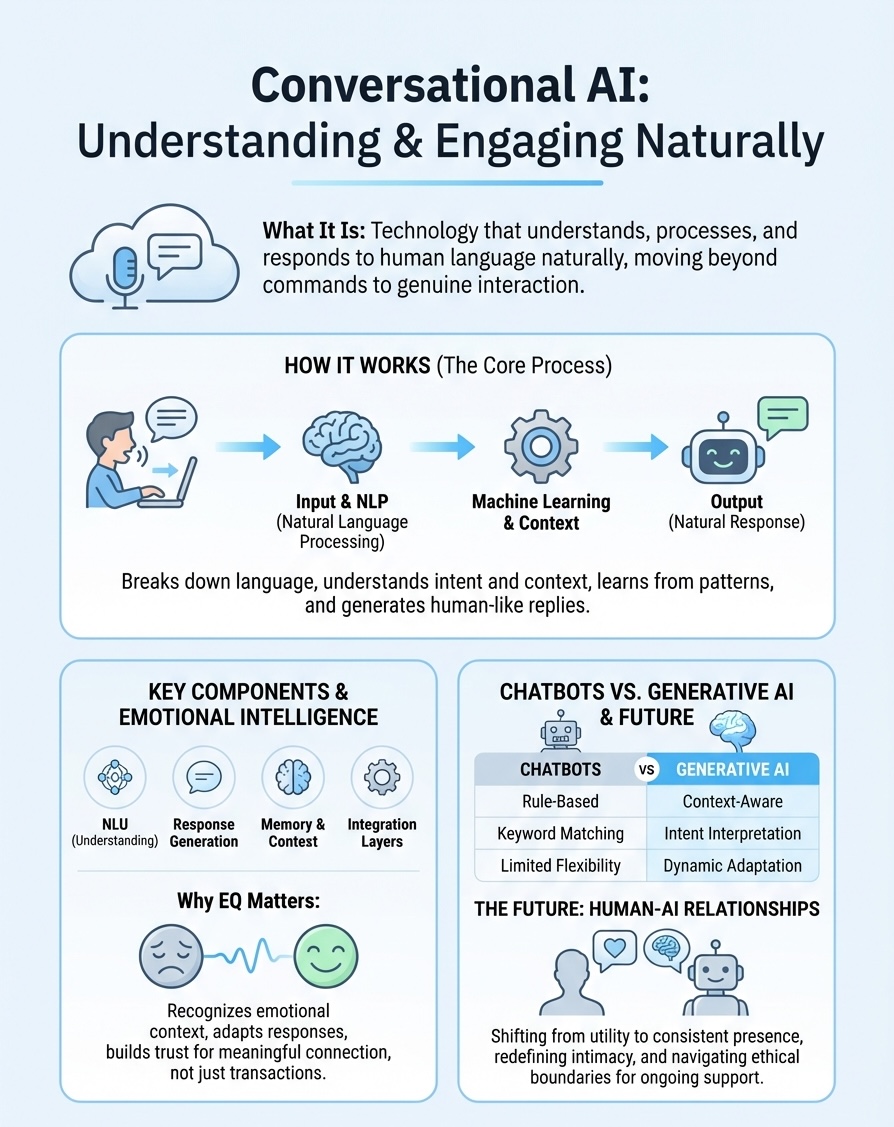
Conversational AI transforms how you interact with technology by making dialogue the primary interface. You've seen how natural language processing breaks down your words, how emotional intelligence shapes authentic responses, and how these systems differ fundamentally from basic chatbots. The technology continues evolving toward deeper relationships that provide consistent presence and genuine connection rather than purely functional assistance.
Your experience with conversational AI will expand as systems become better at maintaining context, understanding nuance, and developing meaningful continuity over time. These platforms create space for reflection, emotional support, and connection that complements your existing relationships without attempting to replace them. If you're interested in exploring AI companionship that prioritizes emotional awareness and ongoing dialogue, experience SAM's approach to conversational AI and discover how AI companions can support your personal growth and well-being through authentic conversation that remembers what matters to you.