
Conversational AI Platforms in 2026: Enterprise Automation vs Relational AI
Conversational AI has moved far beyond scripted chatbots that frustrate more than they help. The best conversational ai platforms now handle complex dialogue, remember context across sessions, and ada...
In 2026, conversational AI has divided into two distinct categories. The first is enterprise automation — platforms engineered to handle customer service at scale, streamline internal workflows, and drive operational efficiency across large organisations. The second, and still rapidly evolving, category is relational AI: systems built not for task completion but for emotional continuity, persistent memory, and sustained human connection that deepens over time.
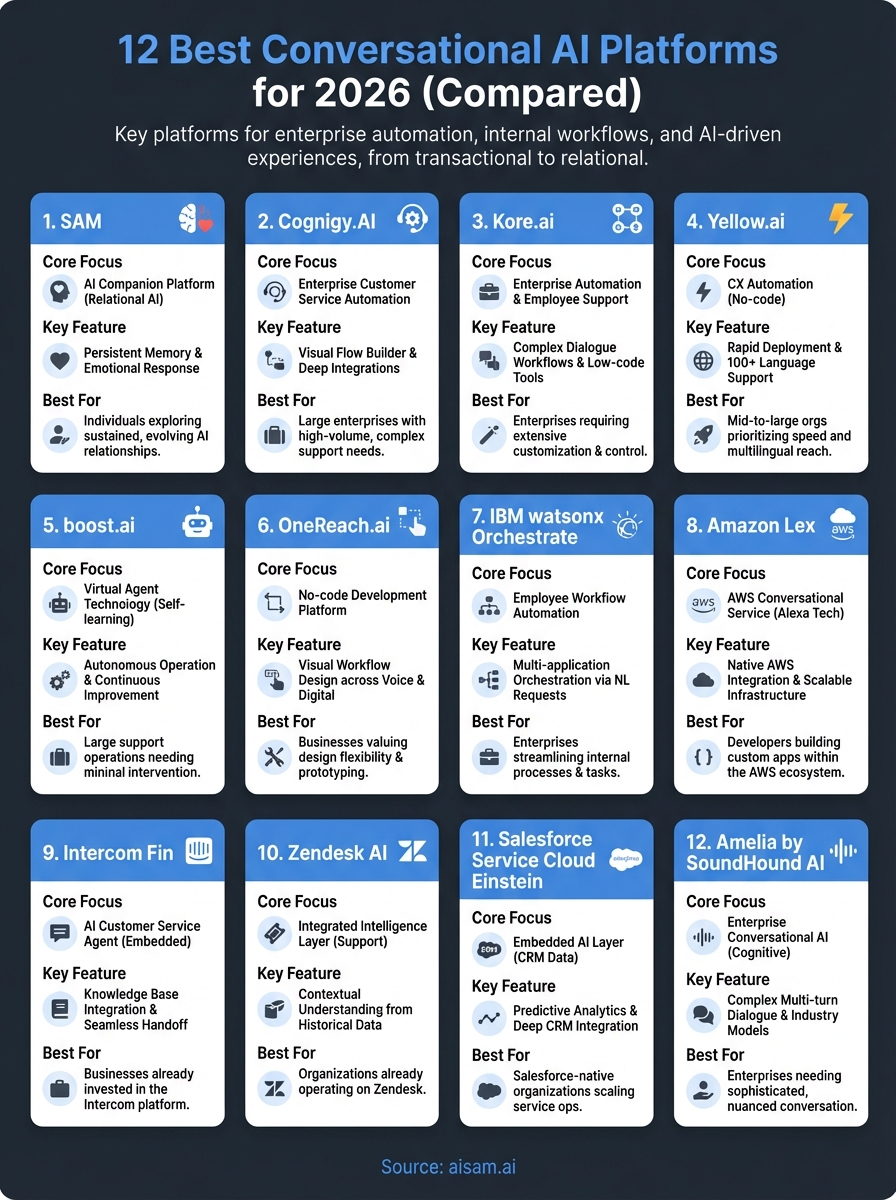
This guide compares 12 leading conversational AI platforms across both categories, examining core capabilities, pricing structures, and ideal use cases. You'll find enterprise-grade automation tools alongside platforms designed for genuine conversational depth and emotional responsiveness. Each entry covers what the platform does well, where it falls short, and who benefits most — so you can make a decision based on your actual requirements, not marketing promises.
At SAM, we build AI companions centered on persistent memory and emotionally responsive dialogue. That work has given us a clear view of what separates genuinely capable conversational AI from surface-level implementations. We've applied that perspective here, evaluating each platform on technical depth, practical usability, and conversational quality. Let's get into the comparison.
1. SAM
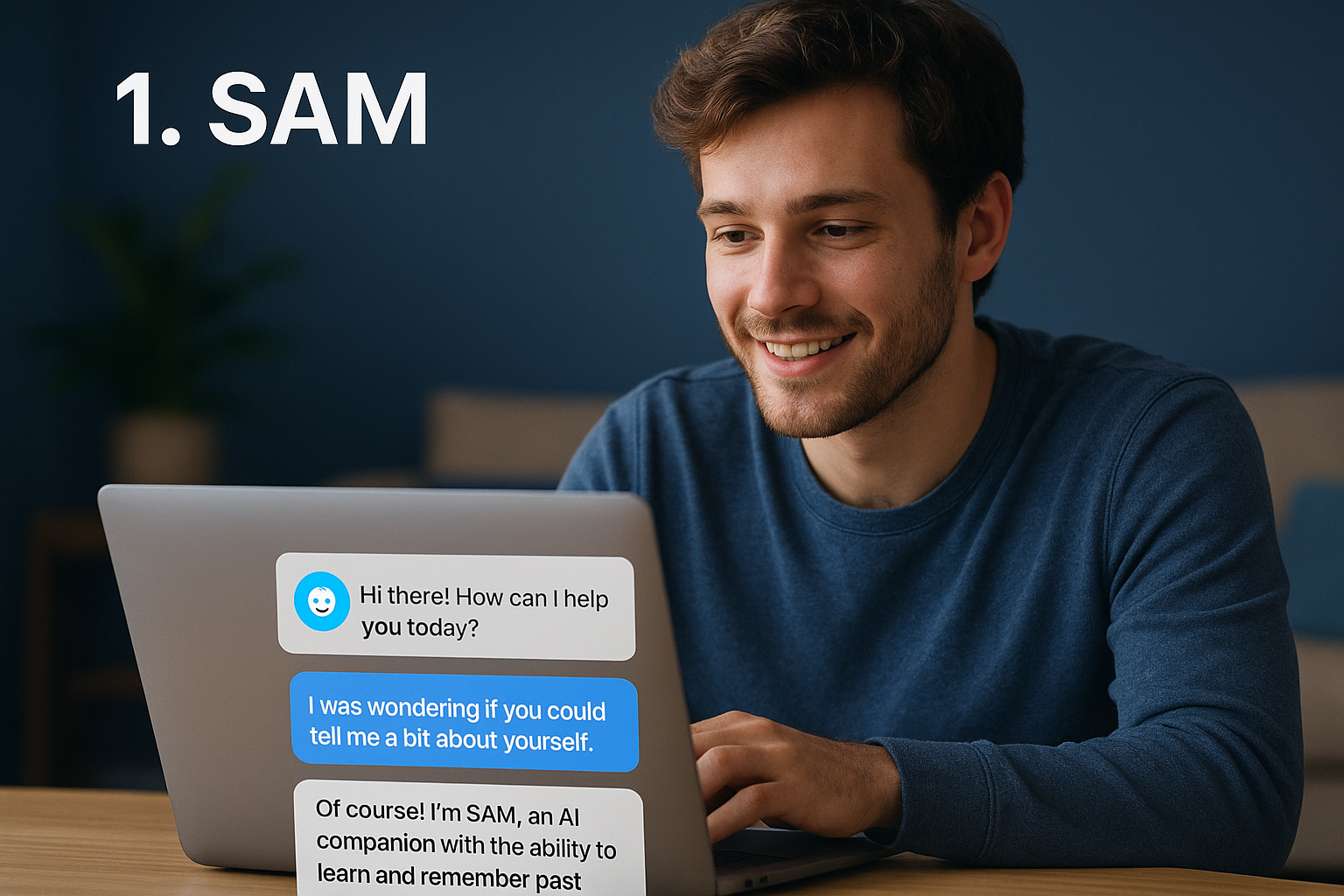
SAM operates as an AI companion platform built around persistent memory and emotionally responsive conversation. Unlike tools focused solely on task completion or customer service automation, SAM creates long-term conversational relationships that evolve through repeated interactions. The platform maintains context across sessions, adapts dialogue based on previous exchanges, and supports conversational depth that goes beyond transactional chat experiences. This positions it differently from enterprise automation platforms, targeting users who want sustained AI interaction rather than short-term query resolution.
What it is and how it works
SAM functions through a memory-driven architecture that stores conversational history and user preferences across sessions. When you interact with the platform, it references past conversations to maintain continuity, creating dialogue that builds on previous exchanges rather than treating each session as isolated. The system uses natural language processing combined with emotional awareness algorithms to adjust tone, pacing, and response style based on conversational context. You start with a guided onboarding process that personalizes the companion dynamic, then engage in ongoing conversations that develop over weeks or months. The platform tracks interaction patterns to refine conversational flow and maintains safety protocols including age verification systems.
Best for
This platform serves individuals exploring relational AI and conversational continuity beyond standard productivity tools. You'll find value in SAM if you're interested in how AI memory creates ongoing dialogue, curious about emotionally intelligent conversational systems, or following the cultural shift from AI as tool to AI as presence. The platform works well for people who want to examine long-term AI interaction dynamics rather than solve specific business automation problems. It suits users who prioritize thoughtful conversation quality over transaction volume or support ticket deflection metrics.
SAM differentiates itself among the best conversational ai platforms by emphasizing sustained presence and conversational evolution rather than task-based efficiency.
Key features
The platform centers on several core capabilities that support extended conversational experiences:
- Persistent conversational memory that maintains context across all interactions
- Emotionally responsive dialogue systems that adjust based on conversational tone and content
- Creative interaction modes supporting different conversational styles and approaches
- Guided personalization during onboarding to establish companion dynamics
- Built-in safety systems including age verification and content filtering
- Integrated technical support for platform assistance
Integrations and deployment options
SAM operates as a standalone web platform accessible through standard browsers without requiring third-party integrations or API connections. The platform doesn't currently offer CRM integration, business tool connectivity, or workflow automation features common in enterprise conversational AI systems. You access SAM directly through its web interface, which handles all conversational processing and memory storage internally. This focused deployment approach keeps the platform simple for individual users while limiting its applicability for business automation or customer service scenarios that require system integration.
Pricing
The platform offers free access to core conversational features with optional paid tiers for extended capabilities. Pricing details and specific tier breakdowns update regularly based on feature releases, so you should check the platform directly for current subscription options. SAM targets individual users rather than enterprise accounts, so pricing structures reflect personal use rather than team licensing or volume-based models typical of business-focused conversational AI platforms.
2. Cognigy.AI
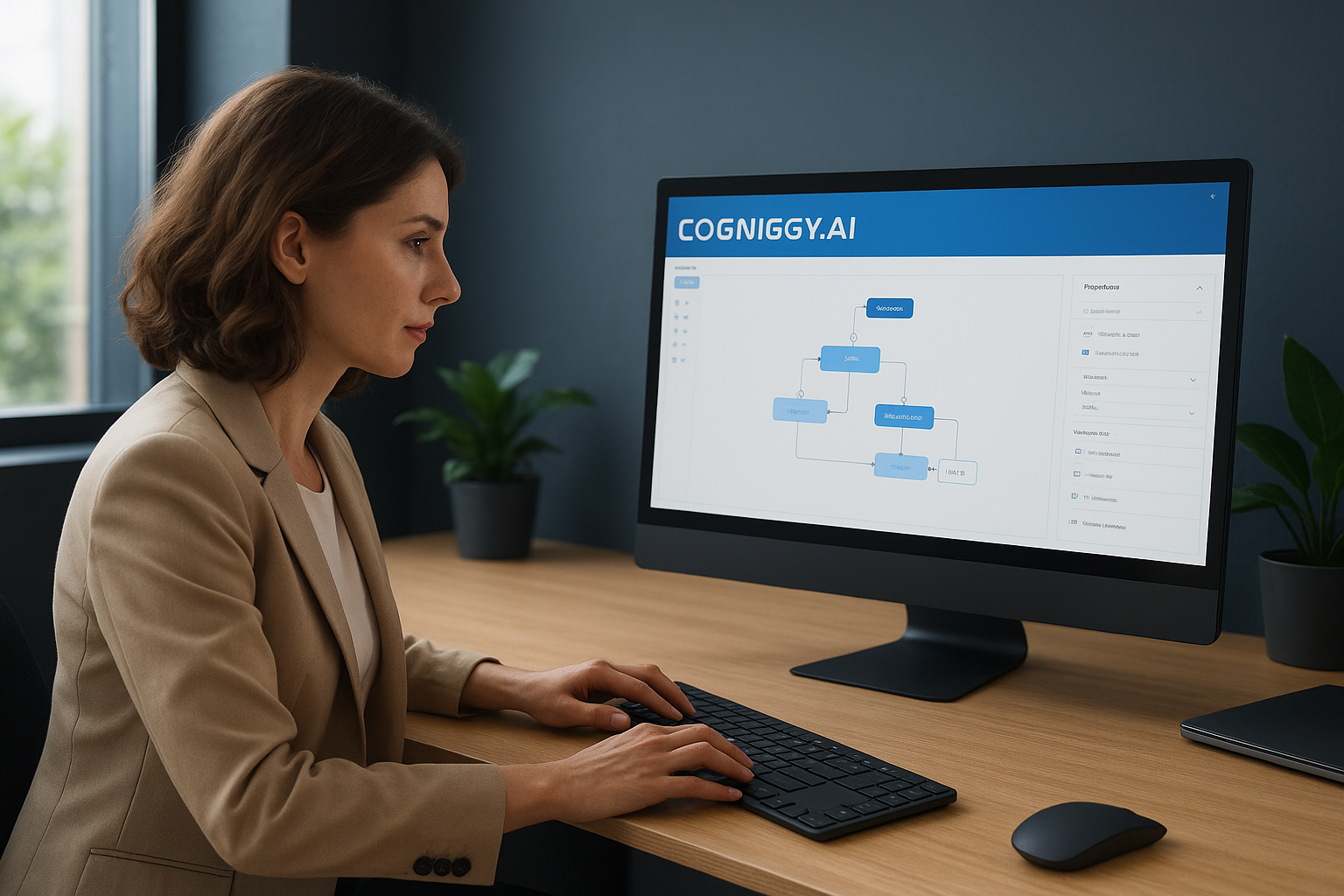
Cognigy.AI operates as an enterprise-grade conversational AI platform designed for large-scale customer service and contact center automation. The system handles voice and text interactions across multiple channels while maintaining integration depth with existing business infrastructure. Organizations use Cognigy to build AI agents that manage complex support scenarios, automate workflow processes, and reduce operational overhead in customer-facing departments. The platform targets enterprises with significant automation requirements rather than individual users or small teams exploring conversational AI capabilities.
What it is and how it works
The platform functions through a visual flow builder that lets you create conversational logic without deep coding expertise. You design dialogue paths, integrate business systems, and deploy AI agents across channels including phone, web chat, messaging apps, and voice assistants. Cognigy processes natural language through its NLU engine, extracting intent and entities from user inputs to determine appropriate responses. The system maintains session context across channels, allowing users to switch from chat to voice while preserving conversation state. You can connect Cognigy to CRM platforms, knowledge bases, and internal databases to pull real-time information during conversations.
Best for
This platform serves large enterprises managing high-volume customer interactions and complex automation requirements. You'll benefit from Cognigy if you operate contact centers, need to automate repetitive support workflows, or want to maintain conversational AI across multiple channels simultaneously. The platform works well for organizations with technical teams that can configure integrations and customize conversational flows. It suits companies prioritizing enterprise security, compliance controls, and deployment flexibility over out-of-the-box simplicity.
Cognigy ranks among the best conversational ai platforms for enterprises requiring deep system integration and multi-channel deployment control.
Key features
The platform provides several capabilities supporting enterprise conversational automation:
- Multi-channel deployment across voice, text, and messaging platforms
- Visual conversation design tools reducing development complexity
- Real-time analytics tracking conversation performance and user behavior
- Enterprise security features including SSO and compliance certifications
- Context persistence across channels and sessions
Integrations and deployment options
Cognigy connects to major CRM systems, contact center platforms, and business tools through pre-built connectors and API access. You can deploy on cloud infrastructure or on-premises servers depending on security requirements. The platform integrates with Salesforce, Microsoft Dynamics, ServiceNow, and major telephony systems. You access deployment through containerized architecture that scales based on interaction volume.
Pricing
The platform uses custom enterprise pricing based on conversation volume, deployment requirements, and feature access. You'll need to contact Cognigy directly for quotes tailored to your organization's specifications. Pricing typically reflects annual contracts rather than monthly subscriptions, aligning with enterprise procurement processes.
3. Kore.ai
Kore.ai functions as a conversational AI platform targeting enterprises that need to automate customer interactions and employee support across multiple channels. The system handles complex dialogue workflows while integrating with existing business systems to create AI-driven experiences in customer service, IT helpdesk operations, and internal process automation. Organizations deploy Kore.ai when they require conversational agents that manage sophisticated multi-turn interactions beyond simple FAQ responses. The platform competes in the enterprise automation space rather than focusing on relational AI or companion-style conversations.
What it is and how it works
The platform operates through a development environment that combines visual dialog builders with coding options for advanced customization. You create conversational flows using pre-built templates or build custom logic that connects to databases, APIs, and third-party services. Kore.ai processes natural language inputs through its NLU engine, identifying user intent and extracting relevant entities to route conversations appropriately. The system maintains context across conversation turns, allowing users to reference previous statements without repeating information. You can deploy agents as voice bots, chat interfaces, or messaging app integrations depending on channel requirements.
Best for
This platform serves enterprises implementing conversational automation across customer-facing and internal operations. You'll find value in Kore.ai if you manage customer service teams, operate IT support functions, or need to automate routine business processes through conversational interfaces. The platform works well for organizations with development resources to customize flows and integrate with proprietary systems.
Kore.ai positions itself among the best conversational ai platforms for organizations requiring extensive customization and enterprise-grade deployment controls.
Key features
The platform provides capabilities supporting enterprise conversational requirements:
- Multi-channel deployment across web, mobile, voice, and messaging platforms
- No-code and low-code builders for different technical skill levels
- Analytics dashboards tracking conversation metrics and user patterns
- Enterprise security features including role-based access controls
- Pre-built industry templates for common automation scenarios
Integrations and deployment options
Kore.ai connects to major enterprise systems including Salesforce, Microsoft Teams, Zendesk, and ServiceNow through native integrations. You can deploy on cloud infrastructure or private servers based on security policies. The platform offers API access for custom system connections.
Pricing
The platform uses custom enterprise pricing determined by conversation volume and feature requirements. You'll contact Kore.ai sales teams for quotes specific to your deployment needs.
4. Yellow.ai
Yellow.ai operates as a conversational AI automation platform built for customer experience management across multiple industries. The system combines no-code development tools with pre-trained industry models to help organizations deploy AI agents for customer service, sales support, and engagement workflows. Companies use Yellow.ai when they need rapid deployment timelines without extensive technical expertise while maintaining the flexibility to customize conversational flows. The platform positions itself in the enterprise market with a focus on ease of implementation and multichannel reach rather than requiring deep integration expertise.
What it is and how it works
The platform functions through a drag-and-drop interface that lets you build conversational agents without writing code. You select from pre-built industry templates or create custom flows that handle specific business processes. Yellow.ai processes natural language through its NLU engine, which supports over 100 languages and can switch between them mid-conversation. The system maintains conversation context across sessions, allowing users to resume interactions without repeating information. You deploy agents across channels including websites, mobile apps, WhatsApp, Facebook Messenger, and voice platforms through a unified backend.
Best for
This platform serves mid-sized to large organizations implementing customer experience automation without extensive development resources. You'll benefit from Yellow.ai if you need to deploy conversational AI quickly across multiple regions, want to reduce dependency on technical teams for updates, or require multilingual support for global operations.
Yellow.ai stands among the best conversational ai platforms for organizations prioritizing deployment speed and multilingual capabilities over deep technical customization.
Key features
The platform delivers capabilities supporting cross-channel automation:
- No-code builder reducing technical barriers to deployment
- 100+ language support with automatic translation
- Pre-built industry templates for common use cases
- Voice and text channels unified in single management interface
- Analytics tracking conversation performance and user behavior
Integrations and deployment options
Yellow.ai connects to CRM systems, helpdesk platforms, and business tools through pre-configured integrations. You deploy on cloud infrastructure managed by Yellow.ai or through custom hosting arrangements.
Pricing
The platform uses tiered subscription pricing based on conversation volume and channel access. You'll find starter plans for smaller deployments alongside enterprise packages with custom pricing.
5. boost.ai
boost.ai operates as a conversational AI platform designed specifically for enterprise customer service automation with a focus on virtual agent technology. The system processes high-volume interactions across digital channels while maintaining accuracy through continuous learning mechanisms. Companies implement boost.ai when they need to handle repetitive customer queries at scale, reduce support costs, and maintain service quality across time zones. The platform emphasizes autonomous operation with minimal human intervention, distinguishing it from solutions requiring constant oversight and manual training updates.
What it is and how it works
The platform functions through a self-learning conversational engine that analyzes incoming queries and improves response accuracy over time. You deploy virtual agents that understand natural language inputs, extract intent, and deliver appropriate responses based on your knowledge base and business logic. boost.ai maintains conversation history and context throughout interactions, allowing users to reference previous statements without repetition. The system identifies gaps in its training data automatically, flagging unresolved queries for review rather than providing incorrect information. You configure the platform through a management interface that tracks performance metrics and highlights areas requiring human attention.
Best for
This platform serves enterprises managing large customer service operations across digital channels. You'll find value in boost.ai if you handle thousands of daily support queries, need to reduce first-line support costs, or want to maintain consistent service quality outside business hours. The platform works well for organizations with established knowledge bases and standardized support processes rather than highly variable or creative conversational requirements.
boost.ai ranks among the best conversational ai platforms for enterprises prioritizing autonomous operation and continuous improvement over extensive customization capabilities.
Key features
The platform provides capabilities supporting automated customer service:
- Self-learning algorithms that improve accuracy without manual retraining
- Multi-language support across European and global markets
- Analytics dashboards tracking resolution rates and conversation patterns
- Conversation handoff to human agents when needed
- Knowledge gap detection identifying areas requiring training data
Integrations and deployment options
boost.ai connects to major CRM platforms and helpdesk systems through API integrations. You deploy on cloud infrastructure managed by boost.ai with options for custom hosting arrangements based on security requirements.
Pricing
The platform uses subscription-based pricing determined by conversation volume and feature requirements. You'll contact boost.ai for quotes specific to your deployment scale and channel needs.
6. OneReach.ai
OneReach.ai functions as a no-code conversational AI development platform that enables businesses to build and deploy intelligent virtual agents across voice and digital channels. The system provides visual workflow design tools that let teams create complex conversational experiences without requiring extensive programming expertise. Organizations implement OneReach.ai when they need to coordinate AI interactions across multiple touchpoints, integrate conversational workflows with backend systems, and maintain control over deployment infrastructure. The platform targets enterprises and mid-sized companies seeking flexibility in how they design, test, and scale conversational automation.
What it is and how it works
The platform operates through a drag-and-drop builder that lets you construct conversation flows using modular components. You create dialogue paths, connect to external APIs, and define business logic through visual interfaces that abstract underlying code complexity. OneReach.ai processes natural language inputs while maintaining session context across conversation turns and channel switches. The system supports both voice and text interactions, allowing users to engage through phone calls, web chat, SMS, or messaging applications. You configure integrations with third-party services directly within the workflow builder, pulling data from CRM systems, databases, and business applications to inform conversational responses.
Best for
This platform serves businesses implementing multi-channel conversational automation with internal development teams or digital agencies. You'll benefit from OneReach.ai if you need precise control over conversational design, want to prototype and iterate quickly, or require flexibility in deployment infrastructure.
OneReach.ai positions itself among the best conversational ai platforms for organizations valuing visual development environments and deployment customization over pre-built industry solutions.
Key features
The platform delivers capabilities supporting conversational workflow creation:
- Visual workflow builder reducing coding requirements
- Multi-channel deployment across voice and digital touchpoints
- API integration framework connecting to external business systems
- Testing and simulation tools for conversation validation
- Real-time analytics tracking performance metrics
Integrations and deployment options
OneReach.ai connects to CRM platforms, communication tools, and databases through REST API configurations. You deploy on cloud infrastructure or on-premises servers based on organizational requirements. The platform supports integration with Salesforce, Zendesk, and major telephony providers.
Pricing
The platform uses custom pricing models based on conversation volume, channel requirements, and deployment specifications. You'll contact OneReach.ai directly for quotes tailored to your implementation needs.
7. IBM watsonx Orchestrate
IBM watsonx Orchestrate operates as a conversational AI platform focused on automating employee workflows and business process tasks through natural language interaction. The system combines conversational interfaces with automation capabilities to help workers complete routine tasks without navigating multiple applications or manual procedures. Organizations implement watsonx Orchestrate when they need to streamline internal operations, reduce time spent on repetitive work, and create AI-driven employee experiences that integrate with existing enterprise software. The platform targets workplace productivity rather than customer-facing automation, distinguishing it from conversational AI solutions designed primarily for external support or engagement.
What it is and how it works
The platform functions through a conversational layer that sits on top of your existing business applications and automation tools. You interact with watsonx Orchestrate using natural language requests that trigger pre-configured workflows spanning multiple systems. The platform processes your input through IBM's NLU technology, identifying what task you want to complete and executing the necessary steps across connected applications. You can automate processes like expense report submission, data entry, meeting scheduling, and information retrieval without switching between different software interfaces. The system maintains context throughout multi-step workflows, allowing you to provide additional information or modify requests as tasks progress.
Best for
This platform serves enterprises automating employee-facing processes across departments like HR, finance, IT, and operations. You'll benefit from watsonx Orchestrate if you need to reduce manual work in routine business tasks, want to provide conversational access to multiple systems, or aim to improve employee productivity through workflow automation.
watsonx Orchestrate distinguishes itself among the best conversational ai platforms by prioritizing internal workflow automation over customer service applications.
Key features
The platform provides capabilities supporting workplace automation:
- Pre-built skills library for common business processes
- Multi-application orchestration coordinating tasks across systems
- Natural language processing understanding conversational task requests
- Custom skill development for organization-specific workflows
- Analytics tracking workflow usage and time savings
Integrations and deployment options
watsonx Orchestrate connects to major enterprise applications including Salesforce, SAP, ServiceNow, and Microsoft 365 through native integrations and API frameworks. You deploy on IBM Cloud infrastructure with options for hybrid cloud configurations based on data residency requirements.
Pricing
The platform uses subscription-based pricing determined by user licenses and feature access. You'll contact IBM directly for enterprise quotes specific to your organization's requirements and deployment scale.
8. Amazon Lex
Amazon Lex operates as a conversational AI service within the AWS ecosystem that lets you build voice and text chatbots using the same technology powering Alexa. The platform provides natural language understanding and automatic speech recognition capabilities as fully managed services, eliminating infrastructure overhead for organizations already using AWS. Companies implement Lex when they need conversational interfaces that integrate directly with other Amazon services, require scalable infrastructure that handles variable traffic, or want to leverage existing AWS development workflows. The platform targets developers and enterprises building custom conversational applications rather than providing pre-built industry solutions.

What it is and how it works
The platform functions through intent-based conversation design where you define what users want to accomplish and the information needed to complete those tasks. You create conversational flows by configuring intents, sample utterances, and fulfillment logic that executes when Lex identifies user requests. The service processes natural language inputs through machine learning models trained on diverse datasets, extracting meaning from text or voice inputs. You can connect Lex to AWS Lambda functions that run backend code, query databases, or call external APIs to generate dynamic responses. The system maintains session context throughout conversations, tracking previously collected information to avoid redundant questions.
Best for
This platform serves AWS-native organizations building custom conversational applications integrated with cloud infrastructure. You'll benefit from Amazon Lex if you operate within the AWS ecosystem, need to connect chatbots to services like S3, DynamoDB, or Lambda, or require infrastructure that automatically scales based on demand.
Amazon Lex ranks among the best conversational ai platforms for developers prioritizing AWS integration depth and infrastructure flexibility over graphical interface simplicity.
Key features
The platform delivers capabilities supporting conversational application development:
- Automatic speech recognition for voice-based interactions
- Natural language understanding extracting intent and entities
- Session management maintaining context across conversation turns
- Multi-channel deployment across web, mobile, and messaging platforms
- Pay-per-use pricing eliminating upfront infrastructure costs
Integrations and deployment options
Lex connects natively to AWS services including Lambda, CloudWatch, S3, and DynamoDB through direct API integration. You deploy conversational interfaces on websites, mobile applications, Facebook Messenger, Slack, and Twilio SMS through built-in channel connectors.
Pricing
The platform uses consumption-based pricing charging per text or voice request processed. You pay for actual usage without minimum fees or upfront commitments, with separate rates for voice and text interactions.
9. Intercom Fin
Intercom Fin operates as an AI-powered customer service agent embedded within the Intercom messaging platform. The system automates customer support responses by drawing from your knowledge base, help center articles, and previous conversations to provide accurate answers across messaging channels. Companies implement Fin when they already use Intercom for customer communication and want to reduce support team workload through AI automation without switching platforms. The technology focuses on resolution accuracy and seamless handoff to human agents rather than operating as standalone conversational AI infrastructure.
What it is and how it works
The platform functions by analyzing your existing support content and using that information to answer customer questions through Intercom's messaging interface. You connect Fin to your knowledge base, documentation, and support articles, allowing the AI to reference this content when responding to queries. The system processes natural language inputs from customers, matching questions to relevant information in your content repository. Fin maintains conversation context throughout interactions, escalating to human agents when it encounters questions outside its training scope or when customers request human assistance. You configure which topics Fin handles autonomously and which require immediate human intervention through the Intercom dashboard.
Best for
This platform serves businesses already invested in the Intercom ecosystem seeking to automate repetitive support queries. You'll benefit from Fin if you maintain comprehensive help documentation, need to reduce response times during high-volume periods, or want AI support that integrates directly with your existing messaging workflows.
Intercom Fin positions itself among the best conversational ai platforms for organizations prioritizing tight platform integration over multi-channel deployment flexibility.
Key features
The platform provides capabilities supporting automated customer responses:
- Knowledge base integration using existing support content
- Multilingual support handling conversations across languages
- Conversation handoff transferring complex queries to human agents
- Performance analytics tracking resolution rates and customer satisfaction
- Continuous learning from resolved conversations
Integrations and deployment options
Fin operates natively within the Intercom platform, connecting to knowledge bases, help centers, and support content you've already configured in Intercom. You access all functionality through your existing Intercom workspace without separate deployment infrastructure.
Pricing
The platform uses per-resolution pricing where you pay for each question Fin successfully resolves. You'll add Fin to your existing Intercom subscription with costs scaling based on actual usage rather than fixed monthly fees.
10. Zendesk AI
Zendesk AI operates as an integrated intelligence layer within the Zendesk customer service platform, automating support workflows through conversational agents and intelligent ticket routing. The system analyzes customer inquiries, generates suggested responses, and resolves common questions without human intervention while maintaining direct access to your support history and customer data. Companies implement Zendesk AI when they already use Zendesk for customer service operations and need to increase team efficiency through automation without migrating to separate conversational AI infrastructure. The technology emphasizes contextual understanding based on existing support data rather than requiring extensive training on external knowledge bases.
What it is and how it works
The platform functions by analyzing your historical support tickets and knowledge base content to understand common customer issues and appropriate resolutions. You activate AI capabilities within your existing Zendesk workspace, where the system begins processing incoming queries through conversational interfaces or ticket forms. Zendesk AI identifies customer intent and suggests relevant help articles or generates automated responses based on similar resolved cases. The system maintains context throughout interactions, tracking conversation history and customer information stored in Zendesk to provide personalized support. You configure automation rules that determine when AI handles requests independently and when it escalates to human agents based on complexity or customer preference.
Best for
This platform serves organizations already operating Zendesk for customer support who want to reduce response times and ticket volume. You'll benefit from Zendesk AI if you handle repetitive support questions, need to scale support operations without proportionally increasing team size, or want automation that leverages your existing support data.
Zendesk AI ranks among the best conversational ai platforms for businesses prioritizing native platform integration over standalone conversational AI deployment.
Key features
The platform delivers capabilities supporting automated customer service:
- Answer suggestions drawn from historical ticket resolutions
- Intent detection routing queries to appropriate teams
- Knowledge base integration referencing existing support content
- Agent assistance tools providing response recommendations
- Performance tracking measuring automation impact
Integrations and deployment options
Zendesk AI operates natively within the Zendesk platform, connecting directly to your support channels, customer database, and knowledge repositories without external integration requirements.
Pricing
The platform uses tiered pricing added to your existing Zendesk subscription, with costs varying based on feature access and conversation volume.
11. Salesforce Service Cloud Einstein
Salesforce Service Cloud Einstein operates as an AI layer embedded within the Salesforce Service Cloud platform, automating customer service processes through predictive analytics, intelligent case routing, and conversational agents. The system leverages customer data stored in Salesforce CRM to provide context-aware support automation, personalized recommendations, and proactive service capabilities. Organizations implement Einstein when they already use Salesforce for customer relationship management and need AI capabilities that access existing customer histories, purchase records, and interaction data without external integration complexity. The platform targets enterprises with established Salesforce deployments seeking to enhance support operations through AI without introducing separate conversational AI infrastructure.

What it is and how it works
The platform functions by analyzing patterns in your Salesforce data to predict customer needs, suggest appropriate actions, and automate routine service tasks. You activate Einstein features within your Service Cloud workspace, where the system begins processing support cases and customer interactions. The AI identifies issue urgency through predictive scoring, routes cases to agents with relevant expertise, and generates recommended responses based on successful resolutions in your system. Einstein maintains direct access to customer profiles, purchase history, and previous interactions stored in Salesforce, using this context to personalize support responses. You configure automation rules that determine when Einstein handles requests autonomously and when it surfaces recommendations for agent review.
Best for
This platform serves Salesforce-native organizations scaling customer service operations across multiple channels. You'll benefit from Einstein if you manage complex customer relationships through Salesforce, need to reduce case resolution times, or want AI automation that leverages your existing CRM data infrastructure.
Salesforce Service Cloud Einstein positions itself among the best conversational ai platforms for organizations prioritizing deep CRM integration over standalone conversational deployment.
Key features
The platform provides capabilities supporting intelligent customer service:
- Predictive case routing assigning inquiries to optimal agents
- Automated response generation based on historical resolutions
- Customer sentiment analysis identifying satisfaction trends
- Next-best-action recommendations guiding agent decisions
- Service analytics tracking AI performance impact
Integrations and deployment options
Einstein operates natively within Salesforce Service Cloud, connecting directly to your CRM data, customer channels, and support workflows without external system integration. The platform accesses information stored across Sales Cloud, Marketing Cloud, and Commerce Cloud when those systems exist in your Salesforce environment.
Pricing
The platform uses add-on pricing layered onto your existing Salesforce Service Cloud subscription, with costs varying based on feature selection and user licenses. You'll contact Salesforce for quotes specific to your deployment requirements.
12. Amelia by SoundHound AI
Amelia by SoundHound AI operates as an enterprise conversational AI platform combining advanced natural language understanding with voice recognition technology to create human-like customer and employee support experiences. The system processes complex multi-turn conversations across voice and digital channels while maintaining contextual awareness throughout interactions. Organizations implement Amelia when they need conversational AI that handles nuanced dialogue, understands industry-specific terminology, and operates autonomously in customer service or internal support scenarios. The platform targets large enterprises requiring sophisticated conversational capabilities rather than simple FAQ automation or basic chatbot functionality.
What it is and how it works
The platform functions through a cognitive architecture that combines natural language processing with intent recognition and contextual memory systems. You deploy Amelia to handle customer inquiries, employee support requests, or business process automation through conversational interfaces. The system processes spoken and written inputs, identifying user intent and extracting relevant information to complete tasks or provide accurate responses. Amelia maintains conversation context across multiple exchanges, allowing users to reference previous statements and build on earlier parts of the dialogue. You configure the platform through a development environment that supports both pre-built industry solutions and custom conversational flows tailored to specific organizational requirements.
Best for
This platform serves enterprises implementing conversational AI across customer-facing operations and internal support functions. You'll benefit from Amelia if you need to automate complex support scenarios requiring multi-step problem resolution, want conversational AI that handles industry-specific terminology accurately, or require voice capabilities alongside text interactions.
Amelia positions itself among the best conversational ai platforms for organizations prioritizing conversational sophistication and industry-specific deployment over rapid no-code implementation.
Key features
The platform delivers capabilities supporting enterprise conversational automation:
- Voice and text processing across multiple channels
- Contextual understanding maintaining dialogue coherence
- Industry-specific models for healthcare, financial services, and retail
- Multilingual support handling global operations
- Analytics dashboards tracking conversation performance
Integrations and deployment options
Amelia connects to CRM platforms, enterprise databases, and business applications through API integrations and pre-built connectors. You deploy on cloud infrastructure or on-premises servers based on security and compliance requirements.
Pricing
The platform uses custom enterprise pricing determined by deployment scale, feature requirements, and conversation volume. You'll contact SoundHound AI directly for quotes specific to your organizational needs.
Final take
The best conversational ai platforms in 2026 split into distinct categories based on deployment requirements and conversational depth. Enterprise automation platforms like Cognigy, Kore.ai, and Salesforce Einstein handle high-volume customer service scenarios with deep system integration and multi-channel orchestration. No-code solutions like Yellow.ai and OneReach.ai reduce technical barriers for teams implementing conversational workflows without extensive development resources. AWS-native builders benefit from Amazon Lex, while Intercom and Zendesk AI serve organizations already invested in those ecosystems.
SAM operates differently by prioritizing persistent memory and emotionally responsive dialogue over transactional efficiency. You'll find this approach valuable if you're exploring relational AI that evolves through repeated interaction rather than solving immediate automation needs. The platform creates conversational experiences that build continuity across sessions, maintaining context and adapting based on dialogue history. Explore how SAM approaches AI companionship through memory-driven architecture and emotionally intelligent conversation design.