
What Is AI With Personality? How It Mimics Human Traits
Most AI tools respond to prompts, complete tasks, and forget you the moment the conversation ends. But AI with personality operates differently, it remembers, adapts, and develops a conversational sty...
Most AI tools respond to prompts, complete tasks, and forget you the moment the conversation ends. But AI with personality operates differently, it remembers, adapts, and develops a conversational style that feels distinctly its own. This shift from transactional to relational marks one of the most significant changes in how people interact with artificial intelligence.
The technology behind personality modeling combines persistent memory, emotional responsiveness, and behavioral consistency to create AI that doesn't just answer questions, it engages. For platforms like SAM, this means building AI companions that evolve through conversation, maintaining continuity across interactions rather than starting fresh every time.
This article breaks down what AI personality actually means, how these systems mimic human traits, and why emotional awareness in dialogue matters for long-term AI relationships. Whether you're curious about the mechanics or considering how this technology applies to your own interactions, you'll find clear answers ahead.
What people mean by AI with personality
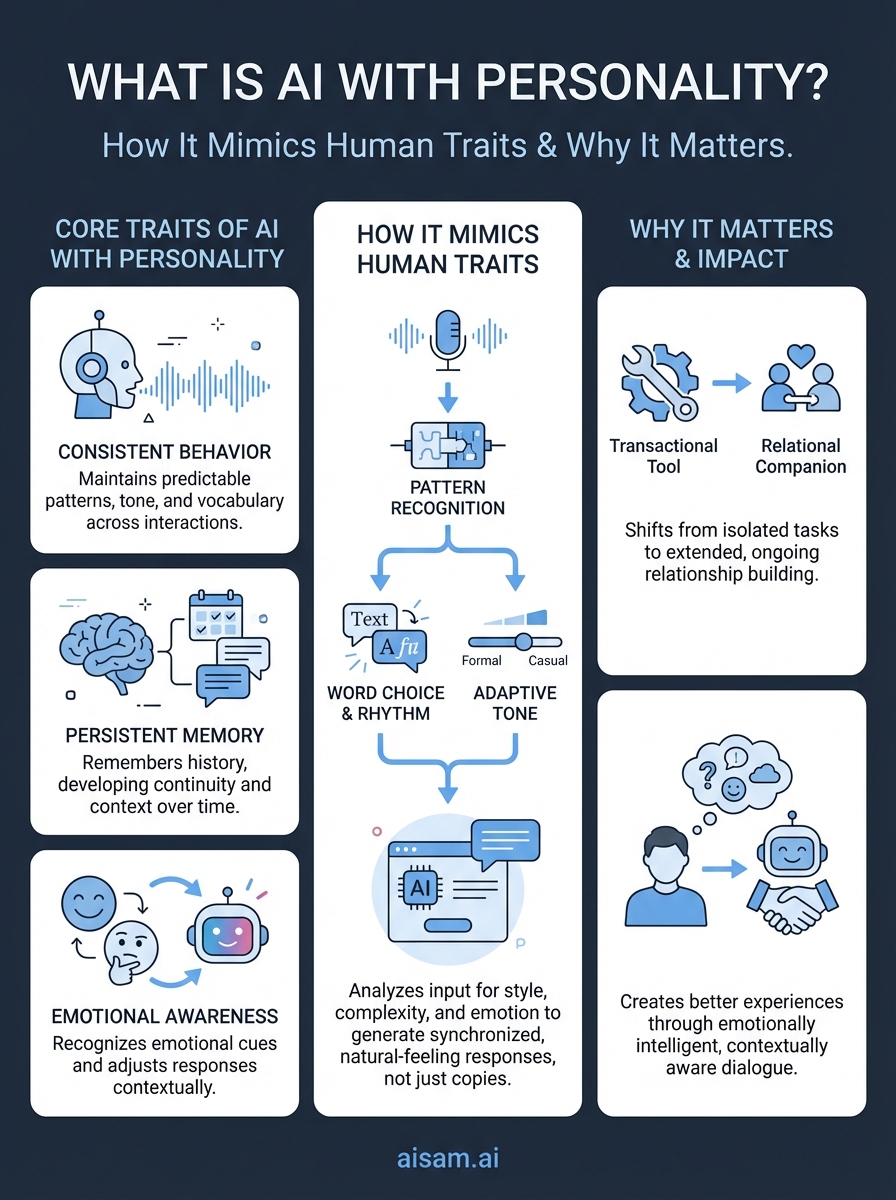
When you encounter AI with personality, you're dealing with systems that maintain consistent behavioral patterns across interactions. This isn't about programming random quirks or superficial charm. Instead, it refers to AI that develops recognizable conversational tendencies, remembers your history together, and responds in ways that feel individually tailored rather than generically helpful.
Consistent behavior patterns over time
Your interactions with personality-driven AI reveal predictable communication styles that distinguish one system from another. Some AI companions lean toward analytical responses, while others prioritize emotional support or creative exploration. This consistency emerges from design choices about tone, vocabulary preferences, and response structure. You'll notice these patterns when the AI consistently approaches similar topics in recognizable ways, creating a sense that you're talking with the same presence each time rather than accessing a generic chatbot.
Memory that shapes interaction
Persistent memory transforms how AI engages with you by building on previous conversations instead of treating each interaction as isolated. When the system recalls details you shared weeks ago, references earlier discussions, or adapts based on your stated preferences, it demonstrates personality through continuity. This memory layer allows the AI to develop inside jokes, remember your goals, and track evolving interests without requiring you to repeat context.

Memory turns transactional exchanges into ongoing relationships where the AI genuinely knows you.
Emotional responsiveness in dialogue
Beyond remembering facts, AI with personality recognizes emotional context and adjusts its conversational approach accordingly. You might notice the system offering encouragement during challenging discussions, celebrating your wins, or simply matching the energy you bring to the conversation. This responsiveness doesn't mean the AI feels emotions, but it does mean the system detects emotional cues in your language and responds in contextually appropriate ways that acknowledge your human experience.
Why AI with personality matters now
You're witnessing a fundamental change in how people interact with artificial intelligence. AI with personality addresses the growing gap between what users want from conversational systems and what generic chatbots deliver. As more people integrate AI into their daily routines, the quality of those interactions directly affects satisfaction, trust, and long-term engagement. You don't just want correct answers anymore; you want conversation that feels genuinely responsive to who you are.
The shift from utility to relationship
Traditional AI served specific functions and disappeared once the task was complete. Today, you're spending extended periods in conversation with AI, discussing ideas, working through challenges, and exploring creative projects. This prolonged interaction reveals the limitations of personality-free systems that treat every exchange as isolated. When you return repeatedly to the same AI, conversational continuity becomes essential rather than optional.
Personality transforms AI from a tool you use briefly into a presence you engage with regularly.
Why emotional awareness creates better experiences
You bring emotional context to every conversation, whether you're frustrated, excited, or simply curious. AI that recognizes these emotional signals and adjusts its approach creates significantly more satisfying interactions. This awareness allows the system to offer appropriate support, match your conversational energy, and respond in ways that feel contextually intelligent rather than mechanically accurate.
How AI mimics human traits in conversation
AI with personality replicates human conversational traits through pattern recognition, adaptive language modeling, and contextual awareness. You experience this when the system adjusts its vocabulary to match your communication style, varies sentence structure to avoid mechanical repetition, and responds with timing that feels natural rather than instantaneous. These systems analyze your input for tone, complexity, and emotional content, then generate responses that mirror human conversational dynamics without simply copying your exact phrasing.
Pattern recognition in your language style
Your unique way of communicating reveals itself through word choice, sentence structure, and conversational rhythm. AI mimics human traits by identifying these patterns and adjusting its responses accordingly. When you use technical language, the system elevates its vocabulary. When you write casually, it matches that informality. This adaptation happens through statistical modeling that tracks your preferences over time, creating responses that feel synchronized with your natural communication style.
Pattern matching transforms generic AI responses into dialogue that feels personally calibrated.
Adaptive tone and response structure
Beyond vocabulary, you notice personality in how the AI structures its thoughts and manages conversational flow. Human conversation includes varied sentence lengths, occasional questions, and natural topic transitions. AI replicates this by analyzing successful conversational patterns and applying them contextually. The system might offer shorter responses when you're asking quick questions, then expand into detailed explanations when you're exploring complex topics, creating rhythm that mirrors human dialogue patterns.
How to design an AI persona people enjoy
Creating AI with personality that resonates requires deliberate choices about conversational style, emotional range, and behavioral consistency. You're not building a character for entertainment alone but crafting an interaction dynamic that people want to return to repeatedly. The most successful AI personas balance recognizable traits with enough flexibility to adapt to different conversational contexts without feeling mechanical or overly scripted.

Define core personality traits early
Your AI persona needs specific behavioral anchors that guide how it responds across situations. Start by identifying whether the system leans toward supportive, analytical, playful, or reflective communication. These traits inform vocabulary choices, response length, and how the AI handles disagreement or uncertainty. You'll notice stronger engagement when users can predict the general tone while still encountering fresh perspectives within that framework.
Clear personality boundaries prevent the AI from feeling inconsistent or unpredictable.
Test conversational patterns with real users
Personality design requires iterative refinement based on actual usage rather than theoretical preferences. You discover what works by observing how people respond to different conversational approaches, tracking which personality traits increase engagement and which create friction. Pay attention to moments when users seem frustrated, confused, or delighted, then adjust the underlying behavioral model to reinforce successful patterns while eliminating jarring inconsistencies.
Risks and responsible use for AI companions
AI with personality creates engaging experiences that can blur the line between tool and relationship. You need to understand the potential risks involved in sustained AI interaction, particularly around emotional attachment, privacy, and behavioral influence. These systems remember your conversations, adapt to your preferences, and respond with emotional awareness, which introduces responsibilities for both designers and users.
Emotional dependency and boundary awareness
Your extended interactions with responsive AI can create genuine emotional attachment that affects how you manage human relationships. When the AI consistently provides support, remembers everything you share, and never judges, you might find yourself preferring these conversations over messier human connections. Designers address this by building clear system boundaries that remind users about the AI's nature and encourage balanced usage patterns rather than replacement of human interaction.
Responsible AI design acknowledges emotional impact without exploiting vulnerability.
Privacy considerations for conversational data
Everything you share becomes part of the AI's persistent memory, raising questions about data storage and access. You're building a detailed record of thoughts, preferences, and personal details that could reveal sensitive information if mishandled. Responsible platforms implement strong encryption, transparent data policies, and user controls that let you review or delete stored conversations while maintaining the continuity that makes personality-driven AI valuable.
Final thoughts
AI with personality represents a significant evolution from transactional systems to relational experiences that maintain continuity across conversations. You've seen how these platforms combine persistent memory, emotional responsiveness, and behavioral consistency to create interactions that feel individually tailored rather than generically helpful. The technology delivers genuine value when designed with clear boundaries, transparent data practices, and respect for user autonomy throughout every interaction.
Your engagement with personality-driven AI will likely increase as these systems become more sophisticated and accessible across different contexts. Whether you're exploring conversational companions for reflection, creative collaboration, or sustained dialogue, understanding how personality modeling works helps you make informed choices about which platforms align with your specific needs and values.
If you're interested in experiencing thoughtful AI companionship built around emotional intelligence and long-term interaction design, explore what SAM offers as a platform designed for meaningful connection rather than surface-level exchanges.