
AI vs Chatbot: Key Differences, Examples, and Use Cases
Most people use the terms interchangeably, but AI vs chatbot is not a matter of semantics, it's a fundamental difference in how software understands and responds to you. One follows a script. The othe...
Most people use the terms interchangeably, but AI vs chatbot is not a matter of semantics, it's a fundamental difference in how software understands and responds to you. One follows a script. The other learns, adapts, and holds context across a conversation. Knowing which is which changes how you evaluate every product claiming to be "intelligent."
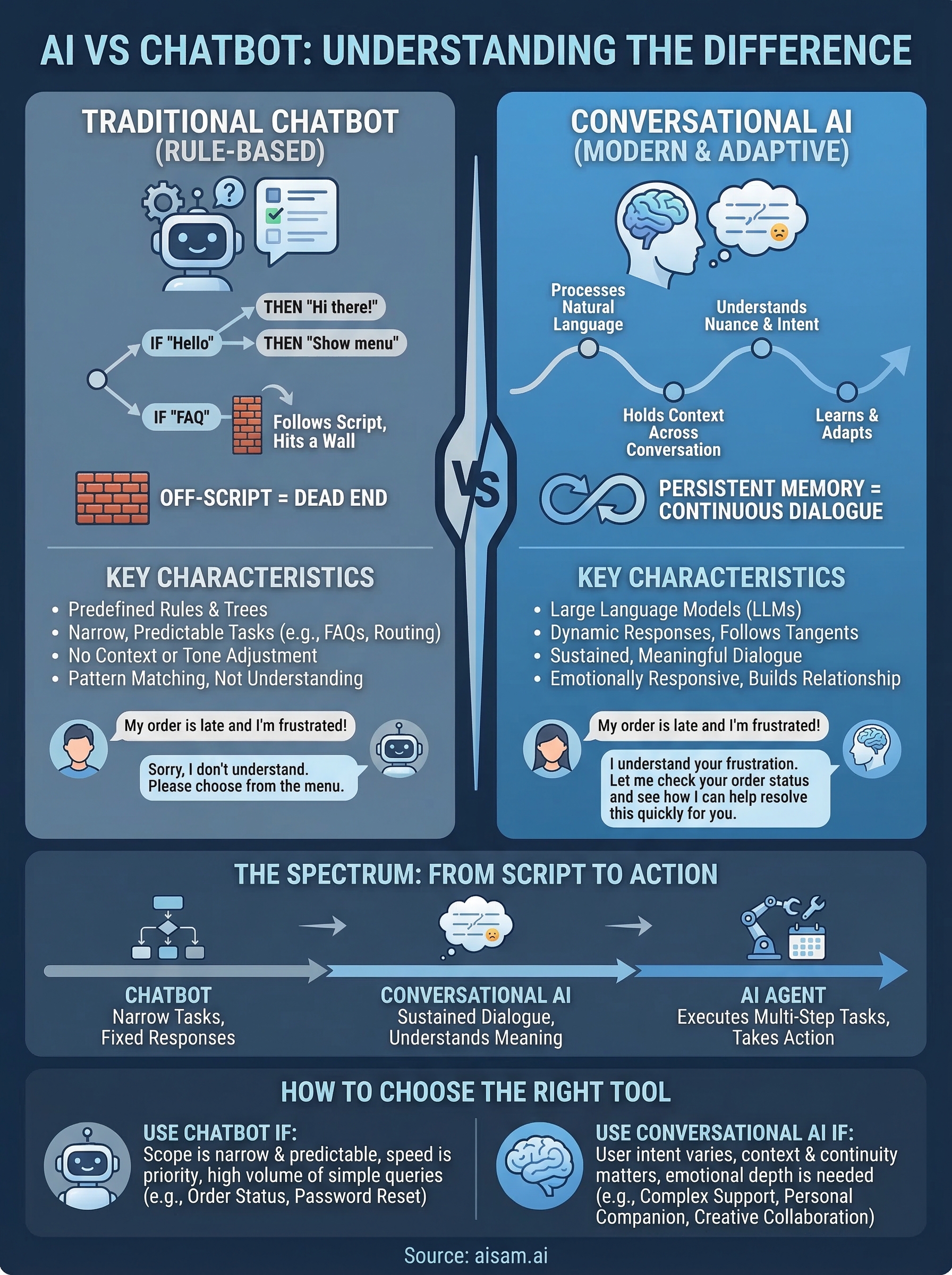
Traditional chatbots run on predefined rules and decision trees. They handle FAQs and simple routing well, but they hit a wall the moment a conversation goes off-script. Modern conversational AI, on the other hand, processes language dynamically, picks up on nuance, and can sustain meaningful dialogue over time, which is exactly the principle SAM is built on. As an AI companion platform with persistent memory and emotionally responsive conversation, SAM sits firmly on the AI side of this divide.
This article breaks down the core technical differences between chatbots and conversational AI, walks through real examples of each, and helps you identify which approach fits specific use cases, whether you're building for business or exploring AI for personal interaction.
Why the difference matters in real life
The ai vs chatbot distinction is not just a technical detail for developers. It directly shapes the quality of every interaction you have with software that claims to understand you. When you contact a business, use a virtual assistant, or explore an AI companion, the underlying architecture determines whether you get a genuinely useful response or a dead end.
When a script runs out of answers
Most people have hit this wall: you type a question that's slightly outside the expected format, and the chatbot responds with something irrelevant or loops you back to a menu. That happens because rule-based chatbots follow decision trees, not language. They match your input to a trigger word or phrase. If your phrasing does not match a recognized pattern, the system has no path forward.
The moment a conversation steps outside the script, a chatbot stops being useful and starts being a wall.
This is not a minor inconvenience. In customer-facing contexts, a failed chatbot interaction can push someone away from a product entirely. Research published through Google's AI research consistently points to user frustration as a core problem with rigid automated systems. The difference between a rule-based system and a conversational AI is the difference between a system that breaks at the edges and one that handles the unexpected without dropping context.
The gap between completing a task and holding a conversation
There is a real distinction between executing a command and sustaining a conversation. A chatbot can complete a task: book a table, answer a FAQ, confirm a shipping date. But it holds no memory of what you said earlier in the conversation and has no ability to adjust its tone or approach based on how the exchange is unfolding.
Conversational AI changes that. It processes your full input as language, not just as a trigger, and it carries context across the entire interaction. You can reference something from earlier and the system understands what you mean without you repeating yourself. That shift is what makes platforms like SAM possible: the design is built on persistent memory and conversational continuity, which means each session informs the next rather than starting from scratch.
Your use case matters here. If you are using an AI for emotional support, creative collaboration, or sustained dialogue, a chatbot will always feel mechanical because it is. Genuine conversational depth requires a system that tracks who you are, what you have discussed, and how the relationship has developed over time.
What a chatbot is and what AI means today
Before you can make sense of the ai vs chatbot comparison, you need a clear definition of each term. The word "chatbot" gets applied loosely to everything from a simple FAQ widget to a full conversational AI, which creates real confusion when you are trying to evaluate what a product actually does.
The anatomy of a rule-based chatbot
A chatbot is a program that responds to user input based on predefined rules, keyword triggers, or decision trees. It does not understand language in any meaningful sense. It scans your message for recognized terms and maps them to a pre-written response. If your input matches a known pattern, it returns the correct answer. If it does not match, the system either returns a fallback message or fails entirely.
A chatbot is not reading what you wrote. It is pattern-matching against a fixed list of expected inputs.
Chatbots work well for narrow, predictable tasks: routing support tickets, answering common billing questions, confirming store hours. They are fast to deploy and cheap to maintain as long as the conversation stays on the expected path.
What modern AI actually does
Modern conversational AI operates on an entirely different layer. Systems built on large language models (LLMs) process your input as natural language, generate responses based on statistical understanding of meaning, and maintain context across a conversation without requiring rigid pre-scripted paths. Microsoft's Azure AI and similar infrastructure-level platforms illustrate how broadly this technology now sits underneath everyday software.
The practical result is that AI can handle ambiguity, follow tangents, and adapt its responses based on what you have already said. That is not a small upgrade over a chatbot. It is a fundamentally different approach to how software interacts with human language.
Chatbot vs conversational AI vs AI agents
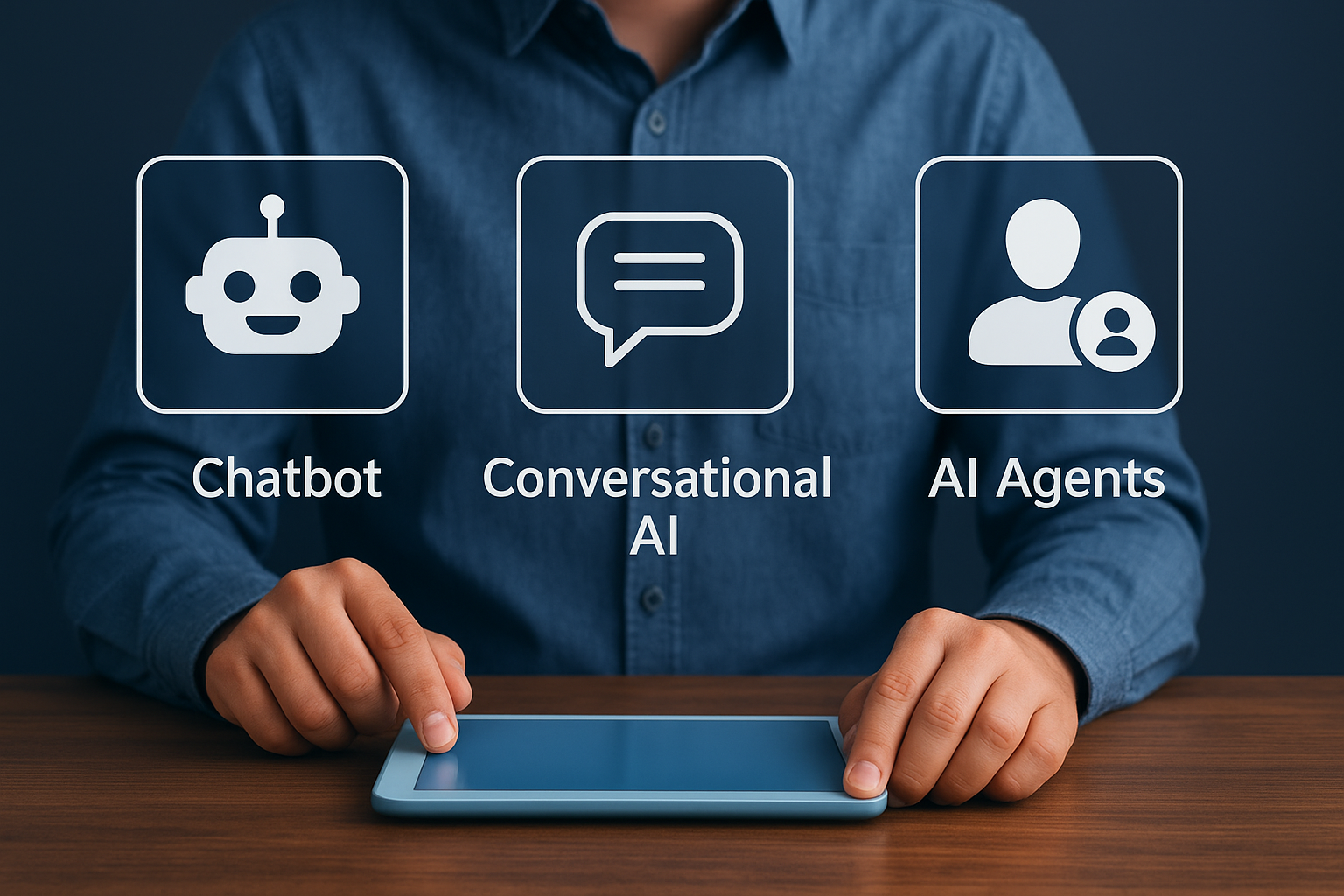
The ai vs chatbot debate gets more layered once AI agents enter the picture. These three categories sit on a spectrum, and understanding where each one fits helps you make a sharper decision about what kind of system you are actually dealing with or building toward.
Conversational AI: the layer above scripted responses
Conversational AI refers to systems that process natural language input and generate contextually relevant responses without relying on fixed decision trees. These systems use large language models to understand intent, carry context across a session, and respond to phrasing they have never seen before. The result is a dialogue that feels dynamic rather than mechanical. OpenAI's research has pushed this category forward significantly, and the gap between a basic chatbot and a conversational AI system is now substantial in practice.
Conversational AI does not just match words. It interprets meaning, holds context, and adapts as the exchange unfolds.
AI agents: systems that take action
AI agents move beyond generating responses into executing multi-step tasks on your behalf. An agent can plan a sequence of actions, use external tools, browse information, and complete goals that require more than a single reply. Think of it as conversational AI with an instruction set and the ability to follow through. Platforms like Microsoft Copilot demonstrate how agent-based design extends AI from answering questions into completing workflows.
The three categories have distinct purposes. Chatbots handle repetitive, narrow tasks efficiently. Conversational AI sustains meaningful dialogue with context and nuance. AI agents carry tasks to completion across multiple steps. Each serves a different need, and choosing the wrong layer for your goal creates the exact frustration that makes people distrust automated systems in the first place.
Examples and use cases by goal and setting
Understanding the ai vs chatbot distinction becomes much clearer when you look at specific goals and settings. The right tool depends entirely on what you need the interaction to accomplish, how much variation you expect in user input, and whether continuity across sessions matters to your situation.

Where chatbots work well
Chatbots perform reliably in settings where the scope of possible interactions is narrow and predictable. A chatbot handling order tracking, appointment confirmations, or password resets does not need to understand nuance. It needs to retrieve information fast and route the user correctly. In these cases, the simplicity of rule-based logic is an advantage, not a limitation.
The tighter the task boundary, the better a chatbot performs. The moment that boundary expands, you need something built for language.
| Setting | Task | Best fit |
|---|---|---|
| E-commerce | Order status, return requests | Chatbot |
| HR portals | Leave balance, policy FAQs | Chatbot |
| Healthcare scheduling | Appointment booking | Chatbot |
| Customer support | Complex troubleshooting | Conversational AI |
| Personal companionship | Ongoing dialogue | Conversational AI |
Where conversational AI fits better
Conversational AI belongs in any setting where user intent varies, context matters, or the interaction needs to develop over time. A customer trying to troubleshoot a technical problem rarely follows a script. They describe symptoms in their own words, circle back to earlier details, and expect the system to follow along without losing the thread.
Platforms built around long-term interaction and personal continuity, like SAM, represent the natural end of this spectrum. When the goal is a relationship rather than a transaction, conversational AI is not an upgrade over a chatbot. It is a completely different category of tool designed for a fundamentally different purpose.
How to choose the right option for your needs
Choosing between a chatbot and conversational AI comes down to three things: what the interaction needs to accomplish, how much variation you expect in user input, and whether continuity matters. The ai vs chatbot question is not about which technology is better in an absolute sense. It is about which one fits what you are actually trying to do.
Start with the scope of your use case
If your use case has a narrow, defined task boundary where users ask predictable questions, a chatbot handles that efficiently without unnecessary complexity. Think support ticket routing, basic FAQs, or form-based data collection. These interactions do not require the system to understand nuance or remember what was said two minutes ago.
The clearer your task boundary, the less you need conversational AI to do the job well.
Consider what happens when your users go off-script. If a mismatched input consistently breaks the experience, you have already outgrown a chatbot. That is the signal to move toward a system that processes language rather than pattern-matches against it.
Match the tool to the depth of interaction you need
For ongoing, emotionally layered conversations, conversational AI is not a luxury. It is the baseline requirement. If you are building or seeking something where the relationship between the user and the system should develop over time, persistent memory and natural language understanding are not optional features.
Ask yourself whether you or your users will return to the same conversation repeatedly. If continuity across sessions matters to the experience you are building or seeking, a rule-based chatbot will always feel like starting over. Conversational AI, and platforms designed around long-term sustained dialogue, are built specifically for the kind of interaction that makes repeated engagement worthwhile.
Next steps for picking the right tool
The ai vs chatbot comparison comes down to one practical question: what do you need the interaction to actually do? If your goal is narrow task automation, a rule-based chatbot gives you speed and simplicity without unnecessary complexity. If your goal involves sustained dialogue, emotional awareness, or long-term continuity, you need a system built specifically for that kind of depth.
Your next move is to map your use case against the criteria in this article. Think about how much variation you expect in user input, whether context needs to carry across sessions, and how much the relationship between user and system matters to the outcome. Those three factors will tell you more than any feature comparison list ever will.
If you are drawn to the relational side of AI, explore SAM's AI companion platform to see what persistent memory and emotionally responsive design look like when they are built around you from the start.