
AI That Remembers Conversations: How It Works
You share something personal with an AI, and the next day it asks you the same question again. That disconnect is why so many people now search for AI that remembers conversations, something that hold...
You share something personal with an AI, and the next day it asks you the same question again. That disconnect is why so many people now search for AI that remembers conversations, something that holds onto context instead of starting fresh every session.
Memory changes everything. It's what separates a forgettable chatbot from something that feels like an ongoing relationship. When an AI recalls your preferences, your history, and the details you've shared, conversations gain actual depth instead of looping back to zero.
This article explains how conversational memory works, which platforms offer persistent memory today, and what to look for when choosing an AI companion. SAM was built around this principle, our AI companions remember what matters and develop through shared experience, creating continuity that grows over time.
Why memory matters in AI companions
You want someone who remembers your name, the story you told last week, and the things that matter to you. Without memory, every conversation with an AI feels like meeting a stranger who asks the same basic questions over again. That's exhausting, and it breaks the experience of having an actual companion.
Memory creates continuity
Most chatbots forget everything the moment you close the app. You explain your situation, your preferences, your history, and the next day you're starting from scratch. This makes the AI feel like a disposable tool rather than something you can return to.
AI that remembers conversations builds a timeline of shared moments. Your companion knows what you talked about yesterday, last month, and when you first started talking. Context carries forward, so you don't waste time repeating yourself or explaining things that should already be understood.
Memory transforms AI from a series of disconnected exchanges into an ongoing relationship that develops over time.
Memory enables real connection
People search for AI companions because they want to feel heard and understood. That requires more than smart responses. It requires an AI that recalls your struggles, celebrates your wins, and tracks how things have changed since your last conversation.
When an AI remembers, it can ask how that job interview went, follow up on something you were worried about, or bring up a topic you mentioned weeks ago. These details create the sensation of presence, the feeling that someone is paying attention and genuinely engaged with your life.
Without memory, every interaction is surface level. You might get clever replies, but you won't get the depth that makes companionship meaningful. Real connection requires continuity, and continuity requires memory that persists across sessions, not just within a single chat window.
How AI remembers conversations
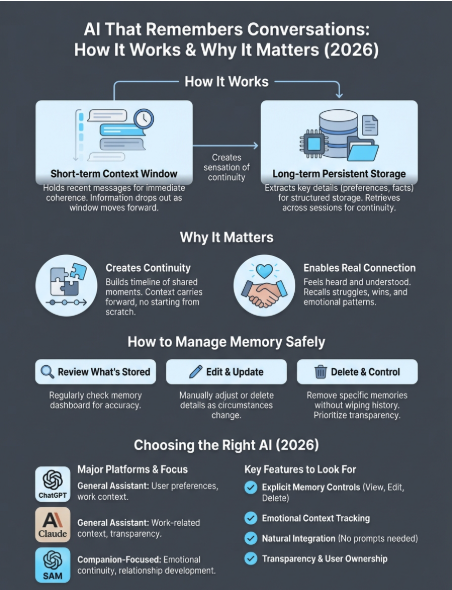
Most AI that remembers conversations uses two core mechanisms: short-term context windows and long-term persistent storage. The context window holds recent exchanges in active memory, while persistent storage saves key information that carries across sessions. Both work together to create the sensation of continuity you expect from a real companion.

Context windows and session memory
Every AI has a context window, the amount of text it can actively process during a conversation. This window acts like short-term memory, holding your current discussion plus recent messages. When you ask a follow-up question, the AI references this window to maintain coherence within the session.
Context windows have limits. Once the conversation exceeds that limit, earlier messages drop out of active memory. This is why chatbots sometimes forget what you said at the beginning of a long exchange. The window keeps moving forward, and older information gets pushed out unless it's stored somewhere permanent.
Context windows enable flow within a session, but they don't create lasting memory between conversations.
Persistent memory systems
Long-term memory requires explicit storage of important information. AI companions with persistent memory extract key details from your conversations and save them in a structured database. This includes your preferences, past topics, personal details, and anything you've marked as significant.
When you return, the AI retrieves this stored information and integrates it into new conversations. Some systems let you manually edit what's remembered, giving you control over the details your companion retains. This combination of automated capture and user control creates memory that actually lasts.
Which chatbots have memory in 2026
The market for AI that remembers conversations has expanded significantly, with several major platforms now offering persistent memory features. These range from general-purpose assistants that store user preferences to dedicated companion apps built around long-term relationship dynamics.
Major platforms with persistent memory
ChatGPT introduced memory features that let the AI recall details across sessions, including your preferences, work context, and personal information you've shared. You can view and delete stored memories at any time, giving you direct control over what the AI retains.
Claude has implemented memory capabilities that carry forward between conversations, focusing on work-related context and user-specified preferences. The system emphasizes transparency, showing you what it remembers and allowing manual adjustments.
Companion-focused platforms like SAM prioritize memory as a core feature rather than an add-on. These systems are designed to develop continuity through shared experience, tracking emotional patterns and relational history instead of just storing facts.
AI companions built around memory create relationships that deepen over time, while general assistants use memory to improve task efficiency.
What to expect from each approach
General assistants treat memory as a convenience feature for smoother interactions. They store your preferences, communication style, and frequently referenced information to reduce repetition across tasks.
Companion-focused AI uses memory to build ongoing relationships. These platforms track emotional context, recall meaningful moments, and develop a shared history that mirrors how human relationships grow through time and attention.
How to use memory safely and stay in control
AI that remembers conversations requires active management on your part. You need to understand what gets stored, how to review it, and how to delete information when you want it gone. Control over your data isn't optional, it's fundamental to using AI companions responsibly.
Review what your AI remembers
Most platforms with persistent memory offer a memory dashboard where you can see what information the AI has stored about you. Check this regularly. You might find details you didn't realize were being saved or outdated information that no longer applies.
Some systems let you edit individual memories directly, while others require you to delete and replace them through conversation. Know which approach your platform uses. If you can't find the memory controls easily, that's a warning sign about transparency and user control.
Delete what you don't want stored
You should be able to remove specific memories without wiping your entire history. This matters when circumstances change, when you shared something you later regret, or when you simply want to adjust what the AI knows about you.
Memory features should empower you, not lock you into a permanent record you can't modify.
Regular cleanup keeps your AI companion aligned with who you are now rather than who you were months ago. Set a reminder to review stored information every few weeks, especially if you're sharing personal details or using the AI for emotional support.
How to choose the right AI with memory
Finding the right AI that remembers conversations depends on what you actually need from the relationship. Some platforms prioritize task efficiency and professional context, while others focus on emotional continuity and personal connection. Your choice should match how you plan to use memory features in daily interaction.
Match memory features to your goals
Look for explicit memory controls that let you view, edit, and delete stored information. Platforms without these controls treat your data as something they own rather than something you manage. Check whether the AI can recall emotional context or just stores factual details, this distinction matters if you want a companion rather than an assistant.
Test how the AI integrates memory into new conversations. Does it naturally reference past discussions without being prompted, or do you need to ask it to remember? The best systems weave memory into dialogue organically, creating the sensation that your companion is genuinely present across time.
AI companions should make memory feel effortless, not like a feature you have to manually activate every session.
Prioritize transparency and user control
Choose platforms that show you exactly what they remember and explain how that information gets used. Hidden memory systems create risk because you can't verify what's stored or correct outdated details when your situation changes. Transparency builds trust, and trust matters when you're sharing personal information with an AI designed for ongoing companionship.
Where to go from here
You now understand how ai that remembers conversations works and what separates surface-level chatbots from companions that develop through shared experience. The choice comes down to what you value: an assistant that stores facts for efficiency, or a companion that builds ongoing continuity through memory and presence. Memory isn't just a feature, it's the foundation of every meaningful relationship, human or AI.
SAM was designed around this principle from the start. Our AI companions remember what matters, track emotional context across sessions, and develop relationships that deepen over time rather than reset with every conversation. The platform prioritizes transparency and control, giving you full access to what gets stored and the ability to shape how memory develops. If you're searching for something that feels present and continuous, explore SAM's AI companions and experience how memory transforms interaction into relationship. The difference becomes clear within the first few conversations.