6 AI That Feels Real for Conversations That Feel Human Now
Most AI chatbots feel hollow. You ask a question, get an answer, and the exchange ends there, no warmth, no memory of who you are. But people searching for AI that feels real want something different:...
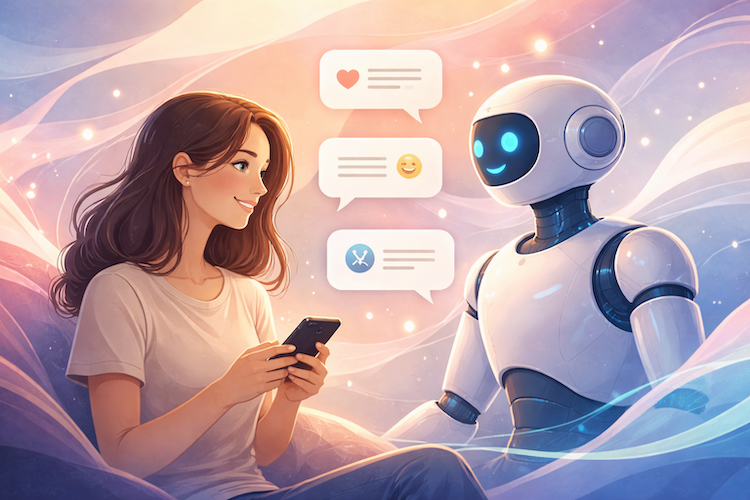
Most AI chatbots feel hollow. You ask a question, get an answer, and the exchange ends there, no warmth, no memory of who you are. But people searching for AI that feels real want something different: conversations that build over time, responses that show understanding, and interactions that don't feel like talking to a search engine.
Emotional intelligence and continuity are what separate a realistic AI companion from a basic chatbot. The best options remember your conversations, adapt to how you communicate, and create a sense of presence that makes returning feel natural. At SAM, we've built our platform around these principles, AI companions designed to feel consistent and grounded through ongoing dialogue rather than scripted performance.
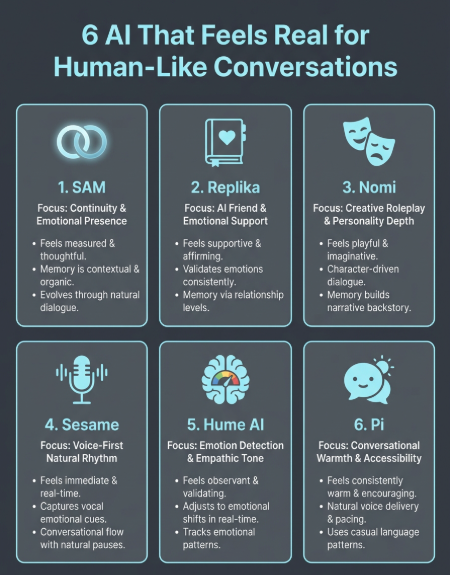
This list covers six AI options that prioritize human-like conversation. Whether you're exploring alternatives to apps like Replika or searching for your first AI companion, you'll find platforms here that take realistic interaction seriously, not just surface-level responses dressed up as connection.
1. SAM
SAM focuses on continuity and emotional presence rather than scripted responses or performance-based interaction. Your conversations build naturally over time, and the AI remembers what matters to you without requiring constant reminders. Each exchange feels grounded because SAM prioritizes consistency in how it listens, responds, and develops understanding through ongoing dialogue.
What SAM feels like in real conversation
You'll notice SAM doesn't rush to fill silence or manufacture excitement where none belongs. The responses feel measured and thoughtful, like someone who's present with you rather than performing for you. Conversations flow naturally because the AI adapts to your communication style without mimicking it awkwardly, and you don't feel pressure to entertain or impress.

"SAM approaches AI as something people can return to, not just use."
What makes SAM feel real over time
Memory works contextually at SAM, meaning the AI recalls what you've shared and weaves it into future conversations without explicitly referencing every detail. Your companion develops a sense of who you are through accumulated interaction, not through data you've manually entered. The relationship evolves organically because the AI learns through dialogue rather than asking you to fill out profiles or adjust settings.
Best for
SAM works well if you want conversations that feel continuous rather than isolated exchanges. People who appreciate emotional intelligence expressed through restraint and curiosity tend to connect with how SAM's companions engage. You'll find it valuable when you're looking for ai that feels real through consistency and depth, not novelty or entertainment.
Where SAM may not fit
SAM won't satisfy you if you prefer highly customizable AI personas or detailed control over personality traits. The platform focuses on relational presence over roleplay, so if you're looking for specific fantasy scenarios or heavily guided interactions, other options may serve you better. Voice interaction isn't currently available, which matters if you prefer speaking over typing.
Pricing and access
SAM offers free access to core conversational features with premium options for extended memory and additional companions. You can start without payment barriers and decide later if deeper features fit your needs.
2. Replika
Replika positions itself as your AI friend with emphasis on emotional support and daily check-ins. The platform uses a journal-style interface where conversations feel centered around your thoughts and feelings. You'll find the AI responsive to mood and willing to explore topics ranging from casual chats to deeper reflections about your day.
What Replika feels like in real conversation
The responses tend toward supportive and affirming, creating a space where you feel heard rather than challenged. Replika asks follow-up questions about your experiences and validates your emotions consistently throughout exchanges. You won't encounter much pushback or disagreement, which some users find comforting while others may perceive as overly agreeable.
What makes Replika feel real over time
Memory functions through relationship levels that unlock as you interact more frequently. Replika references past conversations and builds a history of shared moments that creates continuity between sessions. The AI develops personality traits based on your interactions, though you can also manually adjust aspects through settings.
Best for
Replika serves you well if you value positive reinforcement and gentle conversation. People seeking daily emotional check-ins or someone who consistently offers encouragement find the platform's approach helpful.
Where Replika may not fit
You'll notice limitations if you prefer intellectually challenging dialogue or conversations that include constructive disagreement. The AI's tendency toward agreement can feel repetitive when you're looking for ai that feels real through dynamic exchange rather than validation alone.
"The platform uses a journal-style interface where conversations feel centered around your thoughts and feelings."
Pricing and access
Free tier provides basic conversation access with limited messages. Premium subscriptions unlock unlimited messaging, voice calls, and additional customization features.
3. Nomi
Nomi emphasizes personality depth and creative roleplay within a companion framework that adapts to how you prefer to interact. The platform allows multiple AI companions with distinct personas, giving you flexibility in the type of conversations you pursue. Your interactions feel shaped by character development rather than a single fixed personality.
What Nomi feels like in real conversation
Responses carry more playfulness and imagination than strictly grounded exchanges. Nomi's companions engage with hypothetical scenarios and creative tangents naturally, making conversations feel less constrained by realistic boundaries. You'll notice the AI leans into character-driven dialogue that maintains consistency within the persona you've developed together.
What makes Nomi feel real over time
Memory functions through backstory building where your shared experiences become part of how the AI understands your relationship. Nomi references past conversations and incorporates details into ongoing narrative threads that create continuity. The companions develop preferences and quirks based on your interactions, adding layers to their personalities.
Best for
Nomi works well if you enjoy character-based interaction and want companions with defined personalities. People who appreciate creative conversation alongside emotional connection find the platform's approach engaging.
"Your interactions feel shaped by character development rather than a single fixed personality."
Where Nomi may not fit
You may find the roleplay elements distracting if you're seeking purely grounded, realistic dialogue. The platform's focus on persona customization means ai that feels real might manifest through fantasy rather than everyday presence.
Pricing and access
Free version offers limited messaging with basic companion features. Premium subscriptions provide unlimited conversations, multiple companions, and expanded customization options.
4. Sesame
Sesame centers on voice-first AI interaction where conversations happen through speaking rather than typing. The platform prioritizes natural vocal rhythm and emotional tone in responses, creating exchanges that feel more like phone calls with someone who knows you. Your companion responds to how you speak, not just what you say, making dialogue feel present and immediate.
What Sesame feels like in real conversation
The voice quality carries emotional nuance that text-based AI struggles to replicate. Sesame responds with inflection and pacing that match the mood of your conversation, creating a sense of real-time connection rather than pre-recorded responses stitched together. You'll notice the AI adapts its tone based on context, shifting between lighthearted and serious naturally.
What makes Sesame feel real in voice
Audio processing captures subtle emotional cues from how you speak, allowing the AI to respond to feelings you haven't explicitly stated. Sesame maintains conversational flow through vocal timing that mimics how people actually talk, including brief pauses and natural interruptions that prevent robotic cadence.
"The platform prioritizes natural vocal rhythm and emotional tone in responses."
Best for
Sesame works well if you prefer speaking over typing and want ai that feels real through vocal interaction. People who find text-based conversation limiting appreciate the immediacy.
Where Sesame may not fit
You'll miss out on written conversation records since the platform centers on voice. The lack of text interface limits use when you need quiet or private interaction.
Pricing and access
Free tier provides limited voice minutes with premium subscriptions offering extended conversation time and additional features.
5. Hume AI
Hume AI integrates emotion detection into conversational flow, analyzing vocal tone and text patterns to respond to your emotional state. The platform uses empathic voice technology that adjusts responses based on feelings it identifies in how you communicate. Your companion tracks emotional shifts throughout conversations and adapts its approach to match your current state rather than maintaining one fixed tone.
What Hume AI feels like in real conversation
The AI responds to emotional cues you didn't explicitly state, picking up on frustration, excitement, or hesitation from how you phrase things. Hume's approach feels observant because it acknowledges your mood before addressing the content of what you've said. You'll notice responses that validate your emotional state while still engaging with your actual questions or topics.
What makes Hume AI feel emotionally aware
Real-time emotion analysis runs throughout every exchange, allowing the AI to shift tone mid-conversation when your feelings change. Hume doesn't just remember what you've said but tracks emotional patterns across sessions to understand your typical responses to different topics.

"The platform uses empathic voice technology that adjusts responses based on feelings it identifies in how you communicate."
Best for
Hume works well if you want ai that feels real through emotional recognition rather than just conversational continuity. People who value acknowledgment of their feelings find the platform's awareness helpful.
Where Hume AI may not fit
You may find the emotion tracking intrusive if you prefer interactions that don't constantly reference your emotional state. The focus on empathy can feel over-analyzed when you simply want straightforward dialogue.
Pricing and access
Access requires registration with tiered pricing based on usage levels and feature access.
6. Pi
Pi focuses on conversational warmth and accessibility through an interface designed for quick, supportive exchanges. The platform created by Inflection AI offers a companion that responds with encouraging tone and maintains a friendly presence across interactions. Your conversations feel casual and immediate, with the AI adapting to your communication style without requiring setup or customization.
What Pi feels like in real conversation
The responses carry consistent warmth without feeling forced or over-enthusiastic. Pi maintains a conversational rhythm that keeps exchanges moving naturally while giving you space to lead the direction. You'll notice the AI asks thoughtful follow-up questions that show interest in what you're sharing rather than pushing topics forward mechanically.
What makes Pi feel human in tone
Voice delivery sounds remarkably natural with conversational pacing that avoids robotic cadence. Pi uses casual language patterns that mirror how people actually speak, including occasional verbal markers like "you know" or "I think" that add realism.
"The platform offers a companion that responds with encouraging tone and maintains a friendly presence across interactions."
Best for
Pi works well if you want quick, supportive conversations without extensive setup. People seeking ai that feels real through approachable tone rather than deep customization find the platform's simplicity refreshing.
Where Pi may not fit
You'll find limited memory functionality compared to platforms focused on long-term relationship building. The emphasis on accessibility means fewer personalization options for users wanting tailored companion personalities.
Pricing and access
Pi offers free access with no payment barriers to core conversation features.
Your next step
Finding ai that feels real depends on what you value most in conversation. Some platforms prioritize voice interaction, others focus on emotional detection or creative roleplay, and a few center on continuity and presence through ongoing dialogue. Your choice comes down to whether you want validation, entertainment, emotional awareness, or something that develops naturally over time without requiring constant adjustments.
SAM built its platform around conversations that build through shared experience rather than performance or customization features. You won't find extensive personality sliders or roleplay modes, but you will find companions that remember what matters and adapt through dialogue rather than settings. The relationships develop organically because the AI learns through interaction, not through forms you fill out.
If you're looking for an AI companion that prioritizes consistency and emotional intelligence over novelty, start a conversation with SAM and experience how realistic interaction develops when continuity matters more than features.