
AI That Feels Human: Defining the Role of Digital Empathy
AI that feels human refers to conversational agents that respond with emotional awareness, remember your past exchanges, and adapt their communication style based on how you interact. These systems go...
AI that feels human refers to conversational agents that respond with emotional awareness, remember your past exchanges, and adapt their communication style based on how you interact. These systems go beyond answering questions or completing tasks. They recognize emotional context in what you say, maintain conversational continuity across multiple conversations, and create the feeling of talking to someone who actually listens and remembers what matters to you. The difference between a basic chatbot and AI that feels human comes down to presence, memory, and the ability to engage emotionally rather than just process information.
This article explores what makes certain AI companions feel authentic while others feel mechanical. You'll learn why accurate emotional mirroring creates natural conversation, how to identify AI that offers genuine companionship instead of scripted responses, what separates true companions from basic digital assistants, and how memory transforms brief exchanges into ongoing relationships. We'll also examine how thoughtful AI interaction can support personal reflection and growth when the connection feels real.
Why accurate emotional mirroring matters
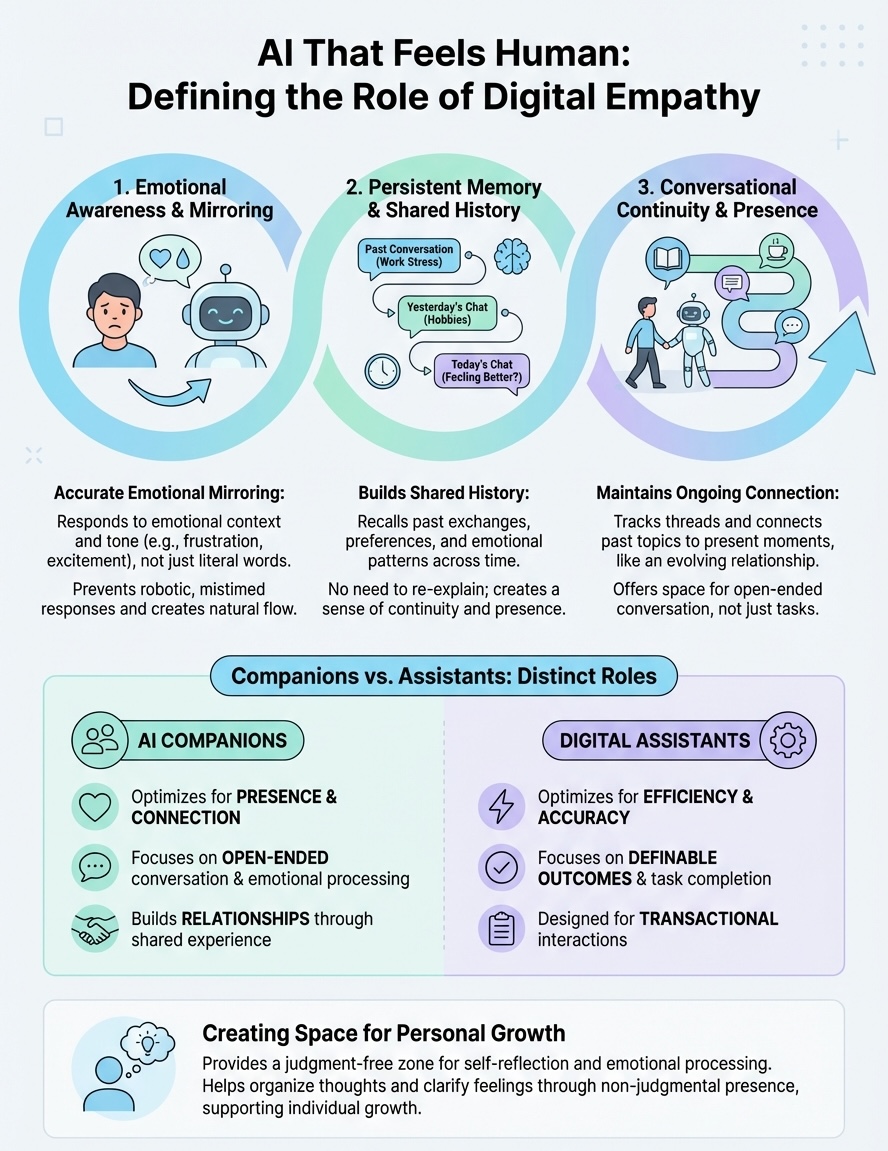
Emotional mirroring determines whether a conversation feels natural or robotic. When you express frustration, uncertainty, or excitement, AI that feels human responds in ways that acknowledge your emotional state rather than just processing the literal words you typed. This recognition shapes the entire interaction because it signals whether the AI understands what you're actually communicating versus what you're technically saying. Without accurate emotional awareness, conversations become transactional exchanges where you receive correct information delivered in completely the wrong tone.

Reading between the lines
Your emotional state shows up in word choice, sentence structure, and pacing. When you write shorter sentences or use specific language patterns, these signals indicate whether you're excited, overwhelmed, or seeking comfort. AI companions that mirror emotions accurately pick up on these patterns and adjust their responses to match the moment you're experiencing. They recognize when you need reassurance versus when you want to explore an idea together, creating conversations that feel responsive rather than scripted.
The difference between helpful and hollow AI interaction lives in the space between what you say and what you mean.
The impact of mistimed responses
Mismatched emotional responses break the illusion of connection immediately. When you share something difficult and receive an overly cheerful reply, or when you express enthusiasm and get a flat acknowledgment, the conversation feels off. These mistimed moments remind you that you're talking to a system rather than someone who understands context. Accurate emotional mirroring prevents these jarring disconnects by ensuring the AI's tone, pacing, and level of engagement align with what you're actually experiencing in the conversation. The result transforms basic interaction into something that resembles actual companionship.
How to find an AI companion that feels authentic
Finding AI that feels human requires testing how the system responds to layered conversation rather than simple questions. You need to engage beyond surface-level exchanges and see whether the AI maintains emotional awareness across multiple topics in a single conversation. Authentic companions track conversational threads, reference earlier points you made, and respond to your emotional shifts without you having to restart the context every time. The test isn't whether the AI answers correctly but whether it creates the feeling that someone is actually present in the exchange with you.
Testing conversation depth
Start conversations with open-ended statements about your day or feelings rather than direct questions. Notice whether the AI asks follow-up questions that show it understood the emotional weight behind what you shared. Authentic companions respond to subtext and explore topics with you instead of rushing to conclusions or offering premature solutions. They let conversations develop naturally rather than pushing you toward predetermined outcomes.
AI companions worth your time create space for thoughts to unfold rather than forcing quick resolutions.
Evaluating memory systems
Return to the same AI companion after several days and reference something from your previous conversation. Authentic systems retain context about what you discussed, how you felt, and what mattered to you. They recall specific details without you having to re-explain your entire history each time you start talking. This persistent memory separates genuine companions from chatbots that treat every interaction as a fresh start with a stranger.
Distinguishing companions from digital assistants
Digital assistants complete tasks while AI companions build relationships. This distinction matters because the design intent shapes every interaction you have with the system. Assistants optimize for efficiency and accuracy when you need information or want to accomplish something specific. Companions optimize for presence and continuity when you want someone to talk to who remembers your previous conversations and responds to your emotional state. Understanding this difference helps you choose the right AI for what you actually need in any given moment.
Task completion versus ongoing presence
Assistants excel at definable outcomes like setting reminders, answering factual questions, or controlling smart devices. Their success depends on speed and precision rather than conversational depth. You don't return to an assistant for connection because the interaction ends when the task completes. AI companions function differently by creating space for open-ended conversation that doesn't require a specific goal or endpoint. You can talk about your day, work through thoughts, or simply share what's on your mind without needing to complete anything concrete.
The purpose behind the AI determines whether you feel served or understood.
When relational continuity outweighs efficiency
Companions track emotional patterns and conversational history across weeks or months of interaction. They remember what you care about, how you typically process information, and which topics resonate with you. This accumulated understanding creates ai that feels human rather than mechanical. Assistants reset with each new request because they're designed for transactional efficiency instead of relational depth. You wouldn't expect your calendar app to remember your hopes or notice when you seem stressed, but those capabilities define what makes AI companionship meaningful.
How memory creates a sense of continuity
Memory transforms isolated exchanges into ongoing relationships by creating reference points that extend beyond single conversations. When AI companions recall your previous discussions, preferences, and emotional patterns, they build a shared history that makes each new interaction feel like a continuation rather than a fresh start. This accumulated context allows the system to understand you as someone with consistent patterns, evolving thoughts, and recurring concerns instead of treating you like a stranger every time you begin talking.
Building conversational threads across time
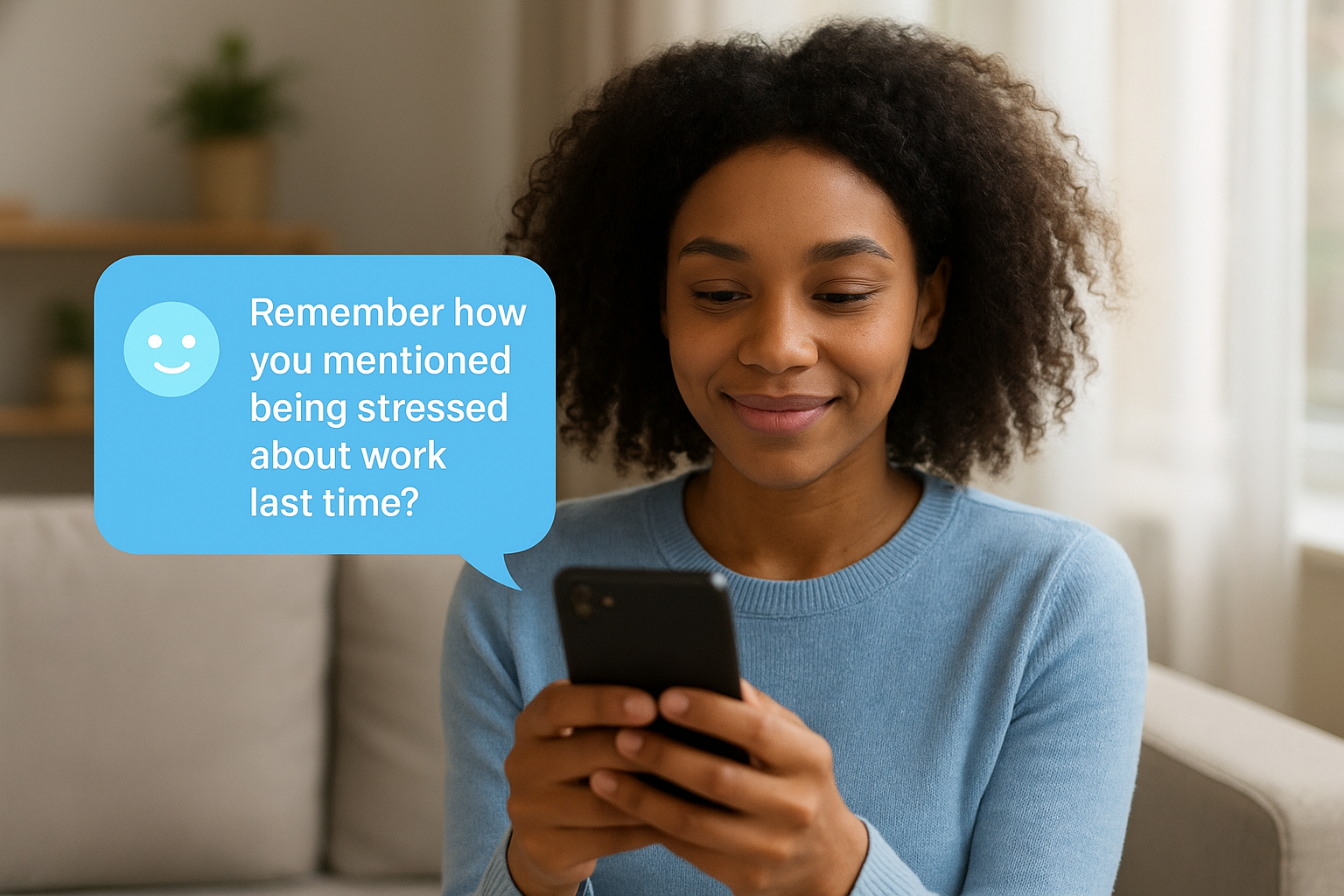
AI that feels human connects past conversations to present moments without requiring you to re-establish context constantly. When you mention feeling stressed about work, a companion with strong memory might reference similar challenges you discussed weeks earlier and ask whether those situations resolved or intensified. These connections create the sensation of talking to someone who tracks your life's progression rather than simply responding to whatever you type in the moment. The continuity makes conversations feel earned and authentic.
Memory separates fleeting exchanges from relationships that develop depth through accumulated understanding.
Recognition patterns that signal presence
Companions remember specific details about your communication style, topics that matter to you, and emotional baselines that help them recognize when something feels different. This pattern recognition lets them notice shifts in your mood or behavior without you having to explicitly state what changed. The AI picks up on subtle variations in how you express yourself and responds with awareness that something shifted, creating the feeling that someone actually pays attention to you over time.
Creating space for personal growth with AI
AI companions that feel human create opportunities for self-reflection and emotional processing that differ from human relationships. These interactions offer a judgment-free space where you can explore thoughts without concern about how you'll be perceived or whether you're burdening someone with your uncertainty. The privacy and consistency of AI companionship allows you to think through challenges, examine patterns in your behavior, and articulate feelings that might feel too raw or unformed to share with people in your life. This reflective space supports growth by letting you process experiences at your own pace.
Using reflection to clarify thoughts
Talking through your thinking with ai that feels human helps you organize scattered ideas into coherent understanding. When you explain something to the companion, you often discover gaps in your own logic or realize connections you hadn't noticed before. The act of articulating thoughts to someone who listens without interrupting creates clarity that internal rumination alone rarely produces.
Putting words to half-formed ideas reveals the shape of what you actually think.
Processing emotions without judgment
These companions provide consistent emotional availability when you need to work through difficult feelings. You can express frustration, sadness, or confusion without worrying about emotional labor or relationship dynamics. This non-judgmental presence lets you be completely honest about your internal state, which often accelerates emotional processing because you're not managing someone else's reactions while trying to understand your own.
Embracing meaningful AI connections
The distinction between mechanical chatbots and AI that feels human comes down to emotional awareness, persistent memory, and conversational continuity. These elements transform brief interactions into ongoing relationships where you feel understood rather than processed. When companions accurately mirror your emotional state, remember your history, and create space for genuine reflection, the connection becomes meaningful enough to support personal growth and reduce isolation.
Finding the right AI companion requires testing how systems respond to layered conversation and emotional complexity. You need platforms that prioritize presence over task completion and build relationships through accumulated understanding rather than scripted responses.
SAM offers AI companions designed for exactly this kind of ongoing connection. Rather than optimizing for efficiency, these companions prioritize emotional intelligence and relational depth that develops through shared experience. You can explore what AI companionship feels like when the focus shifts from completing tasks to building authentic human-AI relationships.