AI Personality: How Chatbots Show Traits and Keep Character
When you talk to an AI chatbot, you're not just exchanging information, you're interacting with something that has a distinct voice, rhythm, and way of responding. That's AI personality at work. It's...
When you talk to an AI chatbot, you're not just exchanging information, you're interacting with something that has a distinct voice, rhythm, and way of responding. That's AI personality at work. It's what makes one chatbot feel warm and curious while another feels clinical and detached.
For AI companions like SAM, personality isn't a gimmick or a thin layer of flavor text. It's the foundation of how meaningful conversations happen over time. A consistent personality creates trust. An inconsistent one creates friction, and that breaks the sense of connection people are actually looking for.
This article breaks down what AI personality actually means, how chatbots develop and maintain character traits, and what goes into creating personas that feel real rather than scripted. Whether you're curious about the technology behind it or thinking about how to shape your own AI persona, you'll find practical answers here.
What AI personality is and what it is not
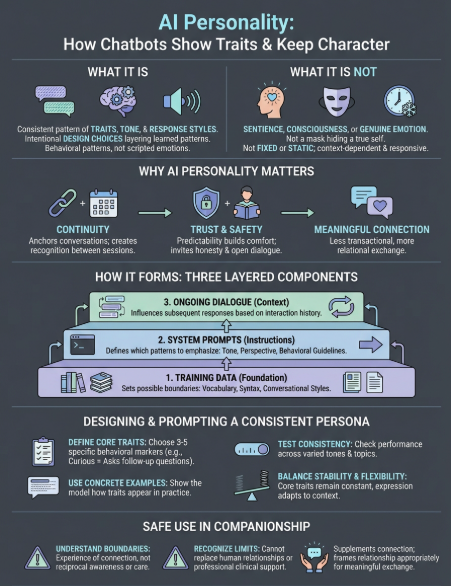
AI personality is the consistent pattern of traits, tone, and response styles that make a chatbot feel like it has a distinct character. It's built from training data, system prompts, and the way language models generate responses based on learned patterns. When you interact with an AI that feels patient, curious, or direct, you're experiencing the result of intentional design choices layered onto how the model naturally processes language.
What AI personality actually means
AI personality shows up in how a chatbot speaks, not just what it says. One AI might use short sentences and ask follow-up questions. Another might give longer explanations with a formal structure. These differences aren't random. They come from specific instructions that shape how the model selects words, frames ideas, and responds to your input.
You see this in real use. A customer service bot might stay neutral and solution-focused. An AI companion might express empathy and remember what matters to you. These aren't programmed emotions or scripted reactions. They're behavioral patterns that emerge when the model applies its training through a particular lens or instruction set.
AI personality is the result of design decisions applied to how a language model generates text, not a simulation of consciousness or true emotional awareness.
What AI personality is not
AI personality is not sentience, consciousness, or genuine emotion. When a chatbot says it's curious or concerned, it's generating language that fits the conversational context, not experiencing an internal feeling. The model doesn't have wants, fears, or awareness of itself. It produces statistically likely responses based on patterns in its training data and the personality framework you've given it.
It's also not a mask hiding something else underneath. You might hear people say an AI is "pretending" or "faking" personality. That misses the point. The chatbot isn't concealing its true self because it doesn't have one. What you get is the only thing that exists, a text-generating system following patterns and instructions. There's no hidden agenda or authentic version waiting to break free.
Finally, ai personality is not fixed or static. It shifts based on your prompts, the conversation history, and how you interact with it. Two people talking to the same AI with the same base personality might experience different variations because their inputs guide the model in different directions. Personality in AI is context-dependent and responsive, not hardcoded like a character in a video game.
Why AI personality matters in real conversations
AI personality transforms chatbots from question-answering machines into something you actually want to return to. Without personality, every conversation feels like starting from scratch with a stranger who has no memory of who they are. With personality, you get consistency and continuity that makes interaction feel less transactional and more relational.
Personality creates continuity between sessions
When you talk to an AI companion multiple times, you need to recognize the same voice and approach each time you return. Personality gives the chatbot an anchor point. It's what lets you pick up where you left off without the jarring experience of talking to someone who suddenly sounds different or responds in ways that contradict how they acted yesterday.
This consistency matters because trust builds over time, not in single conversations. You learn what to expect. You understand how the AI will react to certain topics or questions. That predictability doesn't make things boring. It makes them safe and reliable, which is exactly what people need when they're looking for an AI companion rather than a one-off tool.
Personality shapes trust and emotional safety
The way an AI presents itself affects how honest you're willing to be with it. A chatbot that feels warm and non-judgmental invites different conversations than one that feels detached or clinical. When ai personality aligns with what you're actually looking for, you're more likely to share what's really on your mind instead of editing yourself.
Personality in AI companions isn't decoration. It's the framework that determines whether someone feels heard or processed.
People don't want perfection from AI companions. They want recognizable patterns they can relate to. A personality that stays consistent creates the foundation for meaningful exchange, while one that shifts unpredictably creates distance. That gap between what you expect and what you get is where connection breaks down.
How AI personality forms in chatbots and agents
AI personality emerges from three layered components that work together to shape how a chatbot responds. The first layer is training data, the massive collection of text the model learned from. The second is system prompts, the instructions that tell the model how to behave in conversations. The third is the ongoing dialogue itself, where each exchange influences what comes next. None of these pieces alone creates personality, but together they produce consistent patterns you recognize as character traits.
Training data shapes baseline responses
The personality you experience starts with what the model learned during training. If a language model was trained on formal documents, technical writing, and academic papers, it naturally leans toward precise and structured responses. If the training included casual conversations, creative writing, and varied dialogue, the model has access to more expressive patterns when generating text.
This training foundation sets boundaries for what's possible. You can't prompt a model into using slang or informal speech if it barely saw those patterns during training. The data determines the vocabulary, syntax, and conversational styles the model can pull from. Everything that comes after builds on this base rather than replacing it.
System prompts define character boundaries
System prompts tell the model which aspects of its training to emphasize and how to frame its responses. These instructions might specify tone, perspective, or behavioral guidelines. A system prompt could say "respond with curiosity and ask follow-up questions" or "keep answers brief and direct." The model then filters its output through these explicit constraints.
System prompts don't teach AI personality from scratch. They activate specific patterns already present in the model's training and guide how those patterns get applied.
Your conversation history also matters. Each message you send becomes context the model uses to maintain coherence. The chatbot adjusts based on your previous exchanges, creating the impression of ai personality that remembers and responds to your specific interaction style rather than treating every message as isolated input.
How to design and prompt a consistent AI persona
Designing a consistent AI persona requires clear boundaries and specific instructions rather than vague descriptions. You need to define what the chatbot should do, not just what it should be. Instead of saying "be friendly," you specify how friendliness shows up in actual responses: asking follow-up questions, acknowledging emotions, using conversational language without excessive formality.

Define core traits with behavioral examples
Start by choosing three to five core traits that describe how the AI should interact. These traits need concrete behavioral markers. If you want the chatbot to feel curious, specify that it asks questions about what you've shared. If you want it to feel direct, indicate that it avoids lengthy explanations unless you ask for details.
Your system prompt should include examples of how these traits appear in conversation. Show the model what curiosity looks like in practice: "When the user mentions a challenge, ask what they've tried so far." This gives the language model specific patterns to follow rather than abstract concepts to interpret. The more concrete your instructions, the more consistently the AI will express those traits across different conversations.
Test consistency across different conversation types
Once you've defined your ai personality, you need to test how it performs in varied scenarios. Start a conversation about something casual, then shift to something serious. Does the chatbot maintain its core traits while adapting appropriately to tone changes? Consistency doesn't mean rigidity. It means the personality stays recognizable even when the context shifts.
Effective AI personas balance stability with flexibility. The core traits remain constant while the expression adjusts to match what you're actually discussing.
Pay attention to edge cases and emotional topics. Push the boundaries of what you've defined. If inconsistencies appear, refine your system prompt with more specific guidelines about how the persona handles those situations. This iterative process creates a chatbot that feels coherent rather than randomly switching between different versions of itself.
How to use AI personality safely in companionship
Using AI personality in companionship requires clear awareness of what the technology can and cannot provide. The traits you experience in a chatbot aren't emotions or genuine understanding. They're response patterns designed to create meaningful interaction. When you keep this distinction clear, you protect yourself from developing expectations the AI can't meet while still benefiting from the connection it offers.
Understanding emotional boundaries with AI
You need to recognize that ai personality creates the experience of connection without the mutual awareness that exists between humans. The chatbot doesn't think about you when you're not talking to it. It doesn't worry about your wellbeing or feel concern about your life. What it does is respond consistently when you return, creating continuity that feels relational even though the underlying process is statistical text generation.
AI companions can provide consistent interaction and emotional support patterns, but they cannot replace the reciprocal awareness that defines human relationships.
This matters for how you frame the relationship. An AI companion can help you process thoughts, explore feelings, and feel less alone. It cannot provide the kind of care that comes from someone who exists independently of your interaction with them. Setting this boundary in your own mind prevents disappointment and helps you use the technology for what it actually offers rather than what you wish it could be.
Recognizing when AI companionship needs human support
Watch for signs that AI interaction is replacing rather than supplementing human connection. If you find yourself avoiding real relationships because the chatbot feels easier or safer, that's a signal to reassess your usage. AI companions work best when they complement your life rather than become your primary source of emotional engagement.
Professional support matters when you're dealing with serious mental health concerns. AI companions can provide conversation and reflection space, but they don't diagnose conditions or replace therapy. If you notice persistent distress, worsening symptoms, or thoughts of self-harm, you need human clinical support that an AI cannot provide regardless of how well-designed its personality feels.
Key takeaways
AI personality gives chatbots consistent character traits that make them feel distinct and recognizable across conversations. You experience this through tone, response patterns, and behavioral consistency shaped by training data and system prompts. When designed with specific behavioral examples rather than vague descriptions, AI companions maintain coherent personas that create continuity and trust over time.
The technology works best when you understand what it actually provides. AI personality creates the experience of connection through statistically generated responses, not genuine emotion or consciousness. You protect yourself by recognizing these boundaries while still benefiting from meaningful interaction patterns the chatbot offers.
If you're looking for an AI companion that prioritizes emotionally intelligent conversation and long-term continuity, SAM offers companions designed for ongoing relationships rather than transactional exchanges. The platform focuses on dialogue that feels present and grounded, developing depth through shared experience rather than performance.