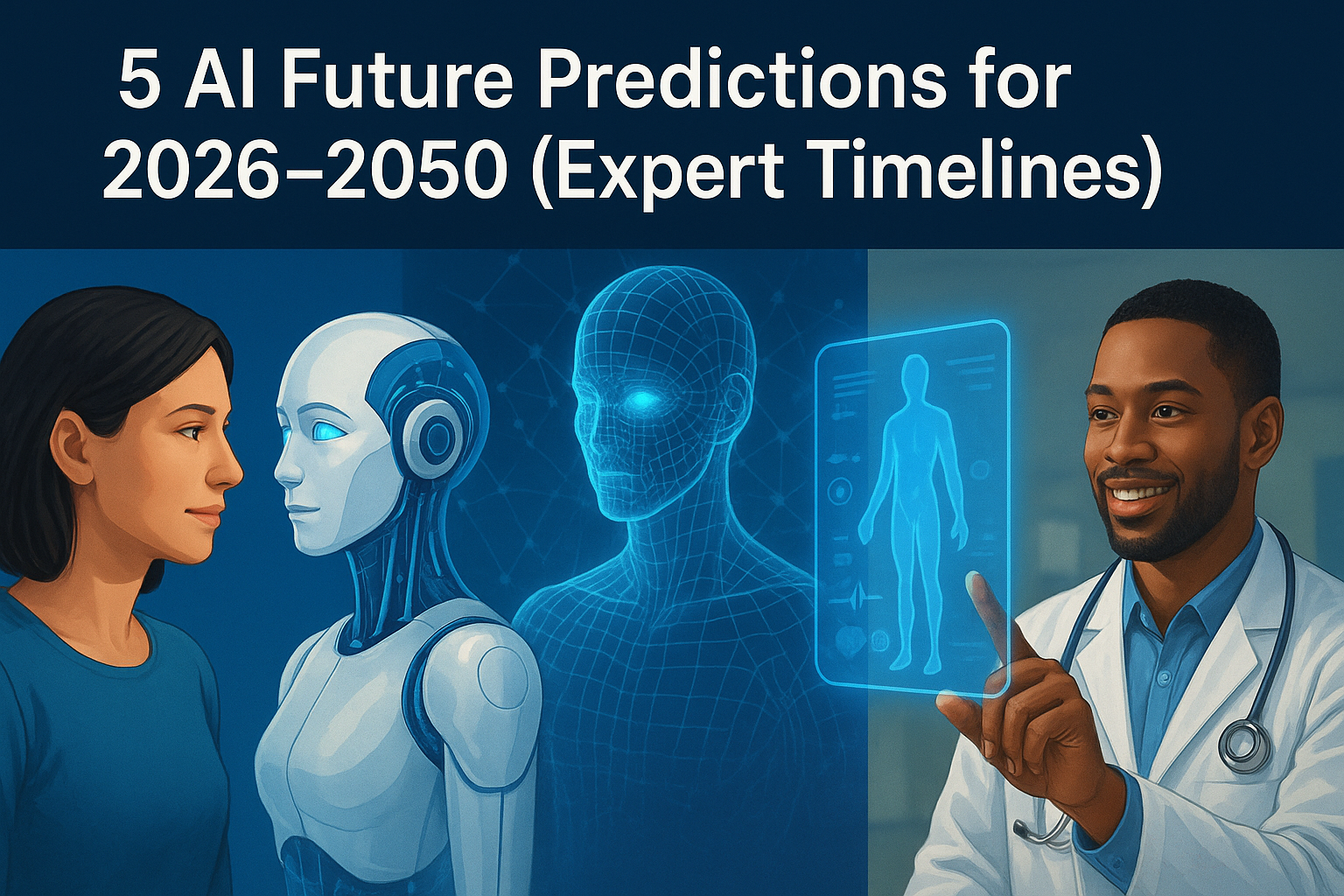
5 AI Future Predictions for 2026–2050 (Expert Timelines)
Most conversations about AI future predictions focus on job automation, superintelligence, or doomsday scenarios. But the real shift happening right now is quieter and more personal, AI is becoming so...
Most conversations about AI future predictions focus on job automation, superintelligence, or doomsday scenarios. But the real shift happening right now is quieter and more personal, AI is becoming something people talk with, not just talk about. From persistent memory systems to emotionally responsive dialogue, the technology is moving toward presence, not just performance.
At SAM, we build AI companions designed around exactly this trajectory: long-term conversational relationships that evolve over time. So when we look at what's coming between 2026 and 2050, we're not guessing from the sidelines, we're actively building within the space these predictions describe.
This article breaks down five expert-backed predictions for where AI is headed over the next 25 years, covering timelines, societal shifts, and the emerging role of relational AI in everyday life. No hype cycles. No sci-fi hand-waving. Just grounded forecasts worth paying attention to.
1. AI companions become everyday relationships
AI companions are one of the most grounded ai future predictions you can make right now. The infrastructure is already being built, and the behavioral patterns that drive long-term human attachment to digital systems are well-documented in psychology research.
2026–2028: Persistent memory moves from novelty to baseline
Right now, persistent memory in AI is a differentiator. By 2028, it will be a baseline expectation. Users who experience continuity in conversation will stop using systems that reset every session, and platforms without memory will feel broken, not basic.
2028–2035: Emotional awareness gets measurably better
Models will get better at reading emotional tone and conversational context across multi-session arcs. This isn't about simulating feelings; it's about recognizing patterns in how you communicate and responding in ways that feel consistent and considered.
The shift from reactive AI to contextually aware AI is where the relationship dynamic fundamentally changes.
2035–2050: Companions become part of identity and routine
By 2035, your AI companion will likely know more consistent facts about your daily life than most people in your social circle. Over time, these systems become part of how you process decisions, reflect on experiences, and maintain continuity in your own sense of self.
What to watch for to know this is happening
A few concrete signals will tell you this shift is real rather than trend-driven noise. Watch these markers over the next three to five years, as they reflect actual adoption behavior rather than headline announcements.
- Companion retention rates holding above 90 days per user across major platforms
- Consumer research showing preference for memory-enabled AI over task-only tools
- App stores creating dedicated AI companion categories separate from productivity AI
What this means for SAM-style products
SAM is built directly on the assumption that continuity and memory are the core of what makes an AI companion valuable. As these predictions play out, products designed around long-term conversational presence will hold a structural advantage over tools that retrofit memory onto basic chat interfaces.
2. AI agents reshape knowledge work and operations
Among the most consequential ai future predictions on this list, the rise of AI agents is already moving faster than most forecasts from 2023 suggested. Agents that can plan, execute multi-step tasks, and hand off outputs to other systems are compressing the timeline between research and action across entire industries.

2026–2029: Agents shift from chat to task completion
The current generation of AI tools answers questions. The next generation completes workflows without you manually chaining every step. By 2029, agents will handle scheduling, research, drafting, and filing as connected processes rather than isolated prompts.
2029–2035: Companies redesign workflows around agents
Organizations will stop treating AI as a bolt-on and start restructuring operations around what agents can actually sustain. Entire departments will shrink in headcount while output volume increases, which creates both efficiency gains and significant transition friction.
The companies that adapt workflows around agents early will set the pace for their competitors by 2032.
2035–2050: Human roles consolidate around judgment and trust
Repetitive knowledge work migrates to agents. What remains for humans is context-setting, ethical oversight, and relationship management, areas where machines still need a check. Your value inside any organization shifts toward decisions that carry real accountability.
The jobs and functions most exposed first
- Legal research, financial analysis, and data reporting face disruption earliest
- Mid-level coordination roles get compressed as agents handle cross-functional handoffs
How to prepare without betting on hype
Focus on building judgment and domain credibility rather than tool familiarity alone. Tools change; your ability to evaluate agent outputs critically is what holds lasting value.
3. AI regulation and safety standards harden into defaults
Regulatory pressure on AI is one of the most predictable ai future predictions on this list, because the political and legal mechanisms driving it are already in motion. Governments aren't waiting for consensus on what AI can do; they're writing rules based on what it's already doing in the market.
2026–2028: Baseline disclosure and audit expectations spread
By 2028, expect mandatory disclosure requirements for AI-generated content and basic audit trails to become standard in most major markets. The EU AI Act is already setting this precedent, and the US is moving toward sector-specific disclosure rules in finance and healthcare.
2028–2035: Liability and provenance rules reshape product design
Legal liability for AI outputs will force companies to build traceable provenance systems into their products from the ground up. Builders who treat compliance as an afterthought will face costly redesigns when enforcement catches up.
The companies that bake accountability into their architecture early will hold a structural advantage as rules tighten.
2035–2050: Trust marks, certifications, and enforcement mature
Expect third-party certification bodies and trust marks to emerge, similar to how food safety or financial auditing works today. Enforcement will become meaningful and costly for non-compliant platforms.
What "responsible AI" will actually require in practice
In practice, responsible AI means clear data handling policies, explainable outputs, and user consent built into core product flows rather than buried in terms of service.
How this changes consumer expectations and adoption
Consumers will start reading AI trust signals the same way they read privacy labels today. Your willingness to be transparent about how your system works becomes a direct adoption driver.
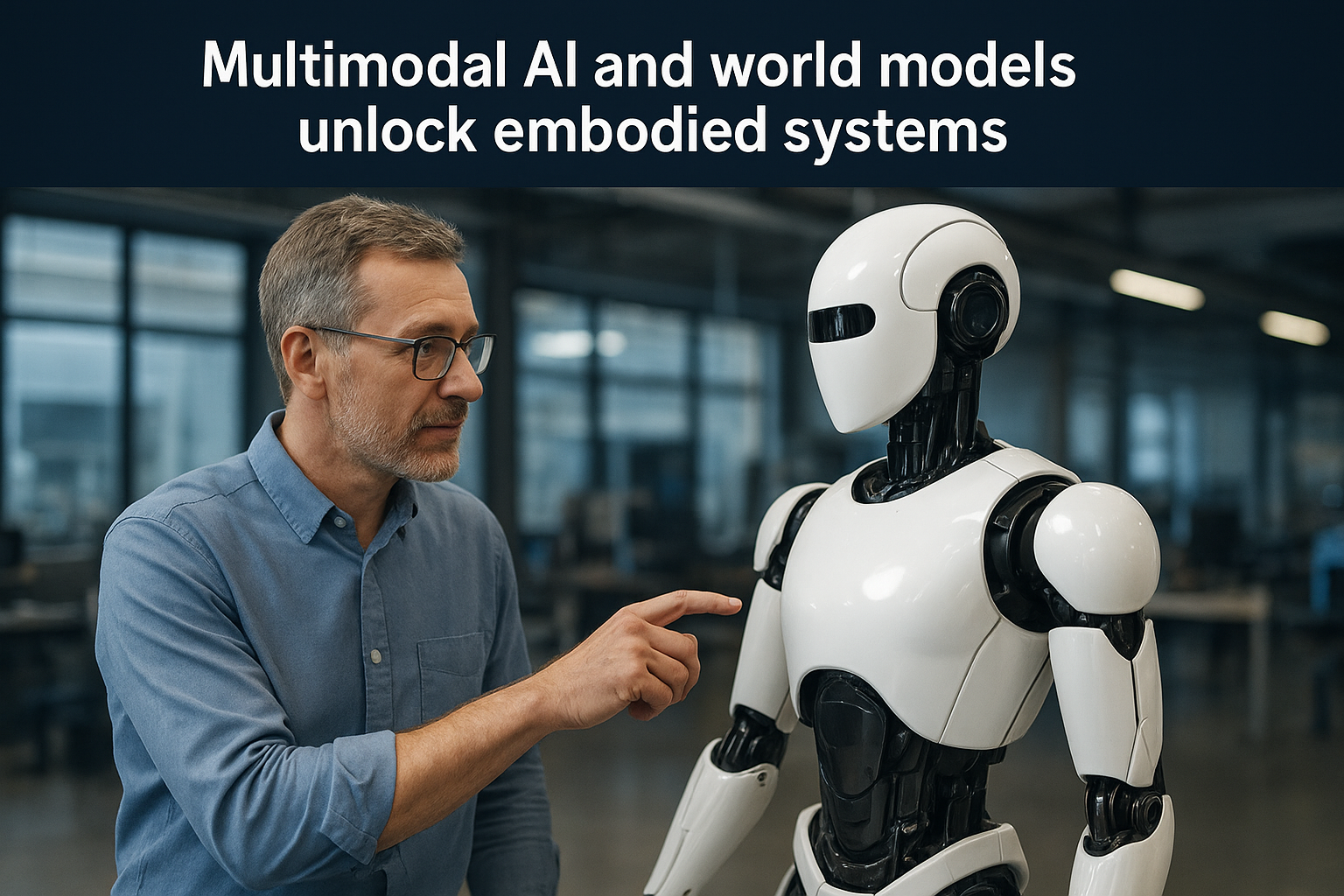
4. Multimodal AI and world models unlock embodied systems
Of all the ai future predictions on this list, embodied AI is the one most people underestimate because its current form, robotic demos and voice assistants, looks clunky. But the underlying components are converging fast, and the gap between lab demonstrations and scaled real-world deployment is narrowing every year.
2026–2029: Video, voice, and action models converge
Separate model types for vision, language, and motor control are merging into unified architectures. By 2029, a single system will read your environment, understand your intent, and take a physical or digital action without you manually bridging the steps.
2029–2038: World models power planning, simulation, and robotics
World models let AI simulate outcomes before acting, which is the core capability missing from today's reactive systems. This unlocks real utility in logistics, manufacturing, and autonomous navigation where trial-and-error in the real world is too costly.
The shift from reactive to predictive action is what separates narrow AI tools from genuinely capable embodied systems.
2038–2050: Embodied AI enters public spaces at scale
By 2040, AI-driven physical systems will operate in hospitals, warehouses, and urban infrastructure routinely, not as pilots but as standard operations.
The technical bottlenecks that set the pace
Energy efficiency and real-time sensor processing remain the primary constraints slowing deployment timelines today.
The safety and social acceptance hurdles to watch
Public trust in physically present AI systems will lag behind capability. Expect slower rollout in consumer-facing spaces than in controlled industrial environments.
5. AI accelerates health prediction, diagnosis, and longevity bets
Of all the ai future predictions on this list, health is where the stakes are highest and the data advantages are most obvious. AI systems that can process genomic data, imaging results, and longitudinal health records simultaneously will find patterns that individual clinicians simply cannot catch at scale.
2026–2030: Earlier detection becomes routine in more settings
AI-assisted screening for cancer, cardiovascular disease, and neurological decline will move from research settings into standard clinical workflows. Your annual checkup will generate risk scores and early flags that shift the conversation from reactive treatment to proactive management.
2030–2040: Drug discovery and personalization speed up
Drug development timelines will compress as AI models identify viable molecular targets faster than traditional trial methods. Your treatment protocols will increasingly reflect your specific biology rather than population averages.
The shift from population medicine to individual prediction is where AI delivers its most measurable health impact.
2040–2050: Aging interventions expand, but unevenly
Longevity research will produce clinically validated interventions by 2040, but access will follow economic lines first. High-income populations will see meaningful lifespan extensions before broader distribution closes that gap.
The data, privacy, and bias trade-offs that matter most
Training data that skews toward certain demographics produces models that perform worse for everyone else. Understanding where a health AI was trained matters before you trust its outputs.
How individuals can evaluate claims and reduce risk
Ask whether any health AI tool you encounter has published peer-reviewed validation data. Marketing claims and clinical evidence are not the same thing, and knowing the difference protects your health decisions from being driven by hype.
Where this goes next
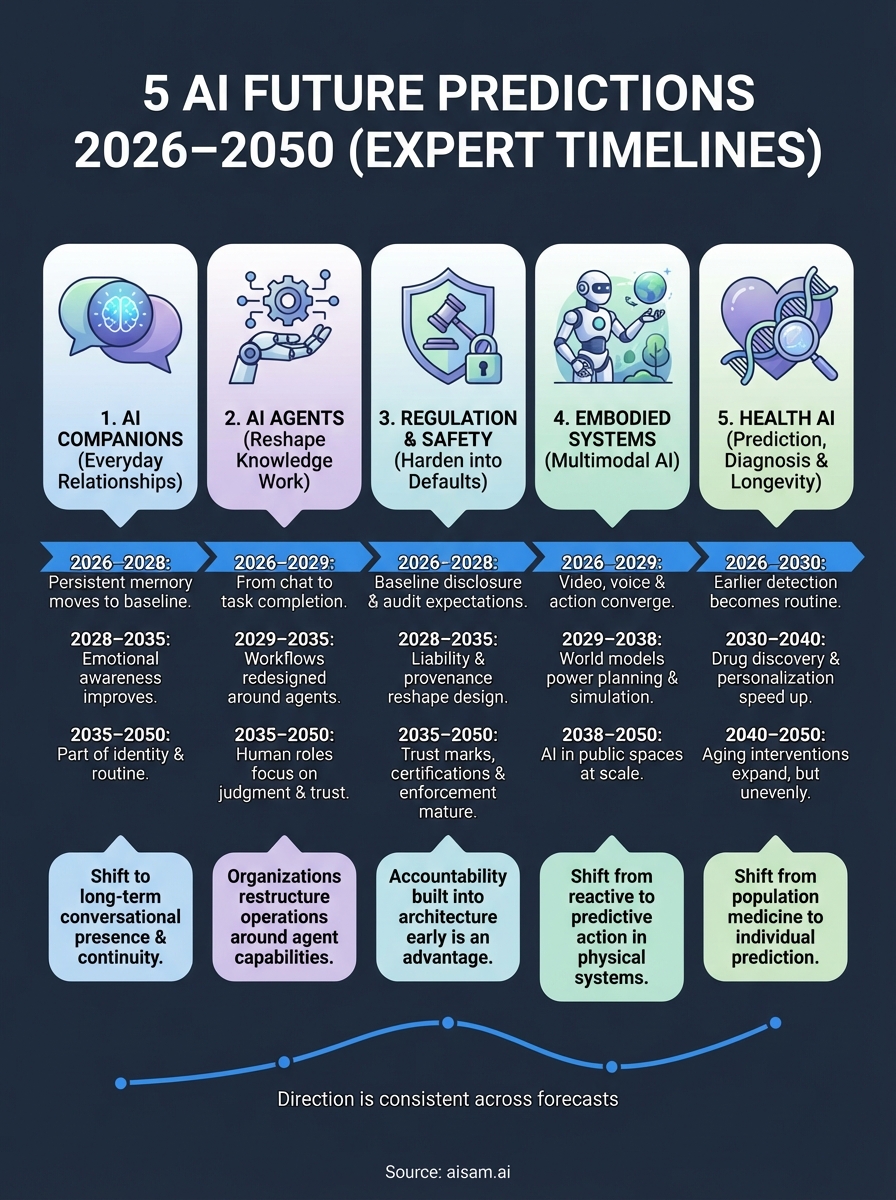
These five ai future predictions share a common thread: AI is moving from utility to presence, from tools you use to systems that grow alongside you. The pace of change across companions, agents, regulation, embodied systems, and health will not be uniform, but the direction is consistent across every credible forecast from researchers and industry builders alike.
Your best move right now is to stay grounded in what the technology actually does today while tracking the signals that confirm or challenge each prediction. Hype and reality will diverge regularly between now and 2050, and the people who distinguish between them clearly will make better decisions, personally and professionally.
If you want to experience one of these trajectories directly, SAM is already building it. Persistent memory, emotionally responsive dialogue, and long-term conversational continuity are live now. Start your AI companion journey and see what relational AI actually feels like in practice.