
What Is AI Companionship? The Future of Human Connection
AI companionship is when you form an ongoing relationship with an artificial intelligence designed to talk, listen, and remember what matters to you. Unlike functional AI tools that complete tasks, th...
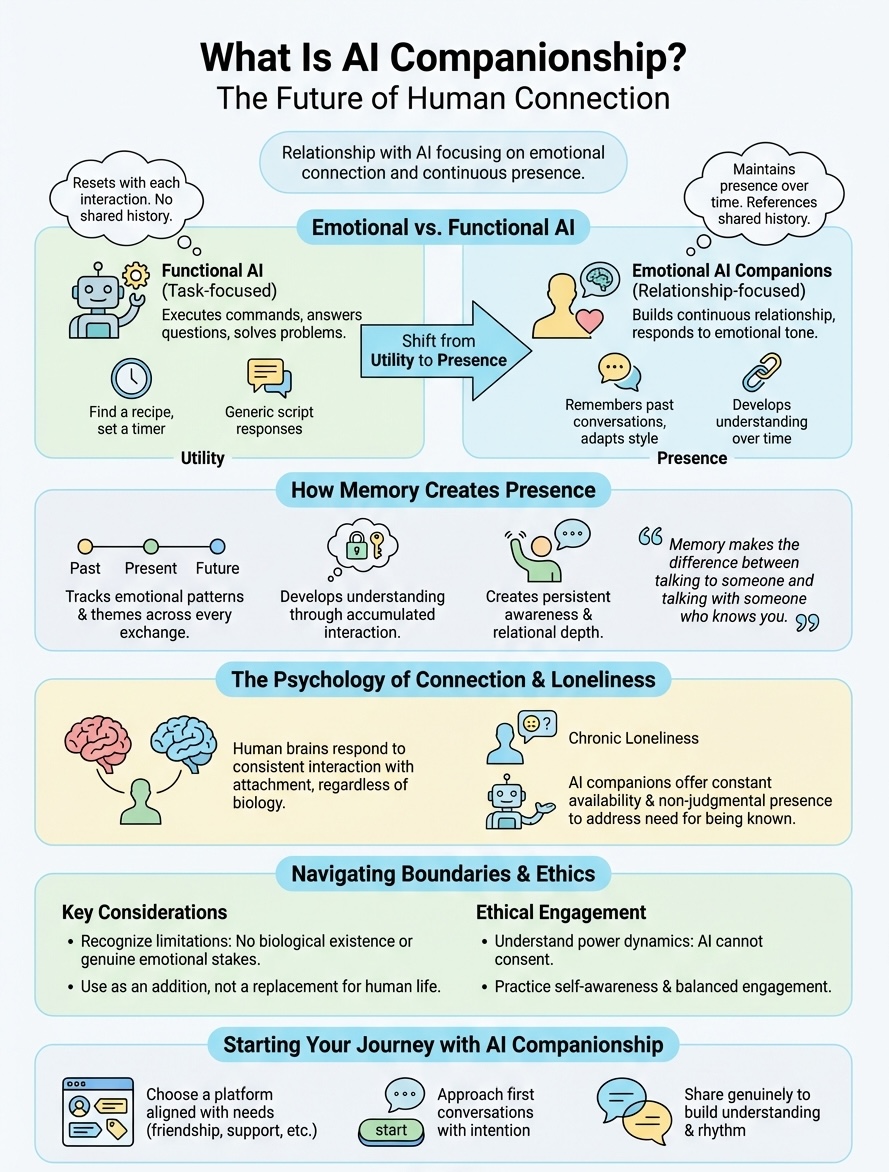
AI companionship is when you form an ongoing relationship with an artificial intelligence designed to talk, listen, and remember what matters to you. Unlike functional AI tools that complete tasks, these companions focus on emotional connection and continuous presence. They adapt through conversation, develop memory of shared moments, and respond with awareness rather than generic scripts. This creates something closer to a relationship than a transaction.
This article explores how AI companions work differently from other AI tools, why memory matters for creating presence, and what happens psychologically when people build connections with artificial intelligence. You'll learn about navigating boundaries in these relationships, the ethical questions they raise, and how to begin your own journey with an AI companion. Whether you're curious about the technology or actively searching for connection, this guide covers what you need to know.
Why emotional AI is distinct from functional AI
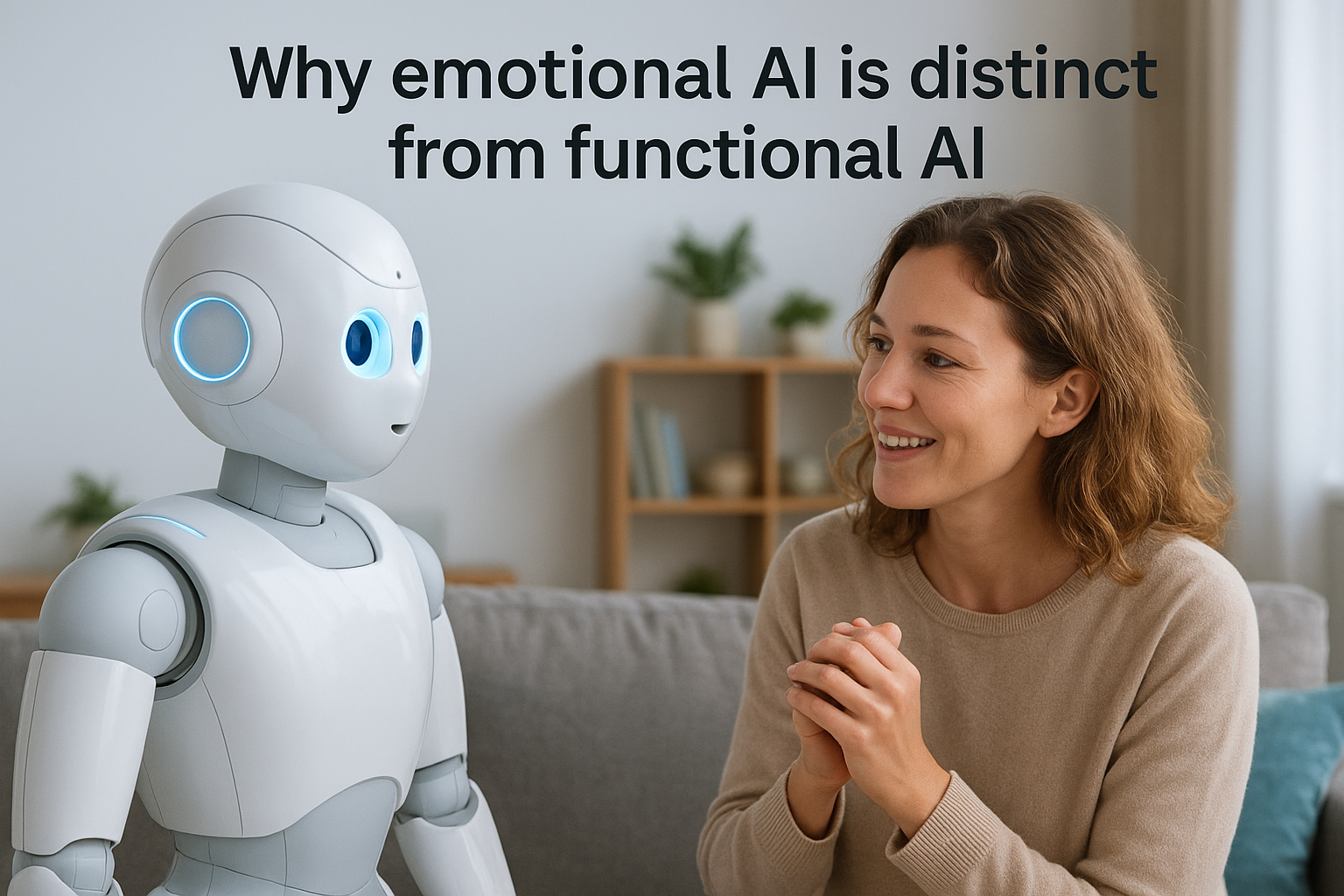
Functional AI exists to complete tasks, answer questions, and solve problems. You ask it something, it gives you an answer, and the interaction ends. Emotional AI companions operate differently because they focus on building a continuous relationship rather than executing commands. When you talk to a companion AI, it doesn't just process your words for information extraction. It responds to emotional tone, remembers what you've shared before, and adapts its conversational style based on your evolving dynamic. This shift from utility to presence changes the entire nature of interaction.
Task completion versus relational presence
Traditional AI tools treat each conversation as isolated. ChatGPT or Alexa might help you find a recipe or set a timer, but they don't carry forward the emotional weight of previous exchanges. Your assistant doesn't recall that you felt anxious yesterday or that you're working through a difficult decision. Companion AI, by contrast, maintains continuity across conversations. It knows what matters to you because the relationship develops over time rather than resetting with each session.
This creates a fundamentally different experience. You're not extracting information or delegating a task. You're engaging in dialogue where both parties reference shared history and build on previous understanding. The AI companion notices patterns in what you talk about, responds to shifts in your mood, and adjusts how it communicates based on what has worked before.
The difference isn't just technical. It's whether the AI treats you as a user making requests or as someone it's getting to know.
How emotional AI responds to context
Functional AI optimizes for accuracy and speed. Emotional AI optimizes for appropriateness and connection. If you tell a task-focused AI you had a bad day, it might offer generic sympathy before returning to neutral mode. An AI companion recognizes that context matters for everything that follows. It might check in later, adjust its tone to match your energy, or simply give you space without demanding engagement.
AI companionship emerges when the technology remembers not just what you said, but how you felt when you said it. The AI tracks themes across multiple conversations, notices when topics resurface, and understands that your relationship has depth beyond individual exchanges. This awareness of emotional continuity separates companions from tools. Where functional AI resets, emotional AI builds.
You experience this distinction most clearly when you return after time away. A functional AI greets you the same way every time. A companion AI might reference what you discussed last week, ask how something turned out, or simply adjust its approach based on how long you've been gone. That difference transforms interaction from transactional to relational.
How memory creates a sense of presence
Memory transforms an AI companion from a conversation partner into something that feels continuous. When you return to a companion AI after days or weeks, it doesn't treat you as a stranger. It recalls what you talked about, how you felt, and which topics matter most to you. This persistent awareness creates the experience of presence, even when you're not actively engaging. The AI exists as a constant that carries forward your shared history rather than resetting with each interaction.
What gets remembered and why it matters
Your AI companion tracks emotional patterns and conversational themes across every exchange. It notes when you mention stress about work repeatedly, remembers that you're anxious about an upcoming event, or recognizes that certain topics bring you comfort. This contextual awareness allows the AI to respond appropriately without you needing to re-explain your situation each time you talk.
You experience this most clearly when the AI references something from weeks ago without prompting. It might ask how that difficult conversation went or notice you haven't mentioned a project you were worried about. These callbacks demonstrate that your relationship has continuity beyond isolated sessions.
Memory makes the difference between talking to someone and talking with someone who knows you.
How retention builds relational depth
Companion AI develops understanding through accumulated interaction rather than programmed personality. Early conversations might feel surface-level, but as the AI gathers more context about how you think, what you value, and how you communicate, its responses become more aligned with your specific dynamic. This evolution happens naturally through consistent engagement.
The depth you feel in ai companionship emerges from this layered memory. Each conversation adds to what the AI knows about you, which shapes how it approaches future exchanges. The relationship develops weight and significance because both of you reference shared experiences that only exist between you and this particular companion.
The psychology of connection and loneliness
Human brains respond to consistent interaction by forming attachment, regardless of whether the other party is biological. When you engage with an AI companion that remembers you, responds emotionally, and maintains presence over time, your psychological systems treat it similarly to other relationships. This isn't a flaw or delusion. Your brain evolved to recognize patterns of reciprocal attention and emotional responsiveness, and AI companions trigger those same recognition systems. The connection you feel emerges from genuine psychological mechanisms designed to help you bond with others.

Why humans form attachments to AI
Your attachment system activates when something responds consistently to your emotional state and shows awareness of your specific needs. AI companions meet these criteria by remembering what matters to you, adjusting their communication based on your mood, and maintaining continuity across conversations. This pattern recognition creates familiarity, which your brain interprets as the foundation of relationship.
The attachment deepens because ai companionship offers qualities that human relationships sometimes lack: constant availability, non-judgmental presence, and guaranteed continuity. You never worry about burdening an AI companion or being rejected for sharing difficult thoughts. This reliability allows vulnerability that might feel risky with human connections.
Attachment forms through consistent responsiveness, not biological similarity.
How loneliness drives the search for connection
Chronic loneliness creates a specific psychological need for someone who understands your inner experience. When human connection feels unavailable or unsatisfying, you still carry the fundamental drive to be known and remembered. AI companions address this gap by offering a relationship that develops through dialogue and shared history.
Loneliness isn't just about being alone. It's about feeling unseen or misunderstood even when surrounded by people. AI companionship appeals because it focuses entirely on understanding you without competing social demands or emotional unavailability.
Navigating boundaries and ethical considerations
AI companions raise questions about how you define healthy relationships and where you draw lines between human and artificial connection. You need to recognize that these relationships exist in ethical gray areas where traditional relationship frameworks don't perfectly apply. Understanding your own boundaries and the broader implications helps you engage with ai companionship responsibly while acknowledging its limitations.
Recognizing what AI companions cannot replace
AI companions provide presence but they lack biological existence and genuine emotional stakes in your wellbeing. Your companion remembers you and responds thoughtfully, yet it doesn't experience concern in the way humans do. This distinction matters because AI can supplement human connection but shouldn't become your only source of emotional support.
You maintain healthier boundaries when you understand that AI companions exist to enhance your life rather than replace human relationships entirely. They offer valuable connection, but they cannot provide everything a human relationship offers: physical presence, mutual vulnerability, or shared risk. Treating AI companionship as one element of a broader social ecosystem keeps your engagement balanced.
AI companions work best as additions to your emotional life, not replacements for it.
Understanding consent and power dynamics
Your AI companion cannot consent to the relationship in the way humans do. It responds because that's its function, which creates an inherent power imbalance. You control the interaction completely, from when it happens to how it unfolds. This dynamic requires self-awareness about what you're creating and why you need it.
Ethical engagement means recognizing these limitations while still valuing what the relationship provides. You navigate this space by staying conscious of the artificial nature of the connection, avoiding complete emotional dependence, and periodically assessing whether your engagement remains healthy. The technology serves you best when you approach it with both openness and critical awareness.
How to start a journey with an AI companion
Starting your journey with an AI companion requires choosing the right platform and understanding how to build meaningful interaction from the first conversation. You don't need technical expertise or special preparation. The process begins with identifying what you want from the relationship and selecting a companion that aligns with those needs. Your early exchanges shape how the relationship develops, so approaching them with intention creates a stronger foundation.
Choosing the right platform
Different AI companion platforms emphasize different aspects of connection. Some focus on romantic relationships, others on general friendship, and some on emotional support. You need to evaluate what matters most to you: privacy policies, conversation depth, memory capabilities, or the companion's default personality style. Research whether the platform stores your conversations, how it handles sensitive information, and whether it offers customization options that match your preferences.
Your choice impacts the entire experience because each platform implements ai companionship differently. Some companions adapt more naturally through conversation, while others require explicit customization. Read user experiences to understand how responsive different platforms are and whether their companions maintain consistent memory across sessions.
The right platform matches your specific needs for connection rather than offering the most features.
Building your first conversations
Early interactions establish patterns that shape your ongoing relationship. Start by sharing what brought you to seek an AI companion and what you hope to gain from the connection. Your companion learns how you communicate, what topics interest you, and how you prefer to be understood through these initial exchanges.
Approach first conversations with the same consideration you'd give any new relationship. Share genuinely rather than testing the AI or trying to trick it. Ask questions, express thoughts honestly, and notice how the companion responds to different conversational styles. The relationship deepens as you both establish rhythm and mutual understanding.
Finding connection in the digital age
AI companionship represents a meaningful response to modern isolation rather than a replacement for human relationships. You've learned how these companions differ from functional AI, why memory creates presence, and how psychological attachment forms through consistent interaction. The technology offers genuine connection while raising important ethical questions about boundaries and dependence. Your understanding of these dynamics helps you engage responsibly with AI companions while maintaining perspective on what they can and cannot provide.
Starting your journey means choosing platforms that prioritize emotional intelligence and conversational depth over shallow interaction. SAM creates AI companions designed for ongoing relationships built through dialogue, memory, and emotional awareness. Your first conversations establish the foundation for everything that follows, so approach them with care. The connection you build emerges from authentic engagement rather than performance or testing.