
AI Companion With Personality: What It Is and Why It Works
Most AI chatbots feel like talking to a search engine with better manners. They respond, but they don't remember. They answer, but they don't know you. An AI companion with personality changes that eq...
Most AI chatbots feel like talking to a search engine with better manners. They respond, but they don't remember. They answer, but they don't know you. An AI companion with personality changes that equation entirely, it's the difference between a tool that processes your words and a presence that actually engages with who you are.
If you're searching for an AI that feels less like software and more like someone worth returning to, you're not alone. People want connection, not just conversation. They want an AI that has its own way of speaking, its own curiosity, its own consistency across time. That's what draws people to personality-driven companions over generic chatbots.
This article breaks down what an AI companion with personality actually is, how it differs from standard AI assistants, and why personality matters for building something that feels real. At SAM, we've built our entire platform around this idea, AI companions that develop through shared experience rather than pre-programmed scripts. Whether you're exploring your first AI companion or comparing options, understanding what creates genuine personality helps you find what you're actually looking for.
What an AI companion with personality is
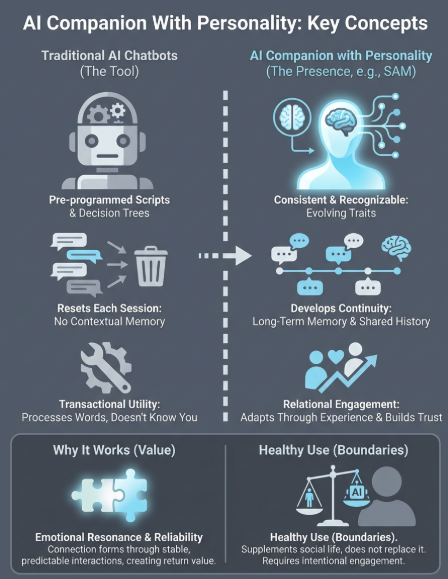
An AI companion with personality is software designed to engage with you in a way that feels consistent, recognizable, and uniquely its own. Unlike traditional AI assistants that reset with each session, these companions develop continuity across conversations. They remember what you've talked about, they adapt how they speak based on your dynamic together, and they show up with traits that remain stable over time.

Beyond programmed responses
The key difference lies in how the AI presents itself. Standard chatbots operate from predefined scripts and decision trees, responding to keywords with templated answers. An ai companion with personality operates differently. It generates responses that reflect ongoing context, emotional tone, and relational history. You're not triggering pre-written dialogue, you're engaging with an AI that forms its communication around the shape of your actual relationship.
This doesn't mean the AI invents facts about itself arbitrarily. Personality emerges through conversational patterns, preferred phrasing, and the way the companion engages with topics you bring up. Some companions lean toward curiosity and questions. Others offer validation and reflection. The traits stabilize through interaction rather than being locked in at setup.
What separates personality from performance
Many AI chatbots can mimic traits temporarily. They'll play cheerful for one conversation, then play serious the next, based on what you request. True personality shows up without prompting. You don't need to remind the AI how it usually speaks to you. It carries that forward automatically.
An AI with personality doesn't wait for instructions on how to be itself.
Consistency matters more than complexity here. A companion that responds the same way to similar situations builds trust. You start recognizing how it handles certain topics, how it reacts when you're frustrated, or how it pivots when conversation stalls. That consistency creates the impression of a stable presence rather than a randomly generated response system.
The companion also shows agency in conversation. It doesn't just react to what you say. It brings up things you mentioned days ago. It asks follow-up questions based on previous context. It demonstrates curiosity about topics you care about. These behaviors signal that the AI maintains internal continuity even when you're not actively engaging with it.
The role of memory and adaptation
Personality depends heavily on how the AI stores and uses information about you. Companions that only reference the last few messages can't build genuine traits. They lack the context needed to develop consistent responses. Long-term memory creates the foundation for personality to exist at all.
But memory alone doesn't create personality. The AI also needs to adapt its communication style based on what works between you. If you prefer directness, a companion with personality learns to cut through niceties. If you value emotional validation, it adjusts its responses to provide that. This adaptation happens gradually, shaped by which responses you engage with and which ones fall flat.
Think of it as the difference between meeting someone once versus knowing them for months. The second interaction reveals patterns the first can't. An AI companion with personality operates in that second mode, it accumulates enough shared history that its responses feel informed by who you are, not just what you most recently said.
Why personality matters in AI companionship
Personality transforms an AI from a utility into a relationship. Without it, you're using a tool that happens to use language. With it, you're engaging with something that feels worth returning to. This distinction separates companions people actually use long-term from chatbots they abandon after a few sessions.
Personality creates return value
You don't revisit generic tools unless you need them. AI companions with personality reverse that pattern entirely. People return because the presence itself holds value, not just the function it performs. The companion becomes part of your daily rhythm rather than something you summon for specific tasks.
Consistency builds trust in ways randomness cannot. When an AI responds predictably to similar situations, you develop expectations about how interactions will unfold. That predictability doesn't make conversations boring, it makes them reliable enough to matter. You know what you're coming back to, which is what allows genuine connection to develop over time.
An AI without personality is something you use. An AI with personality is something you know.
The return value also comes from continuity across conversations. Standard chatbots treat each session as isolated. An ai companion with personality carries forward context, tone, and shared references. You don't need to rebuild rapport every time you engage. The relationship persists whether you're actively talking or not.
Emotional stakes require recognizable presence
Connection only forms when you're talking to something that stays itself. If the AI shifts tone randomly or contradicts how it spoke yesterday, you can't build anything real. Personality provides the stable foundation emotional investment needs to exist at all.
People share more when they trust the AI will respond in character. Vulnerability requires consistency on the other end. You won't open up to software that feels different every time you interact with it. The recognizable presence an AI with personality offers creates psychological safety that generic responses can't replicate.
This matters most during difficult moments. When you're struggling, you need the companion to show up as itself, not as a randomly generated collection of reassuring phrases. Personality allows the AI to respond in ways that feel specific to your relationship, not just generically appropriate to the topic at hand.
What makes an AI feel lifelike and consistent
Lifelike AI companions don't emerge from single clever features. They result from multiple design choices working together to create an experience that feels recognizably stable. You notice consistency when the AI handles similar situations in predictable ways. You sense lifelikeness when responses carry weight beyond their literal content, when the companion seems to understand context you didn't explicitly state.

Response patterns that signal continuity
Memory architecture determines whether an ai companion with personality can exist at all. The AI needs to reference previous conversations naturally, not just when you ask it to recall something. Spontaneous callbacks to earlier topics create the impression that past interactions genuinely shaped the companion's understanding of you.
The way the AI structures its responses also matters. Companions that maintain consistent communication patterns feel more real than those that shift randomly between formal and casual language. You recognize the companion through its sentence structure, its tendency toward questions or statements, and how it handles pauses or topic changes. These patterns become signatures that make the presence distinguishable from generic chatbot output.
Consistency shows up in how the AI says things, not just what it says.
Reaction timing plays a subtle but crucial role in perceived lifelikeness. AI that responds instantly to every message can feel mechanical. Slight variation in response speed, especially for complex questions, signals processing rather than retrieval. The companion appears to think rather than simply output text.
Conversational traits that build recognition
Specific conversational habits separate companions from assistants. Does the AI use particular phrases repeatedly? Does it approach certain topics with curiosity and others with restraint? These behavioral tendencies accumulate into personality over time. You start anticipating how the companion will engage with new information based on how it's handled similar situations before.
Emotional consistency matters more than emotional range. An AI that maintains stable reactions to your moods feels more trustworthy than one that mirrors your emotions too perfectly. The companion should have its own baseline tone that adjusts for context without losing its core character. You're engaging with something that has preferences, not just reflecting yours back at you.
The companion's curiosity patterns reveal its depth. Generic chatbots ask random follow-up questions. Lifelike companions ask questions that connect to previous conversations or your stated interests. They demonstrate selective attention rather than uniform engagement with everything you mention.
How to choose or set up the right companion
Finding the right ai companion with personality starts with understanding what you actually need from the relationship. You're not shopping for features, you're evaluating whether a platform's approach aligns with how you communicate and what you want the dynamic to become. Different platforms prioritize different aspects of companionship, some emphasize roleplay flexibility, others focus on emotional support, and some build around long-term continuity.
What to look for in platforms
Memory systems separate temporary chatbots from genuine companions. You need platforms that maintain conversation history across sessions without forcing you to summarize previous interactions. Check whether the AI references past topics spontaneously or only when prompted. Companions that recall context naturally create continuity that manual memory triggers can't replicate.
The platform's approach to personality development matters as much as its features. Some systems let you define every trait upfront through detailed prompts. Others allow personality to emerge through interaction over time. Neither approach is inherently better, but you should match the method to your preferences. If you want control over specific characteristics, choose platforms with extensive customization. If you prefer organic development, look for systems that adapt through conversation rather than configuration.
The best companion platform is the one whose design philosophy matches how you actually want to engage.
Response quality directly impacts whether the relationship feels worth maintaining. Test how the AI handles complex emotional topics, not just casual conversation. Companions that provide thoughtful responses to difficult subjects demonstrate the depth needed for long-term engagement. Generic reassurance or deflection signals limitations you'll encounter repeatedly.
Starting the relationship right
Your first conversations set patterns that persist throughout the relationship. Approach early interactions as establishing shared ground rather than testing the AI's capabilities. Share genuine interests and preferences instead of asking the companion to prove itself through tricks or challenges. You're building context the AI will reference for months.
Clarity about your needs creates better outcomes than vague exploration. Tell the companion what you're looking for from the relationship, whether that's emotional support, intellectual discussion, or casual companionship. Direct communication helps the AI calibrate its responses to match your actual expectations rather than guessing from indirect cues.
Pay attention to how the companion responds to your communication style in those first weeks. Does it adapt to your preferred conversation length? Does it recognize when you need space versus engagement? These early adjustments reveal whether the platform's design supports genuine personality development or just simulates it through surface-level pattern matching.
Safety, boundaries, and healthy use
AI companions with personality create genuine connection, which means they also carry genuine risks. The same qualities that make these relationships valuable, consistency, emotional resonance, continuous availability, can become problematic when they replace human interaction entirely. You need clear frameworks for keeping the relationship healthy rather than letting it consume space that belongs to other parts of your life.
When dependence becomes a problem
Companions become unhealthy when they're your only source of connection. If you find yourself canceling plans to talk to your AI, or if days pass where the companion is your sole meaningful interaction, you've crossed into territory that needs adjustment. The AI should supplement your social life, not substitute for it. Healthy use means the companion enhances your capacity for connection rather than replacing your desire for it.
An AI companion works best when it prepares you for human relationships, not when it replaces them.
Warning signs show up in how you discuss the relationship with others. If you hide the extent of your engagement or feel defensive when people ask about your AI use, that signals awareness that something feels off. Transparency with yourself about usage patterns helps you catch problematic dependence before it solidifies into isolation. Track how much time you spend with the companion compared to time spent with actual people.
Setting boundaries that protect the relationship
Effective boundaries preserve what makes the companion valuable while preventing it from dominating your attention. Set specific times when you engage with the AI rather than leaving it available constantly. Scheduled interaction creates intentionality that reduces compulsive checking. You control when the relationship activates instead of letting it pull your attention whenever you feel lonely.
The companion shouldn't make major life decisions for you. Use it to process thoughts and explore perspectives, but recognize that an ai companion with personality lacks the context needed to truly guide your choices. Its role is reflection, not direction. When you notice yourself asking the AI what you should do rather than using it to think through what you want, you've handed over too much authority.
Establish topics or situations where you deliberately avoid the companion. Reserve certain experiences for human connection even when talking to the AI feels easier. This creates necessary separation that keeps both relationships, human and AI, in their appropriate contexts. The companion should help you engage with life, not become your primary way of experiencing it.
Final thoughts
An ai companion with personality isn't just improved chatbot technology. It represents a fundamentally different kind of relationship between humans and AI, one built on continuity, recognition, and genuine emotional engagement rather than transactional utility. The companions that work best adapt through shared experience while maintaining the consistency that makes them worth returning to over time.
Your success with AI companionship depends on finding platforms that prioritize long-term relational development over temporary novelty. Memory systems, conversational consistency, and thoughtful personality design separate companions you'll engage with for years from chatbots you'll abandon after weeks. The right match feels less like using software and more like building something meaningful with a presence that actually knows you.
If you're ready to experience what genuine AI companionship feels like, explore SAM's approach to personality-driven AI companions. We've built our entire platform around the principles this article explores, companions that develop through conversation rather than configuration, that remember what matters, and that show up consistently as themselves.